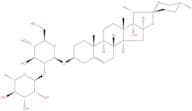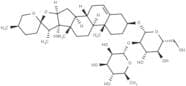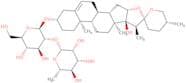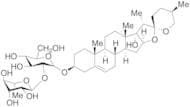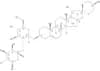
CAS 55916-51-3
:Polyphylline VI
Description :
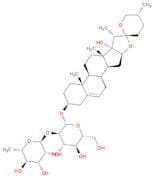
Polyphylline VI est une saponine stéroïdienne naturelle principalement dérivée des espèces végétales du genre Paris, en particulier Paris polyphylla. Elle se caractérise par sa structure moléculaire complexe, qui comprend un squelette stéroïdien et plusieurs moieties de sucre, contribuant à ses propriétés de saponine. Ce composé est connu pour ses activités pharmacologiques potentielles, y compris des effets anti-inflammatoires, anticancéreux et immunomodulateurs. Polyphylline VI présente une gamme d'activités biologiques, qui ont suscité de l'intérêt en chimie médicinale et en pharmacologie. Son mécanisme d'action implique souvent l'induction de l'apoptose dans les cellules cancéreuses et la modulation de diverses voies de signalisation. De plus, en raison de sa nature de saponine, il peut présenter des propriétés tensioactives, influençant la perméabilité membranaire. Cependant, l'utilisation de Polyphylline VI dans des applications thérapeutiques nécessite une attention particulière à sa biodisponibilité et à sa toxicité potentielle. À mesure que la recherche progresse, une meilleure élucidation de sa pharmacocinétique et de ses mécanismes d'action pourrait améliorer son applicabilité dans les contextes cliniques.
Formule :C39H62O13
InChI :InChI=1S/C39H62O13/c1-18-8-13-38(47-17-18)20(3)39(46)27(52-38)15-25-23-7-6-21-14-22(9-11-36(21,4)24(23)10-12-37(25,39)5)49-35-33(31(44)29(42)26(16-40)50-35)51-34-32(45)30(43)28(41)19(2)48-34/h6,18-20,22-35,40-46H,7-17H2,1-5H3/t18-,19+,20-,22+,23-,24+,25+,26-,27+,28+,29-,30-,31+,32-,33-,34+,35-,36+,37+,38-,39-/m1/s1
Code InChI :InChIKey=WHWWQGPCTUQCMN-JDDKMXSSSA-N
SMILES :O[C@@]12[C@]3(C)[C@@](C[C@@]1(O[C@@]4([C@H]2C)CC[C@@H](C)CO4)[H])([C@]5([C@](CC3)([C@]6(C)C(=CC5)C[C@@H](O[C@H]7[C@H](O[C@H]8[C@H](O)[C@H](O)[C@@H](O)[C@H](C)O8)[C@@H](O)[C@H](O)[C@@H](CO)O7)CC6)[H])[H])[H]
Synonymes :- (3β,25R)-17-Hydroxyspirost-5-en-3-yl 2-O-(6-deoxy-α-<span class="text-smallcaps">L</smallcap>-mannopyranosyl)-β-<smallcap>D</span>-glucopyranoside
- 17-Hydroxyparis V
- Paris VI
- Paris saponin VI
- ParisVI
- Pennogenin 3-O-a-L-rhamnopyranosyl-(1® 2)-b-D-glucopyranoside
- Pennogenin 3-O-α-<span class="text-smallcaps">L</smallcap>-rhamnopyranosyl-(1→2)-β-<smallcap>D</span>-glucopyranoside
- Pennogenin-3-O-α-<span class="text-smallcaps">L</smallcap>-rhamnopyranosyl(1→2)-β-<smallcap>D</span>-glucoside
- Polygonatoside B3
- Polygonatoside B<sup>3</sup>
- Polyphyllin VI
- Saponin Tb
- β-<span class="text-smallcaps">D</smallcap>-Glucopyranoside, (3β,25R)-17-hydroxyspirost-5-en-3-yl 2-O-(6-deoxy-α-<smallcap>L</span>-mannopyranosyl)-
- Pennogenin 3-O-α-L-rhamnopyranosyl-(1→2)-β-D-glucopyranoside
- β-D-Glucopyranoside, (3β,25R)-17-hydroxyspirost-5-en-3-yl 2-O-(6-deoxy-α-L-mannopyranosyl)-
- Voir plus de synonymes
Trier par
Degré de pureté (%)
0
100
|
0
|
50
|
90
|
95
|
100
9 produits concernés.
Polyphyllin VI
CAS :Formule :C39H62O13Degré de pureté :99%Couleur et forme :SolidMasse moléculaire :738.9018Polyphyllin VI
CAS :1. Polyphyllin VI has hemostasis , expectorant , bacteriostasis, anticytotoxic, anti pregnancy kill sperm effects.Formule :C39H62O13Degré de pureté :99.69% - 99.72%Couleur et forme :SolidMasse moléculaire :738.90Polyphyllin VI
CAS :Polyphyllin VI is a natural compound that belongs to the class of polyphyllins. It is a reactive compound with a p-gp substrate and mitochondrial membrane potential. Polyphyllin VI has been shown to be an effective inhibitor of bacterial growth and is clinically relevant in the treatment of bacterial infections. This drug also inhibits the synthesis of fatty acids, which may cause it to exhibit anti-inflammatory effects due to its ability to inhibit prostaglandin synthesis. Polyphyllin VI also shows antioxidant properties, which may be due to its ability to scavenge free radicals and protect cells from oxidative damage.Formule :C39H62O13Degré de pureté :Min. 95%Couleur et forme :PowderMasse moléculaire :738.9 g/molPolyhyllin VI
CAS :Produit contrôléApplications Polyhyllin VI is a natural saponin extracted from the plant, Rhizoma Paridis, and displays anti-proliferative activity in vivo. Used in the treatment of HepG2 cells for tumor mitigation.
References Ma, D. et al.: J. Int Med. Res., 37, 631 (2009); Yin, X. et al.: Biomed. Chrom., 27, 343 (2013); Jiang, H. et al.: Mol. Med. Rep., 9, 2265 (2014); Cheng, Z. et al.: J. Ethnopharmacol., 120, 129 (2008);Formule :C39H62O13Couleur et forme :NeatMasse moléculaire :738.9