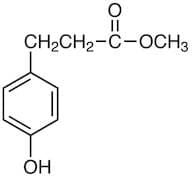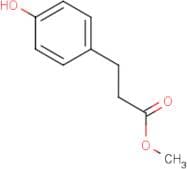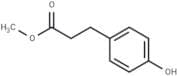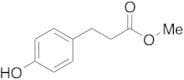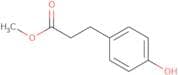
CAS 5597-50-2
:méthyle 3-(4-hydroxyphényl)propionate
- 3-(4-Hydroxyphenyl)-propionic acid methyl ester
- Methyl 3-(4-Hydroxyphenyl)Propanoate
- 2-({5-[(4-methylphenoxy)methyl]-1H-1,2,4-triazol-3-yl}sulfanyl)-1-tricyclo[3.3.1.1~3,7~]dec-1-ylethanone
- Propanoic acid, 3-(4-hydroxyphenyl), methyl ester
- 3-(4-Hydroxyphenyl)propanoic acid methyl ester
- METHYL P-HYDROXYHYDROCINNAMATE
- 4-hydroxy-benzenepropanoic acid methyl ester
- Methyl p-hydroxyphenylpropionate
- Methyl 4-hydroxyhydrocinnamate
- Methyl 3-(p-hydroxyphenyl)propionate
- 3-(4-HYDROCHLORIDE )PROPIONIC ACID METHYL ESTER
- Hydrocinnamic acid, p-hydroxy-, methyl ester
- 3-(4-HYDROXY-PHENYL)-PROPIONIC ACID-OME
- 4-hydroxy-benzenepropanoicacimethylester
- 3-(4-hydroxybenzene)propionic methyl ester
- 3-(4'-HYDROXYPHENYL)-PROPIONIC ACID-OME
- METHYL 3-(4-HYDROXYPHENYL)PROPIONATE, 97 %
- 4-Hydroxyphenylpropionic Acid Methyl Ester
- METHYL 3-(4-HYDROXYPHENYL)PROPIONATE
- Methyl 4-hydroxyphenylpropionate
- Voir plus de synonymes
Methyl 3-(4-Hydroxyphenyl)propionate
CAS :Formule :C10H12O3Degré de pureté :>98.0%(GC)Couleur et forme :White to Light yellow to Light orange powder to lumpMasse moléculaire :180.20Methyl 3-(4-hydroxyphenyl)propionate, 98%
CAS :Useful synthetic intermediate. It can be used to prepare potent and orally available G protein-coupled receptor 40 agonists as potential antidiabetic agents. May be used in the enzymatic coupling of saccharides to protein. This Thermo Scientific Chemicals brand product was originally part of the AlfFormule :C10H12O3Degré de pureté :98%Masse moléculaire :180.20Methyl 3-(4-hydroxyphenyl)propionate
CAS :Formule :C10H12O3Degré de pureté :98%Couleur et forme :SolidMasse moléculaire :180.2005Methyl 3-(4-hydroxyphenyl)propanoate
CAS :Methyl 3-(4-hydroxyphenyl)propanoateFormule :C10H12O3Degré de pureté :98%Couleur et forme : brown solidMasse moléculaire :180.20g/molMethyl 3-(4-hydroxyphenyl)propionate
CAS :Methyl 3-(4-hydroxyphenyl)propionate was discovered in Gynura Bicolor and exhibits antioxidant activity, making it suitable for related research in the field of life sciences.Formule :C10H12O3Degré de pureté :99.89%Couleur et forme :SolidMasse moléculaire :180.23-(4-Hydroxyphenyl)propionic Acid Methyl Ester
CAS :Produit contrôléApplications 3-(4-Hydroxyphenyl)propionic Acid Methyl Ester is a useful synthetic intermediate. It can be used to prepare potent and orally available G protein-coupled receptor 40 agonists as potential antidiabetic agents.
References Sasaki, S., et al.: J. Med. Chem., 54, 1365 (2011); Christiansen, E., et al.: ACS Med. Chem. Lett., 1, 345 (2010)Formule :C10H12O3Couleur et forme :NeatMasse moléculaire :180.2Methyl 3-(4-hydroxyphenyl)propionate
CAS :Formule :C10H12O3Degré de pureté :95%Couleur et forme :Solid, Off-white powderMasse moléculaire :180.203Methyl 3-(4-hydroxyphenyl)propionate
CAS :Methyl 3-(4-hydroxyphenyl)propionate (MPP) is a plant hormone that has been shown to inhibit root formation in plants. MPP inhibits the production of exudates, which are substances secreted by plants that are involved in interactions with other organisms. This effect is mediated through its ability to inhibit the response pathway for root formation, which includes the synthesis of monosubstituted phenols and oligosaccharides. MPP also has a luminescent property, allowing it to be used as a molecular probe for studying this phenomenon. In addition, MPP can be used as an anti-inflammatory agent. This may be due to its ability to inhibit protein synthesis by binding with RNA and DNA molecules in cells or because it inhibits the enzyme phospholipase A2, which is responsible for releasing arachidonic acid from cell membranes.
Formule :C10H12O3Degré de pureté :Min. 95%Couleur et forme :PowderMasse moléculaire :180.2 g/mol