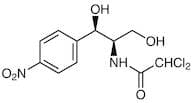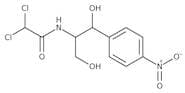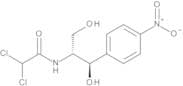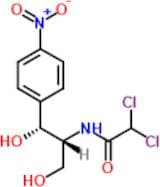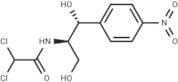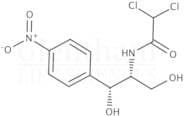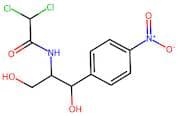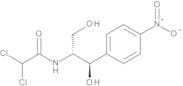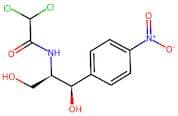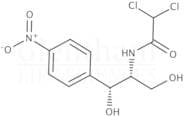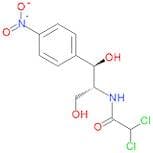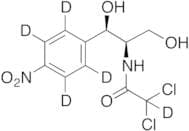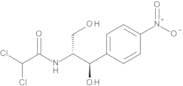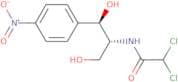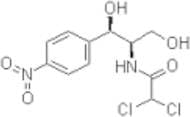
CAS 56-75-7
:(-)-Chloramphénicol
- 2,2-Dichloro-N-(2-Hydroxy-1-(Hydroxymethyl)-2-(4-Nitrophenyl)Ethyl)-Acetamid
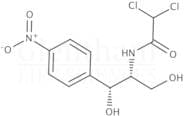
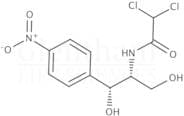
- 2,2-Dichloro-N-[(1R,2R)-2-hydroxy-1-(hydroxymethyl)-2-(4-nitrophenyl)ethyl]acetamide
- 2,2-Dichloro-N-[2-Hydroxy-1-(Hydroxymethyl)-2-(4-Nitrophenyl)Ethyl]Acetamide
- 2,2-dichloro-N-[(1R)-2-hydroxy-1-(hydroxymethyl)-2-(4-nitrophenyl)ethyl]acetamide
- 2,2-dichloro-N-[(1R,2S)-1,3-dihydroxy-1-(4-nitrophenyl)propan-2-yl]acetamide
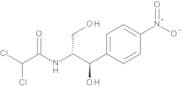
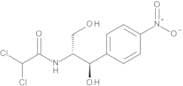
- 2,2-dichloro-N-[(1S,2R)-1,3-dihydroxy-1-(4-nitrophenyl)propan-2-yl]acetamide
- Ak-Chlor
- Alficetyn
- Amphenicol
- Amphicol
- Amseclor
- Anacetin
- Aquamycetin
- Austracol
- Bradyoxetin
- CAF
- CAM
- CAP
- CPh
- Catilan
- Chemicetin
- Chemicetina
- Chlomycol
- Chloramex
- Chloramphenicol
- Chloramsaar
- Chlorasol
- Chlorcetin
- Chloricol
- Chlorocaps
- Chlorocid
- Chlorocide
- Chlorocin
- Chloromycetin
- Chloronitrin
- Chloroptic
- Ciplamycetin
- Cloramfen
- Cloramfenicol
- Cloramficin
- Cloramicol
- Clorocyn
- Cloromisan
- Cylphenicol
- D-(-)-Chloramphenicol
- D-(-)-Threo-2,2-Dichloro-N-[Beta-Hydroxy-Alpha-(Hydroxy-Methyl)-P-Nitrophenethyl]Acetamide
- D-(-)-threo-1-(4-Nitrophenyl)-2-dichloroacetamido-1,3-propanediol
- D-(-)-threo-1-p-Nitrophenyl-2-dichloracetamido-1,3-propanediol
- D-(-)-threo-1-p-Nitrophenyl-2-dichloroacetylamino-1,3-propanediol
- D-(-)-threo-2-Dichloroacetamido-1-p-nitrophenyl-1,3-propanediol
- D-(-)-threo-Chloramphenicol
- D-threo-(1R,2R)-1-p-Nitrophenyl-2-dichloroacetamido-1,3-propanediol
- D-threo-N-Dichloroacetyl-1-p-nitrophenyl-2-amino-1,3-propanediol
- Detreomycin
- Embacetin
- Enicol
- Enteromycetin
- Farmicetina
- Fenicol
- Globenicol
- Gloveticol
- Halcetin
- Intramycetin
- Ismicetina
- Juvamycetin
- Kamaver
- Kemicetine
- Klorita
- Leukomyan
- Leukomycin
- Levocin
- Levomicetina
- Levomitsetin
- Levomycetin
- Levoplast
- Levosin
- Levovetin
- Loromisin
- Mastiphen
- Micloretin
- Micoclorina
- Microcetina
- Mychel
- Mychel-Vet
- Mycinol
- Myclocin
- Mycochlorin
- Novomycetin
- Ocuphenicol
- Opclor
- Ophthochlor
- Pantovernil
- Paraxin
- Quemicetina
- Ronphenil
- Septicol
- Sintomicetin
- Sintomicetina
- Soluthor
- Stanomycetin
- Synthomycetin
- Synthomycin
- Tevcocin
- Tifomycine
- Treomicetina
- Unimycetin
- Veticol
- Viceton
- [R-(R*,R*)]-2,2-Dichloro-N-[2-hydroxy-1-(hydroxymethyl)-2-(4-nitrophenyl)ethyl]acetamide
- D,L-chloramphenicol
- Acetamide, 2,2-dichloro-N-[2-hydroxy-1-(hydroxymethyl)-2-(4-nitrophenyl)ethyl]-, [R-(R*,R*)]-
- nitrophenyl)ethyl]acetamide
- Acetamide, 2,2-dichloro-N-[(1R,2R)-2-hydroxy-1-(hydroxymethyl)-2-(4-nitrophenyl)ethyl]-
- Acetamide, 2,2-dichloro-N-[β-hydroxy-α-(hydroxymethyl)-p-nitrophenethyl]-, D-threo-(-)-
- 2,2-dichloro-N-[(1R)-2-hydroxy-1-(hydroxymethyl)-2-(4-
- D-THREO-2,2-DICHLORO-N-[BETA-HYDROXY-ALPHA-(HYDROXYMETHYL)-4-NITROPHENETHYL]ACETAMIDE
- D-THREO-(-)-2,2-DICHLORO-N-[BETA-HYDROXY-ALPHA-HYDROXYMETHYL-P-NITROPHENETHYL]ACETAMIDE
- D-THREO-2,2-DICHLORO-N-[BETA-HYDROXY-ALPHA-(HYDROXYMETHYL)-4-NITROPHENYL] ACETAMIDE
- D-THREO-2-DICHLOROACETAMIDO-1-(4-NITROPHENYL)-1,3-PROPANEDIOL
- D-2-DICHLOROACETAMIDO-1-P-NITRO-PHENYL-1,3-PROPANEDIOL
- [R-(R*,R*)]-2,2-dichloro-N-[2-hydroxy-1-(hydroxymethyl)-2-(4-nitrophenyl)ethyl]ethanamide
- D(-)-THREO-2,2-DICHLORO-N-[BETA-HYDROXY-ALPHA-(HYDROXYMETHYL)-BETA-(4-NITROPHENYL)ETHYL]ACETAMIDE
- D(-)-THREO-2,2-DICHLORO-N-[BETA-HYDROXY-ALPHA-(HYDROXY-METHYL)-P-NITROPHENYLETHYL]ACETAMIDE
- D-(-)-THREO-2-DICHLOROACETAMIDO-1-(4-NITROPHENYL)-1,3-PROPANEDIOL
- CHLORAMPHENICOLUM
- D-(-)-THREO-2-DICHLOROACETAMIDO-1-[P-NITRO-PHENYL]-1,3-PROPANEDIOL
- ,[theta-(theta,theta)]-
- D-THREO-2,2-DICHLORO-N-[BETA-HYDROXY-ALPHA(HYDROXYMETHYL)-BETA-(4-NITROPHENYL)ETHYL]ACETAMIDE
- Voir plus de synonymes
Chloramphenicol
CAS :Formule :C11H12Cl2N2O5Degré de pureté :>98.0%(T)(HPLC)Couleur et forme :White to Orange to Green powder to crystalMasse moléculaire :323.13(R,R)-Chloramphenicol, 98%
CAS :(R,R)-chloramphenicol, 56-75-7, is is a broad-spectrum, semisynthetic antibiotic suitable for various cell biology applications. Learn more at Thermo Fisher Scientific.Formule :C11H12Cl2N2O5Degré de pureté :98%Couleur et forme :White to yellow to cream to grey, Crystals or powder or crystalline powderMasse moléculaire :323.13Chloramphenicol
CAS :Formule :C11H12Cl2N2O5Degré de pureté :97.68%Couleur et forme :Colorless. OilMasse moléculaire :322.0CHLORAMPHENICOL FOR PEAK IDENTIFICATION CRS
CAS :CHLORAMPHENICOL FOR PEAK IDENTIFICATION CRSFormule :C11H12Cl2N2O5Couleur et forme :White. Whitish. Crystalline Powder. Powder.Masse moléculaire :323.1294Chloramphenicol
CAS :ChloramphenicolFormule :C11H12Cl2N2O5Degré de pureté :99.6%Couleur et forme :Off-WhiteMasse moléculaire :322.01233Chloramphenicol
CAS :Chloramphenicol and its derivatives; salts thereofFormule :C11H12Cl2N205Couleur et forme :White PowderMasse moléculaire :3084.66178Chloramphenicol
CAS :Chloramphenicol (Chloromycetin) is a broad-spectrum antibiotic that inhibits the biosynthesis of bacterial proteins. Cost-effective and quality-assured.Formule :C11H12Cl2N2O5Degré de pureté :99.6% - 99.84%Couleur et forme :Needles Or Elongated Plates From Water Or Ethylene Dichloride SolidMasse moléculaire :323.13Chloramphenicol
CAS :Formule :C11H12Cl2N2O5Degré de pureté :98.5 - 101.5 % (dried basis)Couleur et forme :White to light-yellow crystalline powderMasse moléculaire :323.14Chloramphenicol-d4
CAS :Formule :C11H8D4Cl2N2O5Couleur et forme :Pale Yellow SolidMasse moléculaire :327.15Chloramphenicol, USP grade, low endotoxin
CAS :Formule :C11H12Cl2N2O5Degré de pureté :97.0 - 103.0 %Couleur et forme :White to light-yellow crystalline powderMasse moléculaire :323.14Chloramphenicol, Ph. Eur. grade
CAS :Formule :C11H12Cl2N2O5Degré de pureté :(dried basis) 98.0 - 102.0 %Couleur et forme :A white, greyish-white or yellowish-white, fine, crystalline powder or crystalsMasse moléculaire :323.14Chloramphenicol
CAS :Produit contrôléFormule :C11H12Cl2N2O5Couleur et forme :NeatMasse moléculaire :323.13Chloramphenicol 100 µg/mL in Ethyl acetate
CAS :Produit contrôléFormule :C11H12Cl2N2O5Couleur et forme :Single SolutionMasse moléculaire :323.13Chloramphenicol
CAS :Produit contrôléFormule :C11H12Cl2N2O5Couleur et forme :NeatMasse moléculaire :323.13Chloramphenicol
CAS :Formule :C11H12Cl2N2O5Degré de pureté :97.0%Couleur et forme :Solid, Powder or Crystalline Powder or NeedlesMasse moléculaire :323.13Chloramphenicol 10 µg/mL in Acetonitrile
CAS :Formule :C11H12Cl2N2O5Couleur et forme :Single SolutionMasse moléculaire :323.13Chloramphenicol
CAS :ChloramphenicolFormule :C11H12Cl2N2O5Degré de pureté :>99%Couleur et forme : solidMasse moléculaire :323.13g/molChloramphenicol, USP grade
CAS :Formule :C11H12Cl2N2O5Degré de pureté :97.0 - 103.0 %Couleur et forme :White to light-yellow crystalline powderMasse moléculaire :323.14Chloramphenicol (10mg/ml)
CAS :Chloramphenicol (10mg/ml)Couleur et forme :SolutionMasse moléculaire :323.13g/molChloramphenicol-d5 (100Mug/mL in Acetonitrile)
CAS :Produit contrôléFormule :C11H7D5Cl2N2O5Couleur et forme :ColourlessMasse moléculaire :328.16Chloramphenicol-d5
CAS :Produit contrôléApplications Chloramphenicol-d5, is the labeled analogue of Chloramphenicol (C325030), which has a broad spectrum of activity against Gram-positive and gram-negative bacteria. It is also antibacterial, and antirickettsial.
References Bartz, et al.: J. Biol. Chem., et al.: 172, 445 (1948), Gottlieb, et al.: J. Bacteriol., 55, 409 (1948), Szulczewski, D., et al.: Anal. Profiles Drug Subs., 4, 47 (1975), Price, A., et al.: J. Antibiot., 43, 118 (1981), Shalit, I., et al.: Drugs, 28, 281 (1984),Formule :C11H7D5Cl2N2O5Couleur et forme :Off-WhiteMasse moléculaire :328.16Chloramphenicol
CAS :Produit contrôléApplications Broad spectrum antibiotic obtained from cultures of the soil bacterium Streptomyces venezuelae. It has a broad spectrum of activity against Gram-positive and gram-negative bacteria. Antibacterial; antirickettsial.
References Bartz, et al.: J. Biol. Chem., et al.: 172, 445 (1948), Gottlieb, et al.: J. Bacteriol., 55, 409 (1948), Szulczewski, D., et al.: Anal. Profiles Drug Subs., 4, 47 (1975), Price, A., et al.: J. Antibiot., 43, 118 (1981), Shalit, I., et al.: Drugs, 28, 281 (1984),Formule :C11H12Cl2N2O5Couleur et forme :NeatMasse moléculaire :323.13Chloramphenicol
CAS :Chloramphenicol is produced by Streptomyces venezuelae. It is a broad-spectrum antibiotic with bacteriostatic properties. It interferes with bacterial protein synthesis by reversibly binding to the 50S ribosome unit. Used as substrate in the CAT (chloramphenicol acetyl transferase) assay, where the CAT gene expression is monitored by the ability of a system to transform chloramphenicol into acetyl chloramphenicol, which can be followed by simple thin layer chromatography. It is employed in VTM to prevent bacterial growth during specimen storage and transportation.Formule :C11H12Cl2N2O5Degré de pureté :Min. 98 Area-%Couleur et forme :PowderMasse moléculaire :323.13 g/molChloramphenicol cell culture, 99%, Endotoxin (BET) 0.2 EU/mg
CAS :Formule :C11H12Cl2N2O5Masse moléculaire :323.1Chloramphenicol (CFP) ExiPlus, Multi-Compendial, 98.0-102%
CAS :Formule :C11H12Cl2N2O5Degré de pureté :98.0-102%Couleur et forme :White to pale yellow, Crystalline powder or fine crystals, ClearMasse moléculaire :323.1Chloramphenicol (CFP), 98-102%
CAS :Formule :C11H12Cl2N2O5Degré de pureté :min. 98-102%Couleur et forme :White to pale yellow, Crystalline powder, ClearMasse moléculaire :323.1Chloramphenicol (CFP) for tissue culture, 98-102%
CAS :Formule :C11H12Cl2N2O5Degré de pureté :98 - 102%Couleur et forme :White to pale yellow, Crystalline powder, ClearMasse moléculaire :323.1