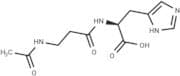
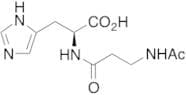
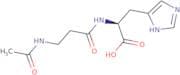
CAS 56353-15-2
:N-Acétyl-L-carnosine
Description :
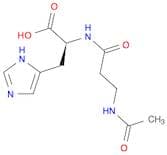
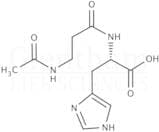
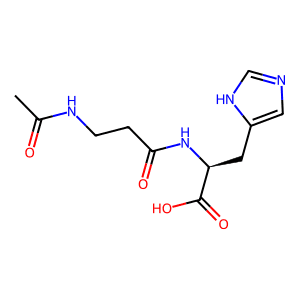
N-Acétyl-L-carnosine est un dérivé de dipeptide formé à partir des acides aminés bêta-alanine et histidine, avec l'ajout d'un groupe acétyle. Il est reconnu pour ses propriétés antioxydantes potentielles et est souvent étudié pour son rôle dans la protection des cellules contre le stress oxydatif. Ce composé est particulièrement noté pour ses applications en santé oculaire, où il est utilisé dans des gouttes oculaires pour aider à gérer des conditions telles que les cataractes et la dégénérescence maculaire liée à l'âge. N-Acétyl-L-carnosine est soluble dans l'eau et présente une stabilité dans des conditions physiologiques, ce qui le rend adapté à diverses formulations. Son mécanisme d'action est censé impliquer la capture de radicaux libres et la modulation des voies de signalisation cellulaire. De plus, il a été étudié pour ses effets neuroprotecteurs potentiels et ses bénéfices dans d'autres tissus. Dans l'ensemble, N-Acétyl-L-carnosine est un composé d'intérêt tant dans les milieux cliniques que de recherche, en particulier dans les domaines de l'ophtalmologie et de la gérontologie.
Formule :C11H16N4O4
InChI :InChI=1S/C11H16N4O4/c1-7(16)13-3-2-10(17)15-9(11(18)19)4-8-5-12-6-14-8/h5-6,9H,2-4H2,1H3,(H,12,14)(H,13,16)(H,15,17)(H,18,19)/t9-/m0/s1
Code InChI :InChIKey=BKAYIFDRRZZKNF-VIFPVBQESA-N
SMILES :[C@@H](CC1=CN=CN1)(NC(CCNC(C)=O)=O)C(O)=O
Synonymes :- (S)-2-(3-Acetamidopropanamido)-3-(1H-imidazol-4-yl)propanoicacid
- <span class="text-smallcaps">L</span>-Histidine, N-(N-acetyl-β-alanyl)-
- <span class="text-smallcaps">L</span>-Histidine, N-acetyl-β-alanyl-
- Can-C
- Histidine, N-(N-acetyl-β-alanyl)-, <span class="text-smallcaps">L</span>-
- N-(N-Acetyl-beta-alanyl)-L-histidine
- N-(N-Acetyl-β-alanyl)histidine
- N-Acetyl Carnosine
- N-Acetyl-<span class="text-smallcaps">L</span>-carnosine
- N-Acetyl-β-alanyl-<span class="text-smallcaps">L</span>-histidine
- N-Acetylcarnosine
- N-acetyl-beta-alanyl-L-histidine
- N-acetyl-beta-alanylhistidine
- Unii-0Tpn86Oqif
- N-Acetyl-β-alanyl-L-histidine
- L-Histidine, N-acetyl-β-alanyl-
- Histidine, N-(N-acetyl-β-alanyl)-, L-
- L-Histidine, N-(N-acetyl-β-alanyl)-
- Voir plus de synonymes
Trier par
Degré de pureté (%)
0
100
|
0
|
50
|
90
|
95
|
100
9 produits concernés.
L-Histidine, N-acetyl-b-alanyl-
CAS :Formule :C11H16N4O4Degré de pureté :97%Couleur et forme :SolidMasse moléculaire :268.2691N-Acetyl-L-carnosine
CAS :Formule :C11H16N4O4Degré de pureté :≥ 98.0%Couleur et forme :White to off-white powderMasse moléculaire :268.27Carnosine Impurity 4
CAS :Formule :C11H16N4O4Couleur et forme :White To Off-White SolidMasse moléculaire :268.27N-Acetylcarnosine
CAS :N-Acetylcarnosine (N-Acetyl-L-carnosine) is thought to be able to combat some of the effects of oxidative stress as it has anti-oxidant properties.Formule :C11H16N4O4Degré de pureté :99.69% - >99.99%Couleur et forme :SolidMasse moléculaire :268.27N-Acetyl-L-carnosine
CAS :Produit contrôléApplications Used in the treatment of cataracts and in the treatment of UV-induced immunosuppression. May act with with lipoic acid (L468725) to reverse age-related metabolic decline and also the indicies of oxidative stress.
References Babizhayev, M., et al.: J. Pharmacol. Toxicol., 1, 201 (2006), Min, J., et al.: J. Neurosci. Res., 86, 2984 (2008), Babizhayev, M., et al.: J. Drug Target., 17, 36 (2009); Hagen et. al, PNAS 99: 1870 (2002); Liu et. al, PNAS 99, 2356 (2002)Formule :C11H16N4O4Couleur et forme :Off-WhiteMasse moléculaire :268.27N-Acetyl-L-carnosine
CAS :N-Acetyl-L-carnosine is a reactive compound that has been shown to be effective in the treatment of metabolic disorders. It inhibits carcinine, an enzyme involved in lipid metabolism, and has been shown to increase carnosine levels in vivo and in human serum. N-Acetyl-L-carnosine also inhibits acetylcholinesterase activity, which may be beneficial for eye disorders such as glaucoma. This compound also possesses antioxidative properties and has been shown to have a high resistance against many enzymes. N-Acetyl-L-carnosine has been studied extensively for its biological effects, including its antioxidant and antiaging properties.Formule :C11H16N4O4Degré de pureté :Min. 98 Area-%Couleur et forme :PowderMasse moléculaire :268.27 g/molN-Acetyl-L-carnosine
CAS :Formule :C11H16N4O4Degré de pureté :97%(HPLC);RGCouleur et forme :SolidMasse moléculaire :268.273