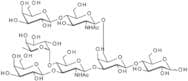
CAS 56501-25-8
:Fucosyllacto-N-néohexaose II
Description :
Fucosyllacto-N-néohexaose II, identifié par son numéro CAS 56501-25-8, est un oligosaccharide complexe qui appartient à la classe des structures glycanes. Il se caractérise par sa composition, qui comprend des unités de fucose, de lactose et d'hexose, contribuant à ses propriétés structurales et fonctionnelles uniques. Cet oligosaccharide est souvent impliqué dans des processus biologiques, en particulier dans la reconnaissance et la signalisation entre cellules, et peut jouer un rôle dans les réponses immunitaires. Fucosyllacto-N-néohexaose II se trouve généralement dans divers fluides biologiques et peut être dérivé du lait ou synthétisé par des processus enzymatiques. Sa complexité structurelle lui permet d'interagir avec des récepteurs spécifiques, ce qui en fait un sujet d'intérêt dans la recherche liée à la glycobiologie et aux applications thérapeutiques potentielles. La stabilité et la solubilité de ce composé peuvent varier en fonction des conditions environnementales, telles que le pH et la température, ce qui peut influencer son activité biologique et ses interactions. Dans l'ensemble, Fucosyllacto-N-néohexaose II représente un domaine d'étude significatif dans le domaine de la chimie des glucides et ses implications en matière de santé et de maladie.
Formule :C46H78N2O35
InChI :InChI=1S/C46H78N2O35/c1-11-23(59)29(65)32(68)43(73-11)81-38-19(9-54)77-42(22(48-13(3)56)39(38)82-45-34(70)31(67)26(62)17(7-52)75-45)83-40-27(63)20(78-46(35(40)71)79-36(15(58)5-50)24(60)14(57)4-49)10-72-41-21(47-12(2)55)28(64)37(18(8-53)76-41)80-44-33(69)30(66)25(61)16(6-51)74-44/h4,11,14-46,50-54,57-71H,5-10H2,1-3H3,(H,47,55)(H,48,56)/t11-,14-,15+,16+,17+,18+,19+,20+,21+,22+,23+,24+,25-,26-,27-,28+,29+,30-,31-,32-,33+,34+,35+,36+,37+,38+,39+,40-,41+,42-,43-,44-,45-,46-/m0/s1
Code InChI :InChIKey=BSVXHMSSYKYLNT-SYJKWMCZSA-N
SMILES :O([C@H]1[C@H](O[C@H]2[C@@H](O)[C@H](O)[C@H](O)[C@H](C)O2)[C@@H](CO)O[C@@H](O[C@@H]3[C@@H](O)[C@H](O[C@@H]([C@@H]([C@H](C=O)O)O)[C@@H](CO)O)O[C@H](CO[C@H]4[C@H](NC(C)=O)[C@@H](O)[C@H](O[C@@H]5O[C@H](CO)[C@H](O)[C@H](O)[C@H]5O)[C@@H](CO)O4)[C@@H]3O)[C@@H]1NC(C)=O)[C@@H]6O[C@H](CO)[C@H](O)[C@H](O)[C@H]6O
Synonymes :- <span class="text-smallcaps">D</smallcap>-Glucose, O-6-deoxy-α-<smallcap>L</smallcap>-galactopyranosyl-(1→4)-O-[β-<smallcap>D</smallcap>-galactopyranosyl-(1→3)]-O-2-(acetylamino)-2-deoxy-β-<smallcap>D</smallcap>-glucopyranosyl-(1→3)-O-[O-β-<smallcap>D</smallcap>-galactopyranosyl-(1→4)-2-(acetylamino)-2-deoxy-β-<smallcap>D</smallcap>-glucopyranosyl-(1→6)]-O-β-<smallcap>D</span>-galactopyranosyl-(1→4)-
- <span class="text-smallcaps">D</smallcap>-Glucose, O-β-<smallcap>D</smallcap>-galactopyranosyl-(1→4)-O-2-(acetylamino)-2-deoxy-β-<smallcap>D</smallcap>-glucopyranosyl-(1→6)-O-[O-6-deoxy-α-<smallcap>L</smallcap>-galactopyranosyl-(1→4)-O-[β-<smallcap>D</smallcap>-galactopyranosyl-(1→3)]-2-(acetylamino)-2-deoxy-β-<smallcap>D</smallcap>-glucopyranosyl-(1→3)]-O-β-<smallcap>D</span>-galactopyranosyl-(1→4)-
- Fucosyllacto-N-neohexaose II
- Lacto-N-fucoheptaose
- O-β-<span class="text-smallcaps">D</smallcap>-Galactopyranosyl-(1→4)-O-2-(acetylamino)-2-deoxy-β-<smallcap>D</smallcap>-glucopyranosyl-(1→6)-O-[O-6-deoxy-α-<smallcap>L</smallcap>-galactopyranosyl-(1→4)-O-[β-<smallcap>D</smallcap>-galactopyranosyl-(1→3)]-2-(acetylamino)-2-deoxy-β-<smallcap>D</smallcap>-glucopyranosyl-(1→3)]-O-β-<smallcap>D</smallcap>-galactopyranosyl-(1→4)-<smallcap>D</span>-glucose
- O-β-D-Galactopyranosyl-(1→4)-O-2-(acetylamino)-2-deoxy-β-D-glucopyranosyl-(1→6)-O-[O-6-deoxy-α-L-galactopyranosyl-(1→4)-O-[β-D-galactopyranosyl-(1→3)]-2-(acetylamino)-2-deoxy-β-D-glucopyranosyl-(1→3)]-O-β-D-galactopyranosyl-(1→4)-D-glucose
- D-Glucose, O-β-D-galactopyranosyl-(1→4)-O-2-(acetylamino)-2-deoxy-β-D-glucopyranosyl-(1→6)-O-[O-6-deoxy-α-L-galactopyranosyl-(1→4)-O-[β-D-galactopyranosyl-(1→3)]-2-(acetylamino)-2-deoxy-β-D-glucopyranosyl-(1→3)]-O-β-D-galactopyranosyl-(1→4)-
- D-Glucose, O-6-deoxy-α-L-galactopyranosyl-(1→4)-O-[β-D-galactopyranosyl-(1→3)]-O-2-(acetylamino)-2-deoxy-β-D-glucopyranosyl-(1→3)-O-[O-β-D-galactopyranosyl-(1→4)-2-(acetylamino)-2-deoxy-β-D-glucopyranosyl-(1→6)]-O-β-D-galactopyranosyl-(1→4)-
Trier par
Degré de pureté (%)
0
100
|
0
|
50
|
90
|
95
|
100
1 produits concernés.
Monofucosyllacto-N-hexaose II
CAS :Monofucosyllacto-N-hexaose II is a tetraol that is used as a reagent in the synthesis of enantioenriched and synthetically tetrasaccharidic products. Monofucosyllacto-N-hexaose II can be obtained by the reaction of Grignard reagents with glucose or by stereoselective reduction of an alpha, beta unsaturated ketone. The presence of the glucose residue in Monofucosyllacto-N-hexaose II makes it an acceptor for esterification reactions. This compound has chiral centers due to its two stereogenic centers at C2 and C3, which are both beta positions on the glucose residue. Monofucosyllacto-N-hexaose II also has a free hydroxyl group at C5 that can be esterified to produce chiral esters.Formule :C46H78N2O35Degré de pureté :Min. 95%Masse moléculaire :1,219.1 g/mol