CAS 56897-53-1
:Carcinine
Description :
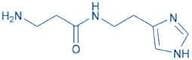
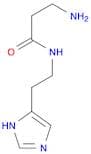
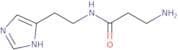
Carcinine, avec le numéro CAS 56897-53-1, est un composé naturellement présent qui est un dérivé de l'acide aminé histidine. Il se caractérise par son rôle dans divers processus biologiques, en particulier dans le contexte du métabolisme cellulaire et de l'activité antioxydante. Carcinine est connu pour ses propriétés neuroprotectrices potentielles, car il peut aider à atténuer le stress oxydatif dans les cellules neuronales. Structurellement, il présente un anneau d'imidazole unique, qui contribue à sa réactivité biochimique et à ses interactions au sein des systèmes biologiques. Le composé a suscité de l'intérêt dans la recherche liée à la biologie du cancer et au vieillissement, car il peut influencer les voies de signalisation cellulaire. De plus, Carcinine est soluble dans l'eau, ce qui facilite ses fonctions biologiques. Bien qu'il ne soit pas largement reconnu comme un agent thérapeutique, sa présence dans certains tissus et ses implications métaboliques en font un sujet d'investigation scientifique en cours. Dans l'ensemble, Carcinine représente un domaine d'étude fascinant au sein de la biochimie et de la pharmacologie, avec des implications potentielles pour la santé et la maladie.
Formule :C8H14N4O
InChI :InChI=1S/C8H14N4O/c9-3-1-8(13)11-4-2-7-5-10-6-12-7/h5-6H,1-4,9H2,(H,10,12)(H,11,13)
Code InChI :InChIKey=ANRUJJLGVODXIK-UHFFFAOYSA-N
SMILES :C(CNC(CCN)=O)C1=CN=CN1
Synonymes :- 3-Amino-N-[2-(1H-imidazol-4-yl)ethyl]propanamide
- 3-Amino-N-[2-(1H-imidazol-5-yl)ethyl]propanamide
- Alistin
- Carcinine
- Decarboxycarnosine
- N-[2-(1H-imidazol-5-yl)ethyl]-beta-alaninamide
- N-[2-(1H-imidazol-5-yl)ethyl]-beta-alaninamide dihydrochloride
- Propanamide, 3-amino-N-(2-(1H-imidazol-4-yl)ethyl)-
- Propanamide, 3-amino-N-[2-(1H-imidazol-5-yl)ethyl]-
- beta-Alanylhistamine
- β-Alanylhistamine
Trier par
Degré de pureté (%)
0
100
|
0
|
50
|
90
|
95
|
100
4 produits concernés.
Carcinine
CAS :Carcinine was originally discovered in the cardiac tissue of the crustacean Carcinus maenas. Both carnosine and carcinine act as natural antioxidants with hydroxyl-radical-scavenging and lipid-peroxidase activities. Unlike carnosine, carcinine is not a substrate for carnosinase or other dipeptidases. Therefore it may play a greater role in the prolongation and potentiation of physiological responses to the therapeutical treatments. Carcinine forms complexes with Cu(II).Formule :C8H14N4ODegré de pureté :> 99%Couleur et forme :White PowderMasse moléculaire :182.23N-(2-(1H-Imidazol-5-yl)ethyl)-3-aminopropanamide
CAS :Formule :C8H14N4ODegré de pureté :%Masse moléculaire :182.2230Carcinine hydrochloride salt
CAS :Carcinine is a natural compound that inhibits the activities of enzymes involved in energy metabolism, including carnosine, which is a dipeptide found in muscle and brain tissue. Carnosine has been shown to be effective against eye disorders such as glaucoma and optic nerve degeneration, as well as cardiac effects. Carcinine has also been shown to inhibit histamine release, which may be due to its ability to suppress the activation of toll-like receptor 4 by lipopolysaccharides or its ability to inhibit the production of pro-inflammatory cytokines. Carcinine hydrochloride salt is a model system for studying carcinine's interactions with carnosine in vivo and in vitro.Formule :C8H14N4O·XHClDegré de pureté :Min. 95%Carcinine
CAS :Carcinine ditrifluoroacetate is a H3 receptor antagonist.Formule :C8H14N4ODegré de pureté :98%Couleur et forme :SolidMasse moléculaire :182.22