CAS 57-04-5
:Phosphate de dihydroxyacétone
Description :
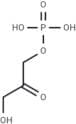
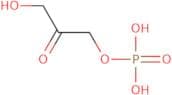
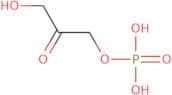
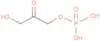
Phosphate de dihydroxyacétone (DHAP) est un intermédiaire clé dans le métabolisme des glucides, en particulier dans la voie glycolytique et le cycle de Calvin. C'est un sucre phosphorylé à trois carbones et se présente sous forme de solide incolore et hygroscopique à température ambiante. Le DHAP est une molécule importante dans l'interconversion des glucides, car il peut être facilement converti en glycérol-3-phosphate, un autre métabolite crucial. Le composé est soluble dans l'eau, ce qui facilite son rôle dans les processus métaboliques. Le DHAP joue un rôle significatif dans la production d'énergie et est impliqué dans la synthèse des triglycérides et des phospholipides. Sa structure présente deux groupes hydroxyles et un groupe phosphate, contribuant à sa réactivité et à sa fonction dans les voies biochimiques. De plus, le DHAP est utilisé dans divers essais biochimiques et applications de recherche, en particulier dans des études liées au métabolisme et à l'activité enzymatique. En raison de son rôle central dans le métabolisme, comprendre les caractéristiques du DHAP est essentiel pour obtenir des informations sur la production d'énergie et l'utilisation des glucides dans les organismes vivants.
Formule :C3H7O6P
InChI :InChI=1S/C3H7O6P/c4-1-3(5)2-9-10(6,7)8/h4H,1-2H2,(H2,6,7,8)
Code InChI :InChIKey=GNGACRATGGDKBX-UHFFFAOYSA-N
SMILES :C(C(CO)=O)OP(=O)(O)O
Synonymes :- (3-Hydroxy-2-oxopropoxy)phosphonic acid
- 1,3-Dihydroxy-2-propanone phosphate
- 1,3-Dihydroxyacetone 1-phosphate
- 1-Hydroxy-2-Oxopropyl Phosphate
- 1-Hydroxy-3-(phosphonooxy)-2-propanone
- 1-Hydroxy-3-(phosphonooxy)aceton
- 2-Propanone, 1,3-dihydroxy-, mono(dihydrogen phosphate)
- 2-Propanone, 1,3-dihydroxy-, phosphate
- 2-Propanone, 1-hydroxy-3-(phosphonooxy)-
- 3-(Fosfonooxi)-1-Hidroxiacetona
- 3-Hydroxy-2-Oxopropyl Dihydrogen Phosphate
- Dhap
- Dihydroxyacetone 3-phosphate
- Dihydroxyacetone monophosphate
- Dihydroxyacetone phosphate
- Dioxyacetone phosphate
- Glycerone phosphate
- Phosphodioxyacetone
- Phosphoric acid, ester with 1,3-dihydroxy-2-propanone
- Voir plus de synonymes
Trier par
Degré de pureté (%)
0
100
|
0
|
50
|
90
|
95
|
100
7 produits concernés.
1-hydroxy-3-(phosphonooxy)acetone
CAS :Formule :C3H7O6PDegré de pureté :95%Masse moléculaire :170.0578Dihydroxyacetone phosphate
CAS :Dihydroxyacetone phosphate is a central metabolite in lipid biosynthesis and glycolysis, involved in Calvin cycle and affected by transaldolase deficiency.Formule :C3H7O6PDegré de pureté :99.9%Couleur et forme :SolidMasse moléculaire :170.06Dihydroxyacetone Phosphate Lithium Salt (Technical Grade)
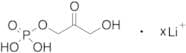
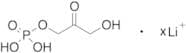
CAS :Produit contrôléFormule :C3H7O6P•xLiCouleur et forme :Dark YellowMasse moléculaire :170.06694Dihydroxyacetone Phosphate Lithium Salt (>90%)
CAS :Produit contrôléStability Hygroscopic
Applications Dihydroxyacetone Phosphate Lithium Salt, is a metabolic intermediate involved in involved in a wide variety of metabolic pathways including glycolysis and lipid biosynthesis. In plants, Dihydroxyacetone phosphate is involved with the synthesis of vitamin B6.
References Jun Ogawa et. al.: et al.: Bioscience, biotechnology, and biochemistry, 67(4), undefined (2003-6-6); John P Richard, Biochemistry, 51(13), undefined (2012-3-14);Formule :C3H7O6P•xLiDegré de pureté :>90%Couleur et forme :NeatMasse moléculaire :170.06694Glycerone phosphate lithium salt
CAS :Glycerone phosphate lithium salt is a reactive molecule that serves as an intermediate in the synthesis of rapamycin, a complex of glycerone phosphate and rapamycin. Glycerone phosphate lithium salt is used to detect the presence of glutamate dehydrogenase and to purify monoclonal antibodies. Glycerone phosphate lithium salt has been shown to react with platinum-based chemotherapy, which may be due to its ability to bind to active sites on cancer cells. This molecule also has been shown to reduce high cholesterol levels in mice and inhibit skin cancer tumor growth. Glycerone phosphate lithium salt's physiological effects have not been fully determined, but it may have some anticancer activity.Formule :C3H7O6P·xLiDegré de pureté :Min. 95%Masse moléculaire :170.06 g/molGlycerone phosphate hemimagnesium salt hydrate
CAS :Glycerone phosphate hemimagnesium salt hydrate is a substrate molecule that is used in the control analysis of dihydroxyacetone phosphate. Glycerone phosphate hemimagnesium salt hydrate is an optimum concentration for 3T3-L1 preadipocytes and has been shown to have an effect on energy metabolism. Glycerone phosphate hemimagnesium salt hydrate also has enzymatic activity, which can lead to neuronal death or skin cancer. This compound is a monosodium salt that can be found in cytosolic calcium, which is present in cells and helps regulate muscle contraction. Glycerone phosphate hemimagnesium salt hydrate can also be found in basic proteins that are vital for cell function.Formule :C3H5O6P·xH2OMgDegré de pureté :Min. 95 Area-%Couleur et forme :PowderMasse moléculaire :180.19 g/molGlycerone phosphate
CAS :Glycerone phosphate is a cytosolic calcium (Ca2+) substrate molecule that is used to measure the activity of phospholipase A2, an enzyme that catalyzes the hydrolysis of membrane lipids. Glycerone phosphate has been shown to inhibit neuronal death and may be useful in treating neurodegenerative diseases such as Alzheimer's disease. Glycerone phosphate has also been shown to bind to monoclonal antibodies, which are proteins that bind specifically to antigens on the surface of cancer cells, thereby preventing them from binding to their corresponding receptors on healthy cells. This may limit the spread of tumor growth and increase their sensitivity to platinum-based chemotherapy.Formule :C3H7O6PDegré de pureté :Min. 95%Masse moléculaire :170.06 g/mol