

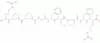
CAS 58-82-2
:Bradykinine
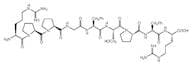
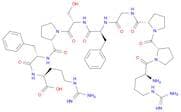
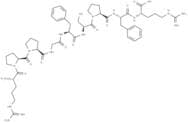
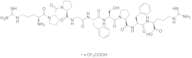
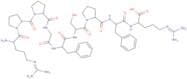
- H-Arg-Pro-Pro-Gly-Phe-Ser-Pro-Phe-Arg-OH
- N~5~-(diaminomethylidene)ornithylprolylprolylglycylphenylalanylserylprolylphenylalanyl-N~5~-(diaminomethylidene)ornithine
- N~5~-(diaminomethylidene)-L-ornithyl-L-prolyl-L-prolylglycyl-L-phenylalanyl-L-seryl-L-prolyl-L-phenylalanyl-N~5~-(diaminomethylidene)-L-ornithine
- 1: PN: JP2005049164 SEQID: 1 claimed protein
- 1: PN: US20040198666 SEQID: 1 unclaimed protein
- 1: PN: US20040220110 PAGE: 2 unclaimed protein
- 1: PN: WO02102835 SEQID: 3 unclaimed protein
- 1: PN: WO2006130718 SEQID: 1 unclaimed protein
- 1: PN: WO2006134125 SEQID: 22 claimed protein
- 1021: PN: WO2006091861 SEQID: 1021 claimed protein
- 107: PN: WO2006069765 SEQID: 107 claimed protein
- 11: PN: US20040209344 SEQID: 7 unclaimed protein
- 13: PN: WO0023092 SEQID: 13 unclaimed protein
- 14: PN: US6525021 SEQID: 13 unclaimed protein
- 147: PN: US20030119021 SEQID: 25 unclaimed protein
- 15: PN: US6258776 SEQID: 24 unclaimed protein
- 153: PN: WO2006067198 SEQID: 165 claimed protein
- 16: PN: WO2006079099 SEQID: 1 unclaimed protein
- 165: PN: US20050175581 SEQID: 165 unclaimed protein
- 175: PN: WO2008008805 SEQID: 178 unclaimed protein
- 18: PN: JP2006280210 SEQID: 18 unclaimed protein
- 187: PN: US20030176421 PAGE: 54-55 claimed protein
- 19: PN: US20060223140 SEQID: 18 claimed protein
- 19: PN: WO2007022248 SEQID: 19 claimed protein
- 2: PN: WO2005042027 SEQID: 1 unclaimed protein
- 2: PN: WO2005057221 PAGE: 17 unclaimed protein
- 3: PN: WO02059343 SEQID: 3 unclaimed protein
- 3: PN: WO2006050091 SEQID: 7 claimed protein
- 38: PN: WO2006017688 SEQID: 38 unclaimed protein
- 41: PN: WO03028666 SEQID: 38 unclaimed protein
- 57: PN: FR2862981 SEQID: 57 unclaimed protein
- 57: PN: WO2004033476 SEQID: 57 unclaimed protein
- 6: PN: US6395513 SEQID: 9 unclaimed protein
- 6: PN: WO0112656 SEQID: 47 unclaimed protein
- 7: PN: US20040170685 SEQID: 7 unclaimed protein
- 8: PN: WO2004069857 PAGE: 49 unclaimed protein
- 9: PN: US20060013855 SEQID: 9 unclaimed protein
- 9: PN: WO2004068928 PAGE: 65 unclaimed protein
- 9: PN: WO2005097186 SEQID: 9 claimed protein
- Arginine, N2-[N-[1-[N-[N-[N-[1-(1-arginyl-L-prolyl)-L-prolyl]glycyl]-3-phenylalanyl]seryl]prolyl]-3-phenylalanyl]-
- Bradiquinina
- Bradykinin (human)
- Bradykinine
- Brs 640
- Callidin I
- Kallidin 9
- Kallidin I
- L-Arginine, L-arginyl-L-prolyl-L-prolylglycyl-L-phenylalanyl-L-seryl-L-prolyl-L-phenylalanyl-
- L-Bradykinin
- Voir plus de synonymes
Bradykinin
CAS :For cellular and molecular biology applications
Couleur et forme :White to off-white, SolidBradykinin
CAS :Formule :C50H73N15O11Degré de pureté :98%Couleur et forme :SolidMasse moléculaire :1060.2085Bradykinin
CAS :Bradykinin is an inflammatory mediator.Formule :C50H73N15O11Degré de pureté :99.68%Couleur et forme :SolidMasse moléculaire :1060.21Bradykinin Trifluoroacetic Acid
CAS :Produit contrôléFormule :C50H73N15O11•xC2HO2F3Couleur et forme :NeatMasse moléculaire :1060.2Bradykinin (Human, Bovine, Rat, Mouse)
CAS :Bradykinin is a peptide hormone that is produced in the body by the kininase enzyme. It is an activator of ion channels and ligand for the G-protein coupled receptors B1, B2, and B3. Bradykinin is used as a research tool to study cell biology, pharmacology, and life science. It interacts with proteins such as erythrocyte protein band 4.4, alpha-2-macroglobulin receptor, alpha-bungarotoxin binding protein, beta-chain integrin receptor, and platelet membrane glycoprotein IIb/IIIa receptor. Bradykinin has been shown to inhibit the activity of bradykinin B1 receptor (Ki = 0.4 nM) and bradykinin B2 receptor (Ki = 0.6 nM).
Formule :C50H73N15O11Degré de pureté :Min. 95%Masse moléculaire :1,060.2 g/molBradykinin
CAS :Custom research peptide; min purity 95%.Formule :C50H73N15O11Degré de pureté :Min. 95%Masse moléculaire :1,060.22 g/molBradykinin
CAS :Bradykinin is a peptide that belongs to the class of natural compounds. It is a signal peptide, which is used in the regulation of various biological functions such as inflammation and pain. Bradykinin has been shown to have an anti-cancer effect on cancer tissues, with the highest potency observed in bone cancer. Bradykinin also causes an increase in eosinophil cationic protein, which can be measured in biological samples such as blood. This compound has been shown to have a variety of effects on enzyme activities and can be used as a chemotherapeutic agent for diseases such as congestive heart failure and chronic kidney disease. Bradykinin has low potency for inhibition of creatinine sulfate synthesis.
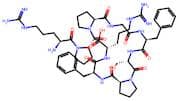
Formule :C50H73N15O11Degré de pureté :Min. 95%Masse moléculaire :1,060.22 g/mol2-[[2-[[1-[2-[[2-[[2-[[1-[1-[2-amino-5-(diaminomethylideneamino)pentanoyl]pyrrolidine-2-carbonyl]pyrrolidine-2-carbonyl]amino]acetyl ]amino]-3-phenylpropanoyl]amino]-3-hydroxypropanoyl]pyrrolidine-2-carbonyl]amino]-3-phenylpropanoyl]amino]-5-(diaminomethy
CAS :Custom research peptide; min purity 95%. For different specs please use the Peptide Quote Tool
Formule :C50H73N15O11Masse moléculaire :1,060.22 g/mol






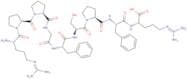
![2-[[2-[[1-[2-[[2-[[2-[[1-[1-[2-amino-5-(diaminomethylideneamino)pentanoyl]pyrrolidine-2-carbonyl]p…](/_next/image/?url=https%3A%2Fstatic.cymitquimica.com%2Fproducts%2F3D%2Fthumb%2FPP50751.jpg&w=3840&q=75)