CAS 583-93-7
:Acide diaminopimélique
Description :
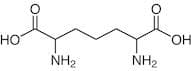
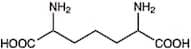
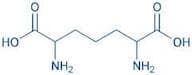
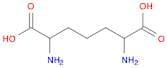
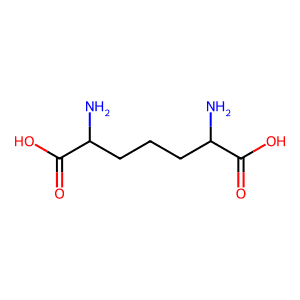
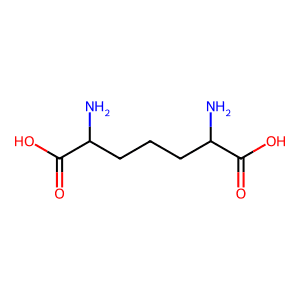
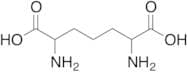
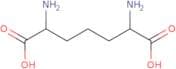
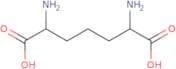
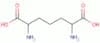
Acide diaminopimélique (DAP) est un acide aminé qui joue un rôle crucial dans la biosynthèse du peptidoglycane, un composant clé des parois cellulaires bactériennes. Il existe sous deux formes stéréoisomériques, les isomères L et D, la forme L étant plus répandue dans la nature. Le DAP se caractérise par la présence de deux groupes amino (-NH2) et d'un groupe acide carboxylique (-COOH) dans sa structure, ce qui contribue à sa basicité et à sa réactivité. Ce composé se trouve généralement dans certaines bactéries, en particulier dans les parois cellulaires des bactéries Gram-négatives, et est essentiel à leur croissance et survie. Le DAP peut également être impliqué dans diverses voies métaboliques et est un précurseur pour la synthèse d'autres biomolécules importantes. En termes de propriétés physiques, c'est généralement un solide cristallin blanc soluble dans l'eau. Sa structure et ses propriétés uniques en font un composé significatif en microbiologie et en biochimie, en particulier dans les études liées à la résistance aux antibiotiques et à la synthèse de la paroi cellulaire bactérienne.
Formule :C7H14N2O4
InChI :InChI=1S/C7H14N2O4/c8-4(6(10)11)2-1-3-5(9)7(12)13/h4-5H,1-3,8-9H2,(H,10,11)(H,12,13)
Code InChI :InChIKey=GMKMEZVLHJARHF-UHFFFAOYSA-N
SMILES :C(C(O)=O)(CCCC(C(O)=O)N)N
Synonymes :- (2R,6R)-2,6-diammonioheptanedioate
- (2R,6S)-2,6-diaminoheptanedioic acid
- 2,6-Bis(azaniumyl)heptanedioate
- 2,6-Diaminoheptanedioic Acid
- Diaminopimelic acid
- Heptanedioic acid, 2,6-diamino-
- Nsc 45225
- α,α′-Diaminopimelic acid
- α,ε-Diaminopimelic acid
- 2,6-Diaminopimelic acid
Trier par
Degré de pureté (%)
0
100
|
0
|
50
|
90
|
95
|
100
13 produits concernés.
2,6-Diaminopimelic Acid
CAS :Formule :C7H14N2O4Degré de pureté :>98.0%(T)Couleur et forme :White to Almost white powder to crystalMasse moléculaire :190.202,6-Diaminopimelic acid, 96%
CAS :2,6-Diaminopimelic acid is used as a constituent of proteoglycans. It is used as a component of bacterial cell wall. This Thermo Scientific Chemicals brand product was originally part of the Alfa Aesar product portfolio. Some documentation and label information may refer to the legacy brand. The orFormule :C7H14N2O4Degré de pureté :96%Couleur et forme :White to cream to pale brown, Powder and/or chunksMasse moléculaire :190.202,6-Diaminopimelic acid
CAS :A non-competitive inhibitor of aspartokinase I, corresponds to ε-carboxylysine.Formule :C7H14N2O4Degré de pureté :> 99%Couleur et forme :WhiteMasse moléculaire :190.22,6-Diaminoheptanedioic acid
CAS :Formule :C7H14N2O4Degré de pureté :97%Couleur et forme :SolidMasse moléculaire :190.19712,6-Diaminoheptanedioic acid
CAS :2,6-Diaminoheptanedioic acidDegré de pureté :≥98%Masse moléculaire :190.2g/mol2,6-Diaminopimelic acid
CAS :Formule :C7H14N2O4Degré de pureté :(Titration) ≥ 96.0%Couleur et forme :White to pale brown powderMasse moléculaire :190.202,6-Diaminoheptanedioic acid
CAS :2,6-Diaminoheptanedioic acidDegré de pureté :98%Couleur et forme :SolidMasse moléculaire :190.20g/mol2,6-Diaminoheptanedioic acid
CAS :Diaminopimelic acid or DAPA is a lysine-like amino acid derivative that is a key component of the bacterial cell wall.Formule :C7H14N2O4Degré de pureté :99.79% - 99.95%Couleur et forme :SolidMasse moléculaire :190.22,6-Diaminopimelic Acid
CAS :Produit contrôléApplications 2,6-Diaminopimelic Acid is useful in biological studies involving amino acids and amino sugars as molecular indicators of the origins of organic matter in buried tephra soils.
References Hobara, S., et al.: Geoderma, 373, 114449 (2020)Formule :C7H14N2O4Couleur et forme :NeatMasse moléculaire :190.22,6-Diaminopimelic acid
CAS :2,6-Diaminopimelic acid is a peptide that has been shown to have antimicrobial activity. This compound binds to the Toll-like receptor 2 and causes cell lysis by disrupting the membrane. In vitro assays show that 2,6-diaminopimelic acid is active against high resistance Gram-positive bacteria such as penicillin-resistant Staphylococcus aureus, methicillin resistant Staphylococcus aureus (MRSA), Streptococcus pneumoniae, and Enterococcus faecalis. 2,6-Diaminopimelic acid also inhibits the growth of Gram-negative bacteria such as Escherichia coli and Salmonella enterica serovar Typhi. The mechanism of action is not well understood but may be due to its ability to chelate metal ions or inhibit penicillin binding proteins in the bacterial cell wall.Formule :C7H14N2O4Couleur et forme :White PowderMasse moléculaire :190.2 g/mol2,6-Diaminopimelic acid, mixture of Isomers
CAS :2,6-Diaminopimelic acid is a high quality reagent that is used in the manufacture of many complex compounds and fine chemicals. This compound can be used as an intermediate, a building block, or a reaction component. 2,6-Diaminopimelic acid is useful in research because it is versatile and can be used to make many different types of chemicals. It has a CAS number of 583-93-7 and can be found on the list of speciality chemicals.Formule :C7H14N2O4Masse moléculaire :190.20 g/mol2,6-Diaminoheptanedioic acid
CAS :Formule :C7H14N2O4Degré de pureté :95%Couleur et forme :SolidMasse moléculaire :190.199