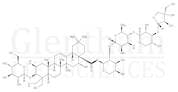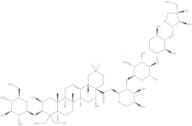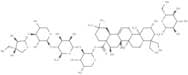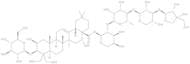
CAS 58479-68-8
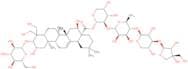
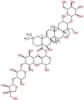
:Platycodine D
Description :
Platycodine D est une saponine triterpénoïde principalement dérivée de la racine de Platycodon grandiflorus, une plante couramment utilisée en médecine traditionnelle, notamment en Asie de l'Est. Elle est connue pour ses diverses activités biologiques, y compris des propriétés anti-inflammatoires, immunomodulatrices et anticancéreuses. La structure chimique de Platycodine D présente un squelette de type dammarane, qui contribue à sa bioactivité. Elle est généralement caractérisée par sa solubilité dans l'eau et les solvants organiques, bien que sa solubilité puisse varier en fonction du solvant utilisé. Platycodine D a fait l'objet de nombreuses études sur ses effets pharmacologiques, y compris son potentiel à améliorer la santé respiratoire et son rôle dans la modulation des réponses immunitaires. De plus, elle présente des effets cytotoxiques contre certaines lignées cellulaires cancéreuses, ce qui en fait un composé d'intérêt dans la recherche sur le cancer. Comme de nombreux produits naturels, les processus d'extraction et de purification peuvent influencer son efficacité et sa biodisponibilité, soulignant l'importance de techniques analytiques appropriées dans l'étude de ses propriétés et applications.
Formule :C57H92O28
InChI :InChI=1S/C57H92O28/c1-23-40(81-45-39(72)41(28(64)18-76-45)82-49-43(73)56(75,21-61)22-78-49)36(69)38(71)46(79-23)83-42-33(66)27(63)17-77-48(42)85-50(74)57-12-11-51(2,3)13-25(57)24-7-8-30-52(4)14-26(62)44(84-47-37(70)35(68)34(67)29(16-58)80-47)55(19-59,20-60)31(52)9-10-53(30,5)54(24,6)15-32(57)65/h7,23,25-49,58-73,75H,8-22H2,1-6H3/t23-,25-,26-,27-,28+,29+,30+,31+,32+,33-,34+,35-,36-,37+,38+,39+,40-,41-,42+,43-,44-,45-,46-,47-,48-,49-,52+,53+,54+,56+,57+/m0/s1
Code InChI :InChIKey=CYBWUNOAQPMRBA-NDTOZIJESA-N
SMILES :C(O[C@H]1[C@H](O[C@H]2[C@H](O)[C@H](O)[C@@H](O[C@H]3[C@H](O)[C@@H](O[C@H]4[C@H](O)[C@](CO)(O)CO4)[C@H](O)CO3)[C@H](C)O2)[C@@H](O)[C@@H](O)CO1)(=O)[C@]56[C@](C=7[C@@](C)(C[C@H]5O)[C@@]8(C)[C@](CC7)([C@]9(C)[C@@](CC8)(C(CO)(CO)[C@@H](O[C@@H]%10O[C@H](CO)[C@@H](O)[C@H](O)[C@H]%10O)[C@@H](O)C9)[H])[H])(CC(C)(C)CC6)[H]
Synonymes :- (1-2)-L-arabinopyranosyl ester, (2beta,3beta,16alpha)-
- 2,16,23,24-tetrahydroxy-, O-D-apio-beta-D-furanosyl-(1-3)-O-
- 3-O-[(2S,3R,4R)-3,4-dihydroxy-4-(hydroxymethyl)tetrahydrofuran-2-yl]-beta-D-xylopyranosyl-(1->4)-6-deoxy-alpha-L-mannopyranosyl-(1->2)-1-O-[(2beta,3beta,16alpha)-3-(beta-D-glucopyranosyloxy)-2,16,23,24-tetrahydroxy-28-oxoolean-12-en-28-yl]-alpha-L-arabinopyranose
- Olean-12-en-28-oic acid, 3-(beta-D-glucopyranosyloxy)-
- Olean-12-en-28-oic acid, 3-(β-<span class="text-smallcaps">D</smallcap>-glucopyranosyloxy)-2,16,23,24-tetrahydroxy-, O-<smallcap>D</smallcap>-apio-β-<smallcap>D</smallcap>-furanosyl-(1→3)-O-β-<smallcap>D</smallcap>-xylopyranosyl-(1→4)-O-6-deoxy-α-<smallcap>L</smallcap>-mannopyranosyl-(1→2)-α-<smallcap>L</span>-arabinopyranosyl ester, (2β,3β,16α)-
- beta-D-xylopyranosyl-(1-4)-O-6-deoxy-alpha-L-mannopyranosyl-
- beta-D-xylopyranosyl-(1-4)-O-6-deoxy-alpha-L-mannopyranosyl-
- (1-2)-L-arabinopyranosyl ester, (2beta,3beta,16alpha)-
- Olean-12-en-28-oic acid, 3-(beta-D-glucopyranosyloxy)-
- 2,16,23,24-tetrahydroxy-, O-D-apio-beta-D-furanosyl-(1-3)-O-
- Olean-12-en-28-oic acid, 3-(β-D-glucopyranosyloxy)-2,16,23,24-tetrahydroxy-, O-D-apio-β-D-furanosyl-(1→3)-O-β-D-xylopyranosyl-(1→4)-O-6-deoxy-α-L-mannopyranosyl-(1→2)-α-L-arabinopyranosyl ester, (2β,3β,16α)-
- Voir plus de synonymes
Trier par
Degré de pureté (%)
0
100
|
0
|
50
|
90
|
95
|
100
9 produits concernés.
Platycodin D
CAS :Formule :C57H92O28Degré de pureté :95%Couleur et forme :SolidMasse moléculaire :1225.3236Platycodin D
CAS :Platycodon D (PD) and D3 (PD3) isolated from Platycodon grandiflorum has been previously reported to show anti-inflammatory activities in rats, PD may stimulate TNF-α synthesis or inhibit degradation of TNF-α mRNA, suggest a dichotomous regulation of these important proinflammatory mediators by PD and PD3.Formule :C57H92O28Degré de pureté :95%~99%Couleur et forme :White powderMasse moléculaire :1225.34Platycodin D
CAS :Platycodin D may stimulate TNF-α synthesis or inhibit degradation of TNF-α mRNA.Formule :C57H92O28Degré de pureté :99.2% - 99.65%Couleur et forme :SolidMasse moléculaire :1225.32Platycodin d
CAS :Natural glycosideFormule :C57H92O28Degré de pureté :≥ 98.0 % (HPLC)Couleur et forme :PowderMasse moléculaire :1225.34Platycodin D
CAS :Produit contrôléApplications Platycodin D is a known inhibitor of the proliferation of human gastric cancer cells as well as inducing apoptosis. It also causes anti-atherosclerotic.
References Wu, J. et al.: Biol. Pharm. Bull. 35, 1216 (2012); Chun, J. et al.: J. Cell. Biochem., 114, 456 (2013);Formule :C57H92O28Couleur et forme :NeatMasse moléculaire :1225.32Platycodin D
CAS :Platycodin D is a natural product that belongs to the class of platycodins. It is a polysaccharide with anti-inflammatory properties and has been shown to suppress inflammation, oxidative injury, and improve mitochondrial function in vitro. Platycodin D also inhibits Toll-like receptor (TLR) signaling pathways that are activated by extracellular bacteria or their products. Platycodin D binds to dsDNA and inhibits DNA binding proteins such as dextran sulfate. This interaction prevents the induction of the inflammatory response. The effects of platycodin D have been demonstrated in an experimental model involving mice. In vivo studies on rats have shown that this compound has an anti-inflammatory effect and reduces oxidative injury.Formule :C57H92O28Degré de pureté :Min. 98 Area-%Couleur et forme :PowderMasse moléculaire :1,225.32 g/mol