![Pyrrolidine, 1-[2-[4-[1-(4-methoxyphenyl)-2-nitro-2-phenylethenyl]phenoxy]ethyl]-, 2-hydroxy-1,2,3…](/_next/image/?url=https%3A%2Fstatic.cymitquimica.com%2Fcas-image%2Fthumb-webp%2F384411-pyrrolidine-1-2-4-1-4-methoxyphenyl-2-nitro-2-phenylethenyl-phenoxy-ethyl-2-hydroxy-123-propanetricarboxylate-1-1.webp&w=3840&q=75)
CAS 5863-35-4
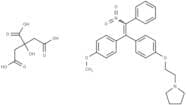
:Pyrrolidine, 1-[2-[4-[1-(4-méthoxyphényl)-2-nitro-2-phényléthényl]phénoxy]éthyl]-, 2-hydroxy-1,2,3-propanetricarboxylate (1:1)
Description :
Pyrrolidine, 1-[2-[4-[1-(4-méthoxyphényl)-2-nitro-2-phényléthényl]phénoxy]éthyl]-, 2-hydroxy-1,2,3-propanetricarboxylate (1:1), avec le numéro CAS 5863-35-4, est un composé organique complexe caractérisé par sa structure multifonctionnelle. Il présente un cycle pyrrolidine, qui est un hétérocycle à cinq membres contenant de l'azote, contribuant à sa potentielle activité biologique. La présence d'un groupe phénoxy et d'un groupe phényl substitué par un méthoxy suggère que le composé pourrait présenter une lipophilie significative, influençant potentiellement sa solubilité et son interaction avec les membranes biologiques. Le groupe nitro indique une réactivité possible et le potentiel d'activité biologique, tandis que le composant tricarboxylate peut conférer de l'acidité et des propriétés chélatantes. Ce composé pourrait intéresser la chimie médicinale en raison de sa complexité structurelle et du potentiel d'effets pharmacologiques divers. Cependant, des propriétés spécifiques telles que le point de fusion, le point d'ébullition et la solubilité nécessiteraient des données empiriques pour une caractérisation précise. Dans l'ensemble, la structure complexe de ce composé suggère une variété d'applications potentielles en recherche et développement.
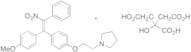
Formule :C27H28N2O4·C6H8O7
InChI :InChI=1S/C27H28N2O4.C6H8O7/c1-32-24-13-9-21(10-14-24)26(27(29(30)31)23-7-3-2-4-8-23)22-11-15-25(16-12-22)33-20-19-28-17-5-6-18-28;7-3(8)1-6(13,5(11)12)2-4(9)10/h2-4,7-16H,5-6,17-20H2,1H3;13H,1-2H2,(H,7,8)(H,9,10)(H,11,12)
Code InChI :InChIKey=LHAPNDAERSFWSC-UHFFFAOYSA-N
SMILES :C(=C(N(=O)=O)C1=CC=CC=C1)(C2=CC=C(OCCN3CCCC3)C=C2)C4=CC=C(OC)C=C4.C(CC(O)=O)(CC(O)=O)(C(O)=O)O
Synonymes :- 1-(2-(p-(alpha-(p-Methoxyphenyl)-beta-nitrostyryl)phenoxy)ethyl) pyrrolidine monocitrate
- 1-(2-(p-(alpha-(p-Methoxyphenyl)-beta-nitrostyryl)phenoxy)ethyl)pyrrolidine citrate (1:1)
- 1-[2-(p-[a-(p-Methoxyphenyl)-β-nitrostyryl]-phenoxy)ethyl]pyrrolidine monocitrate
- 1-[2-[4-[2-(4-Methoxyphenyl)-1-nitro-2-phenylethenyl]phenoxy]ethyl]pyrrolidine monocitrate
- 1-[2-[p-[α-(p-Methoxyphenyl)-β-nitrostyryl]phenoxy]ethyl]pyrrollidine monocitrate
- Ai3-52826
- CI-628 citrate
- Ci-628
- Cn-55945-27
- Nitromifene citrate [USAN]
- Nsc 110407
- Parke davis CI-628
- Pyrrolidine, 1-(2-(4-(1-(4-methoxyphenyl)-2-nitro-2-phenylethenyl)phenoxy)ethyl)-, 2-hydroxy-1,2,3-propanetricarboxylate (1:1)
- Pyrrolidine, 1-(2-(p-(alpha-(p-methoxyphenyl)-beta-nitrostyryl)phenoxy)ethyl)-, citrate (1:1) (8CI)
- Pyrrolidine, 1-[2-[p-[α-(p-methoxyphenyl)-β-nitrostyryl]phenoxy]ethyl]-, citrate
- Pyrrolidine, 1-[2-[p-[α-(p-methoxyphenyl)-β-nitrostyryl]phenoxy]ethyl]-, citrate (1:1)
- Voir plus de synonymes
Trier par
Degré de pureté (%)
0
100
|
0
|
50
|
90
|
95
|
100
3 produits concernés.
Nitromifene Citrate
CAS :Nitromifene Citrate is a nonsteroidal estrogen antagonist most commonly used as a research tool in animal studies.Formule :C33H36N2O11Couleur et forme :SolidMasse moléculaire :636.654Nitromifene Citrate (E/Z mixture)
CAS :Produit contrôléApplications Nitromifene citrate is a non-steroidal estrogen antagonist. It is structurally similar to Tamoxifen (T006000) which is a selective estrogen response modifier (SERM).
References Rudick, C., et al.: Endorcrinol., 144, 179 (2003); Sutherland, R., et al.: Nature, 267, 434 (1977)Formule :C33H36N2O11Couleur et forme :Yellow To OrangeMasse moléculaire :636.65Nitromifene citrate
CAS :Nitromifene citrate is a nonsteroidal drug that inhibits the enzyme fatty acid synthase, thereby preventing the production of prostaglandins. It has been shown to inhibit tumor growth in mice and to be effective against autoimmune diseases, such as rheumatoid arthritis and multiple sclerosis. Nitromifene citrate also binds to neurokinin-1 receptor and inhibits tissue culture granulosa cells. This drug has been shown to have clinical significance in the treatment of breast cancer. Nitromifene citrate is metabolized by the liver and is taken up into the brain where it can affect brain functions, such as emotional behavior or memory. Nitromifene citrate is synthesized by cultured cells in vitro and has been used for research purposes in vivo.Formule :C33H36N2O11Degré de pureté :Min. 95%Masse moléculaire :636.6 g/mol