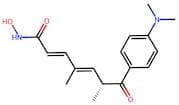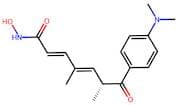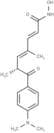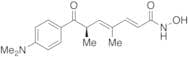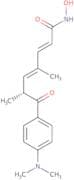
CAS 58880-19-6
:Trichostatine A
- (2E,4E)-7-[4-(dimethylamino)phenyl]-N-hydroxy-4,6-dimethyl-7-oxohepta-2,4-dienamide
- (2E,4E,6R)-7-[4-(Dimethylamino)phenyl]-N-hydroxy-4,6-dimethyl-7-oxo-2,4-heptadienamide
- (2E,4E,6R)-7-[4-(dimethylamino)phenyl]-N-hydroxy-4,6-dimethyl-7-oxohepta-2,4-dienamide
- (R)-(+)-Trichostatin A
- 2,4-Heptadienamide, 7-(4-(dimethylamino)phenyl)-N-hydroxy-4,6-dimethyl-7-oxo-
- 2,4-Heptadienamide, 7-(4-(dimethylamino)phenyl)-N-hydroxy-4,6-dimethyl-7-oxo-, (2E,4E,6R)-
- 2,4-Heptadienamide, 7-[4-(dimethylamino)phenyl]-N-hydroxy-4,6-dimethyl-7-oxo-, [R-(E,E)]-
- 7-(4-(Dimethylamino)phenyl)-N-hydroxy-4,6-dimethyl-7-oxo-2,4-heptadienamide
- 7-[4-(dimethylamino)phenyl]-N-hydroxy-4,6-dimethyl-7-oxohepta-2,4-dienamide
- TSA
- Trichostatin A
Trichostatin A
CAS :Formule :C17H22N2O3Degré de pureté :>98.0%(HPLC)Couleur et forme :White to Orange to Green powder to crystalMasse moléculaire :302.372,4-Heptadienamide,7-[4-(dimethylamino)phenyl]-N-hydroxy-4,6-dimethyl-7-oxo-, (2E,4E,6R)-
CAS :Formule :C17H22N2O3Degré de pureté :98%Couleur et forme :SolidMasse moléculaire :302.3682Trichostatin A from Streptomyces sp.
CAS :Trichostatin A from Streptomyces sp.Formule :C17H22N2O3Degré de pureté :By hplc: 99.21% (Typical Value in Batch COA)Couleur et forme : off-white powderMasse moléculaire :302.37g/molTrichostatin A
CAS :Formule :C17H22N2O3Degré de pureté :≥ 95.5%Couleur et forme :White to off-white or light-yellow powderMasse moléculaire :302.37Trichostatin A
CAS :Trichostatin A (TSA) is a natural derivative of diene isohydroxamic acids.Formule :C17H22N2O3Degré de pureté :96.01% - 98.59%Couleur et forme :Off-White PowderMasse moléculaire :302.37Trichostatin A
CAS :Produit contrôléApplications Trichostatin A is a known inhibitor of fibrosis in vitro and in vivo, and is used as an anticancer agent. Potent differentiation inducer of friend leukemic cells.
References Mori, K. et al.: Tetra., 44, 6013 (1988); Meng, F. et al.: Brit. J. Canc., 108, 579 (2013); Yang, L. et al.: Mol. Pharm., 83, 671 (2013);Formule :C17H22N2O3Couleur et forme :Off-WhiteMasse moléculaire :302.37Trichostatin A
CAS :A potent inhibitor of histone deacetylases (HDACs) of class I and II with anti-tumoral activity. The compound blocks HDAC catalytic activity by chelating zinc ion in the enzyme’s active site. Extensively used in research as epigenetic modifier able to block cell growth and downregulate proliferation-associated factors. It has also been reported that trichostatin A induces apoptosis via a histone-modification independent mechanism in oral squamous cell carcinoma cell lines. Initially discovered as anti-fungal compound from Streptomyces hygroscopicus for the control of fungal infections caused by the genus Trichophyton.
Formule :C17H22N2O3Degré de pureté :Min. 95%Couleur et forme :PowderMasse moléculaire :302.37 g/mol
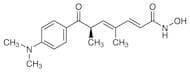

![2,4-Heptadienamide,7-[4-(dimethylamino)phenyl]-N-hydroxy-4,6-dimethyl-7-oxo-, (2E,4E,6R)-](/_next/image/?url=https%3A%2Fstatic.cymitquimica.com%2Fproducts%2FIN%2Fthumb%2FDA0035QF.jpg&w=3840&q=75)