CAS 59080-40-9
:PBB 153
Description :
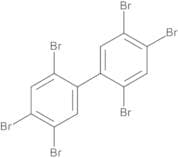
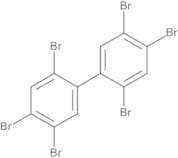
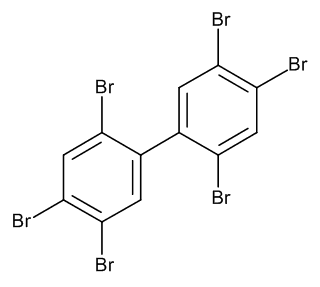
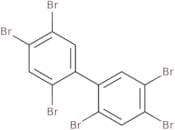
PBB 153, ou biphényle polybromé 153, est un retardateur de flamme bromé appartenant à une classe de composés connus sous le nom de biphényles polybromés (PBB). Il se caractérise par sa structure chimique, qui consiste en deux cycles phényliques avec plusieurs atomes de brome substitués à diverses positions. PBB 153 est principalement utilisé dans les plastiques et les textiles pour réduire l'inflammabilité. Il est connu pour sa persistance dans l'environnement et son potentiel de bioaccumulation dans les organismes vivants, soulevant des préoccupations concernant ses impacts écologiques et sur la santé. PBB 153 a été associé à divers effets indésirables, y compris la perturbation endocrinienne et la potentielle cancérogénicité. En raison de ces préoccupations, de nombreux pays ont mis en œuvre des réglementations pour limiter ou interdire l'utilisation des PBB dans les produits de consommation. Sa détection dans des échantillons environnementaux et des tissus biologiques a suscité des recherches continues sur ses effets à long terme et le développement d'alternatives plus sûres. Dans l'ensemble, PBB 153 illustre les défis posés par les polluants organiques persistants dans les matériaux modernes.
Formule :C12H4Br6
InChI :InChI=1/C12H4Br6/c13-7-3-11(17)9(15)1-5(7)6-2-10(16)12(18)4-8(6)14/h1-4H
Code InChI :InChIKey=HMBBJSKXDBUNNT-UHFFFAOYSA-N
SMILES :BrC1=C(C=C(Br)C(Br)=C1)C2=C(Br)C=C(Br)C(Br)=C2
Synonymes :- 1,1'-Biphenyl, 2,2',4,4',5,5'-Hexabromo-
- 1,1′-Biphenyl, 2,2′,4,4′,5,5′-hexabromo-
- 2,2′,4,4′,5,5′-Hexabromo-1,1′-biphenyl
- 2,2′,4,4′,5,5′-Hexabromobiphenyl
- 2,4,5,2′,4′,5′-Hexabromobiphenyl
- 67774-32-7
- Bb 153
- Pbb 153
- 2,2',4,4',5,5'-Hexabromobiphenyl
- C018566
- 345-Hbb
- 2,2’,4,4’,5,5’-Hexabromobiphenyl,10mg/L,1ml
- 3,3',4,4',6,6'-Hexabromobiphenyl
- 2,2’,4,4’,5,5’-hexabromo-1’-biphenyl
- 2,2',4,4',5,5'-HEXABB (PBB-153)
- 245-Hbb
- 2,4,5,2',4',5'-hexabromobiphenyl
- PBB NO 153
- 2,2’,4,4’,5,5’-Hexabromobiphenyl,100mg/L,1ml
- Voir plus de synonymes
Trier par
Degré de pureté (%)
0
100
|
0
|
50
|
90
|
95
|
100
5 produits concernés.
PBB No. 153 10 µg/mL in Cyclohexane
CAS :Produit contrôléFormule :C12H4Br6Couleur et forme :Single SolutionMasse moléculaire :627.58PBB Mix 5 10 µg/mL in Cyclohexane
CAS :Produit contrôlé- 115245-07-3
- 115245-08-4
- 13029-09-9
- 13654-09-6
- 16400-50-3
- 2052-07-5
- 2113-57-7
- 53592-10-2
- 57422-77-2
- 59080-32-9
- 59080-33-0
- 59080-34-1
- 59080-35-2
- 59080-36-3
- 59080-37-4
- 59080-39-6
- 59080-40-9
- 59261-08-4
- 60044-24-8
- 60044-25-9
- 67888-96-4
- 92-66-0
- 92-86-4
Formule :C12H4Br6Couleur et forme :MixtureMasse moléculaire :627.58PBB 153
CAS :Produit contrôléApplications PBB 153 is a related compound of PBB 37 (P215150), a brominated biphenyls that can be used as a flame retardant and often incorporated into consumer products including appliances, electronics and plastics. PBB 153 is also a persistent organic pollutant.
References Thoma, H. and Hutzinger, O. Chemosphere 16, 1353 (1987); Mwangi, J. K., et al.: Environ. Pollut. 216, 924 (2016)Formule :C12H4Br6Couleur et forme :White To Off-WhiteMasse moléculaire :627.58PBB 153
CAS :Produit contrôléPhenylbutazone (PBB) is a non-steroidal anti-inflammatory drug (NSAID) that has potent enzyme inducers. PBB is used to treat inflammation, pain, and fever. It is not an analgesic and does not relieve pain by itself. Phenylbutazone inhibits the cyclooxygenase enzyme and can thereby reduce prostaglandin synthesis or increase the production of thromboxane A2, which is a vasoconstrictor and platelet aggregator. This drug also has been shown to have carcinogenic potential in rats and may be associated with liver lesions in humans. Phenylbutazone binds to serum proteins such as albumin, which may contribute to its long half-life. The half-life of phenylbutazone is reduced when it binds to adipose tissue or polybrominated biphenyls (PBBs). PBB 153 is a congener of phenylbutazone with lowFormule :C12H4Br6Degré de pureté :Min. 95%Masse moléculaire :627.6 g/mol