CAS 598-02-7
:Diéthyl phosphate
Description :
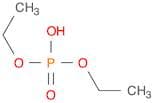
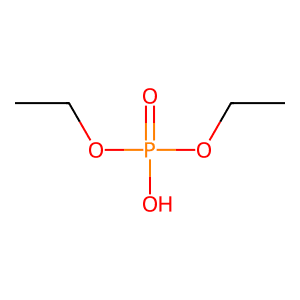
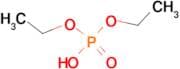
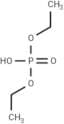
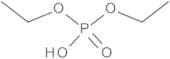
Diéthyl phosphate, avec le numéro CAS 598-02-7, est un composé organophosphoré caractérisé par ses groupes fonctionnels esters dérivés de l'acide phosphorique. Il apparaît sous la forme d'un liquide incolore à jaune pâle avec une légère odeur et est soluble dans l'eau et les solvants organiques. Diéthyl phosphate est connu pour son rôle d'intermédiaire dans la synthèse de divers produits chimiques et comme réactif en chimie organique. Il présente une toxicité modérée et peut agir comme inhibiteur de la cholinestérase, une caractéristique partagée avec d'autres organophosphorés. Le composé a des applications en agriculture en tant que pesticide et dans la production d'ignifugeants. Sa structure chimique comprend deux groupes éthyles attachés à un groupe phosphate, contribuant à sa réactivité et à son interaction avec les systèmes biologiques. Des précautions de sécurité sont essentielles lors de la manipulation de Diéthyl phosphate en raison de ses effets potentiels sur la santé, y compris l'irritation de la peau et des yeux, et son impact environnemental nécessite une élimination et une gestion soigneuses.
Formule :C4H11O4P
InChI :InChI=1S/C4H11O4P/c1-3-7-9(5,6)8-4-2/h3-4H2,1-2H3,(H,5,6)
Code InChI :InChIKey=UCQFCFPECQILOL-UHFFFAOYSA-N
SMILES :P(OCC)(OCC)(=O)O
Synonymes :- Ai3-17002
- Brn 1704113
- Diethyl acid phosphate
- Diethyl hydrogen phosphate
- Diethyl phosphate
- Diethyl phosphoric acid
- Ethyl phosphate ((C<sub>2</sub>H<sub>5</sub>O)<sub>2</sub>(HO)PO)
- Ethyl phosphate, (ETO)2(HO)PO
- Ethyl phosphate, di-
- Jp 502
- Nsc 97178
- O,O-Diethyl hydrogen phosphate
- Ethyl phosphate ((C2H5O)2(HO)PO)
- Voir plus de synonymes
Trier par
Degré de pureté (%)
0
100
|
0
|
50
|
90
|
95
|
100
11 produits concernés.
Diethyl hydrogen phosphate
CAS :Formule :C4H11O4PDegré de pureté :95%Couleur et forme :LiquidMasse moléculaire :154.1015Diethyl hydrogen phosphate
CAS :Diethyl hydrogen phosphateDegré de pureté :95%Masse moléculaire :154.10g/molDiethyl phosphate
CAS :Produit contrôléFormule :C4H11O4PCouleur et forme :NeatMasse moléculaire :154.10Diethyl Hydrogen Phosphate
CAS :Formule :C4H11O4PDegré de pureté :>98.0%(T)Couleur et forme :Colorless to Yellow clear liquidMasse moléculaire :154.10Diethyl phosphate
CAS :Degré de pureté :95.0%Couleur et forme :LiquidMasse moléculaire :154.1020050048828Diethyl phosphate
CAS :Diethyl phosphate (Diethyl phosphoric acid), a Non-Specific Metabolite of Organophosphorus Pesticides.Formule :C4H11O4PDegré de pureté :99.7%Couleur et forme :SolidMasse moléculaire :154.1Phosphoric Acid Diethyl Ester
CAS :Produit contrôléStability Moisture Sensitive
Applications Phosphoric acid diethyl ester is an organophosphate that is usually found in pesticides and is known to induce changes in male hormone profile by decreasing serum testosterone and inhibin B levels. Phosphoric acid diethyl ester is also known to negatively affect the health of women and newborns living in agricultural communities.
Not a dangerous good if item is equal to or less than 1g/ml and there is less than 100g/ml in the package
References Aguilar-Garduno, C., et al.: Toxicology, 307, 55 (2013); Huen, K., et al.: Environ. Res., 117, 8 (2012)Formule :C4H11O4PCouleur et forme :Off-WhiteMasse moléculaire :154.1Diethyl phosphate
CAS :Diethyl phosphate is a phosphorus oxide that reacts with diethyl to form diethyl phosphate. This compound is an enzyme substrate and has a reaction mechanism in which it undergoes hydrogen bonding interactions with sodium carbonate. The hydroxyl group of the diethyl phosphate reacts with the dinucleotide phosphate to form the product, ethylene glycol. Diethyl phosphate is used as an intermediate in the synthesis of various drugs including cannabinoid derivatives, for example, anti-tuberculosis drugs such as pyrazinamide and rifampicin. It also has biological properties that are similar to those of pyrimidine compounds such as 5-fluorouracil and cytosine arabinoside.Formule :C4H11O4PDegré de pureté :Min. 95%Couleur et forme :Clear LiquidMasse moléculaire :154.1 g/mol