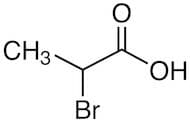
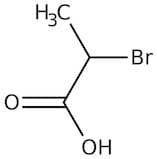
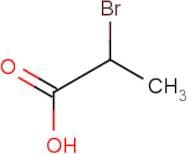
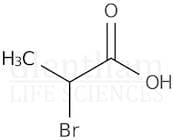
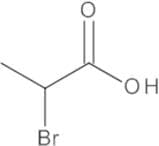
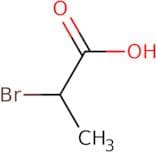
CAS 598-72-1
:Acide 2-bromopropionique
- (2R)-2-bromopropanoate
- (2S)-2-bromopropanoate
- (RS)-2-Bromopropanoic acid
- (RS)-2-Bromopropionic acid
- (RS)-α-Bromopropionic acid
- (±)-α-Bromopropanoic acid
- 2-Bromine Propionic
- 2-Bromopropanoic acid
- 2-Bromopropionic acid
- <span class="text-smallcaps">DL</span>-2-Bromopropionic acid
- <span class="text-smallcaps">DL</span>-α-Bromopropionic acid
- Alpha Bromo Propionic Acid
- DL-2-Bromopropionic
- NSC 172
- Propanoic acid, 2-bromo-
- Propionic acid, 2-bromo-
- Propionic acid, α-bromo-
- Salicylamide O-Acetate Sodium Salt
- Voir plus de synonymes
2-Bromopropionic Acid
CAS :Formule :C3H5BrO2Degré de pureté :>98.0%(GC)(T)Couleur et forme :Colorless to Light yellow to Light orange clear liquidMasse moléculaire :152.982-Bromopropionic acid, 98%
CAS :It is employed as pharmaceutical and agrochemical intermediate. It is used as an alkylation agent for mercaptans and other sulfur containing compounds. This Thermo Scientific Chemicals brand product was originally part of the Alfa Aesar product portfolio. Some documentation and label information maFormule :C3H5BrO2Degré de pureté :98%Couleur et forme :White or translucent to pale yellow, Low-melting fused solid (clear liquid as melt)Masse moléculaire :152.982-Bromopropanoic acid
CAS :2-Bromopropanoic acid
Degré de pureté :98%Couleur et forme :LiquidMasse moléculaire :152.97g/mol2-Bromopropanoic acid
CAS :Formule :C3H5BrO2Degré de pureté :≥ 98.5%Couleur et forme :Colourless, white or yellow liquid or solidMasse moléculaire :152.972-BROMOPROPIONIC ACID
CAS :BR1120 - 2-BROMOPROPIONIC ACID
Formule :C3H5BrO2Degré de pureté := 99% (GC)Couleur et forme :LiquidMasse moléculaire :152.9752-Bromopropionic Acid
CAS :Produit contrôléApplications 2-Bromopropionic Acid is a versatile reactant used in emulsion polymerization in the preparation of reversible addition-fragmentation chain transfer (RAFT) agent.
References Ferguson, C., et al.: Macromolecules, 35, 9243 (2002); Ferguson, C., et al.: Macromolecules, 38, 2191 (2005);Formule :C3H5BrO2Couleur et forme :NeatMasse moléculaire :152.972-Bromopropionic acid
CAS :2-Bromopropionic acid is a tetroxide used in organic synthesis. It is an intermediate in the synthesis of 2,4-dibromopropionamide and 2,4-dibromo-3-methylpentanoic acid. The reaction mechanism of this process starts with the formation of a bromine atom from bromine monoxide and hydrogen peroxide. This bromine atom reacts with the carbon to form an alkyl radical that reacts with another molecule of bromine monoxide to form an alkyl radical that is stabilized by two atoms of hydrogen (i.e., CBr). The alkyl radical then undergoes a nucleophilic attack on iodobenzene to form an iodoalkane intermediate. This intermediate reacts with acetic acid to form the desired product, acetyl chloride. This reaction also produces iodoacetic acid as a byproduct.
Formule :C3H5BrO2Degré de pureté :Min. 95%Masse moléculaire :152.97 g/mol