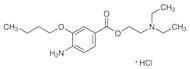
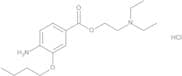
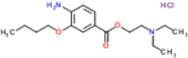
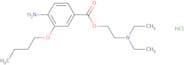
CAS 5987-82-6
:Chlorhydrate d'oxybuprocaïne
Description :
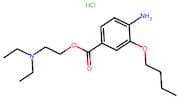
Chlorhydrate d'oxybuprocaïne, également connu sous le nom de proxymétacaïne, est un anesthésique local appartenant à la classe des anesthésiques esters. Il est couramment utilisé en ophtalmologie pour sa capacité à fournir une anesthésie de surface lors de diverses procédures oculaires. La substance apparaît sous forme de poudre cristalline blanche à blanc cassé et est soluble dans l'eau, ce qui facilite son application dans des solutions aqueuses. Chlorhydrate d'oxybuprocaïne agit en bloquant les canaux sodiques, inhibant ainsi la propagation des impulsions nerveuses et entraînant une perte temporaire de sensation dans la zone ciblée. Son début d'action est relativement rapide, et la durée de l'anesthésie peut varier en fonction de la concentration utilisée et de l'application spécifique. Le composé est généralement bien toléré, bien que des effets secondaires potentiels puissent inclure une irritation locale ou des réactions allergiques. En raison de son efficacité et de son profil de sécurité, Chlorhydrate d'oxybuprocaïne est largement utilisé dans les milieux cliniques, en particulier pour les procédures impliquant l'œil, telles que la tonométrie et la chirurgie de la cataracte.
Formule :C17H28N2O3·ClH
InChI :InChI=1S/C17H28N2O3.ClH/c1-4-7-11-21-16-13-14(8-9-15(16)18)17(20)22-12-10-19(5-2)6-3;/h8-9,13H,4-7,10-12,18H2,1-3H3;1H
Code InChI :InChIKey=PRGUDWLMFLCODA-UHFFFAOYSA-N
SMILES :C(OCCN(CC)CC)(=O)C1=CC(OCCCC)=C(N)C=C1.Cl
Synonymes :- 2-(Diethylamino)ethyl 4-amino-3-butoxybenzoate hydrochloride
- 2-[(4-amino-3-butoxybenzoyl)oxy]-N,N-diethylethanaminium chloride
- Benoxil
- Benoxinate Hcl
- Benzoic acid, 4-amino-3-butoxy-, 2-(diethylamino)ethyl ester, hydrochloride (1:1)
- Benzoic acid, 4-amino-3-butoxy-, 2-(diethylamino)ethyl ester, monohydrochloride
- Boxinate
- Cebesine
- Conjucaine
- Conjuncain
- Dorsacaine
- Dorsacaine hydrochloride
- Lacrimin
- Minims
- Novesin
- Novesine
- Oxybuprocaine HCL
- Oxybuprocaine hydrochloride
- Voir plus de synonymes
Trier par
Degré de pureté (%)
0
100
|
0
|
50
|
90
|
95
|
100
15 produits concernés.
Oxybuprocaine Hydrochloride
CAS :Formule :C17H28N2O3·HClDegré de pureté :>98.0%(T)(HPLC)Couleur et forme :White to Light yellow powder to crystalMasse moléculaire :344.88OXYBUPROCAINE HYDROCHLORIDE CRS
CAS :OXYBUPROCAINE HYDROCHLORIDE CRSFormule :C17H29ClN2O3Couleur et forme :Added ModifiedMasse moléculaire :344.8768Oxybuprocaine hydrochloride
CAS :Oxybuprocaine hydrochlorideFormule :C17H28N2O3HClDegré de pureté :99.8%Couleur et forme :WhiteMasse moléculaire :344.18667Benoxinate Hydrochloride
CAS :Aromatic amino-alcohol-phenols, aromatic amino-acid-phenols and other aromatic amino compounds with oxygen functionFormule :C17H28N2O3·HClCouleur et forme :Off-White White PowderMasse moléculaire :308.20999Oxybuprocaine hydrochloride
CAS :Oxybuprocaine hydrochloride (Oxybuprocaine HCl), a local anesthetic, is used especially in otolaryngology and ophthalmology.Formule :C17H29ClN2O3Degré de pureté :>99.99%Couleur et forme :White Crystalline PowderMasse moléculaire :344.88Oxybuprocaine hydrochloride
CAS :Oxybuprocaine hydrochlorideDegré de pureté :≥98%Masse moléculaire :344.88g/molBenoxinate hydrochloride
CAS :Formule :C17H29ClN2O3Couleur et forme :White to off-white powder or crystalsMasse moléculaire :344.88Oxybuprocaine Hydrochloride
CAS :Produit contrôléFormule :C17H28N2O3·ClHCouleur et forme :NeatMasse moléculaire :344.88Benoxinate Hydrochloride
CAS :Produit contrôléApplications Benoxinate is a local anesthetic used in ophthalmology to numb the surface of the eye for a variety of procedures.
References Ogbuehi, K.C., et al.: Clin. Ophthalmol., 6, 871 (2012); Hung, C.H., et al.: Anesthesia. Anal., 110, 238 (2009); Schmidt, A.C., et al.: Pharma. Res., 22, 2121 (2005);Formule :C17H28N2O3·ClHCouleur et forme :NeatMasse moléculaire :344.88Oxybuprocaine hydrochloride
CAS :Produit contrôléOxybuprocaine hydrochloride is a local anesthetic that belongs to the group of x-ray diffraction data. It is a chemical compound that has been shown to be effective in inducing anesthesia in humans. Oxybuprocaine hydrochloride binds to proteins, such as benzalkonium chloride, and inhibits cell growth. It also has an anti-inflammatory effect by preventing the release of prostaglandins. Oxybuprocaine hydrochloride stabilizes chemical bonds and does not react with oxygen or water, making it a suitable candidate for use in eye drops and other solutions for application to skin cells. As well as this, oxybuprocaine hydrochloride can be used as a contrast agent for x-rays when dissolved in human serum or nutrient solution and can be detected using an electrochemical detector.Formule :C17H29ClN2O3Degré de pureté :Min. 95%Couleur et forme :White PowderMasse moléculaire :344.88 g/mol2-(Diethylamino)ethyl 4-amino-3-butoxybenzoate hydrochloride
CAS :Formule :C17H29ClN2O3Degré de pureté :99+%Couleur et forme :SolidMasse moléculaire :344.88Oxybuprocaine hydrochloride
CAS :Produit contrôléOxybuprocaine hydrochloride is a local anesthetic agent that blocks nerve conduction and inhibits the generation of action potentials. It has a high lipid solubility, which allows for rapid onset and short duration of action. Oxybuprocaine hydrochloride is used in the treatment of corneal ulcers, eye disorders, and other conditions where pain relief is desired. The safety and efficacy of oxybuprocaine hydrochloride has been studied in pregnant women, fetal bovine serum, and other animal models. In vitro studies demonstrated that it is chemically stable when exposed to benzalkonium chloride or benoxinate. Clinical relevance in humans has been established by demonstrating that human serum does not contain sufficient quantities of oxybuprocaine to cause toxicity.Formule :C17H29ClN2O3Degré de pureté :Min. 95%Masse moléculaire :344.88 g/mol