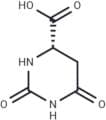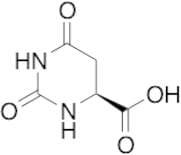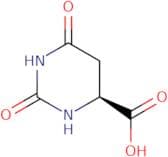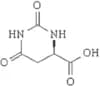
CAS 5988-19-2
:Acide L-dihydroorotique
Description :
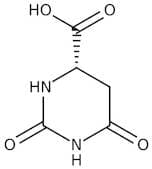
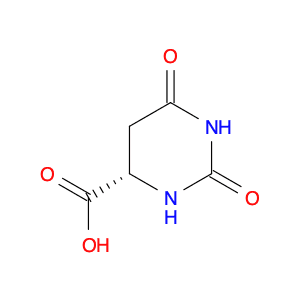
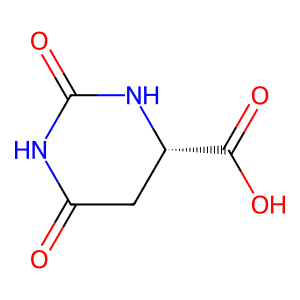
Acide L-dihydroorotique, avec le numéro CAS 5988-19-2, est un dérivé de pyrimidine qui joue un rôle crucial dans la biosynthèse des nucléotides, spécifiquement dans la voie de synthèse de novo des pyrimidines. C'est un solide cristallin blanc à blanc cassé qui est soluble dans l'eau et présente une nature légèrement acide. Le composé se caractérise par sa capacité à subir une oxydation pour former de l'acide orotique, qui est un précurseur important dans la synthèse des acides nucléiques. Acide L-dihydroorotique est impliqué dans divers processus biologiques, y compris le métabolisme cellulaire et la régulation de la croissance cellulaire. Sa formule structurelle comprend un groupe d'acide dihydroorotique, qui présente un cycle de pyrimidine avec deux groupes acides carboxyliques. Ce composé est d'un intérêt en pharmacologie et en biochimie, en particulier pour ses applications thérapeutiques potentielles dans des conditions liées au métabolisme des nucléotides. De plus, il sert de substrat pour des enzymes telles que la dihydroorotate déshydrogénase, qui est une cible pour certains médicaments anticancéreux et immunosuppresseurs.
Formule :C5H6N2O4
InChI :InChI=1/C5H6N2O4/c8-3-1-2(4(9)10)6-5(11)7-3/h2H,1H2,(H,9,10)(H2,6,7,8,11)/t2-/m0/s1
Code InChI :InChIKey=UFIVEPVSAGBUSI-REOHCLBHSA-N
SMILES :C(O)(=O)[C@@H]1CC(=O)NC(=O)N1
Synonymes :- (4S)-2,6-Dioxo-1,3-diazinane-4-carboxylic acid
- (4S)-Hexahydro-2,6-dioxo-4-pyrimidinecarboxylic acid
- (S)-2,6-Dioxohexahydropyrimidine-4-carboxylic acid
- 4-Pyrimidinecarboxylic acid, hexahydro-2,6-dioxo-, (4S)-
- 4-Pyrimidinecarboxylic acid, hexahydro-2,6-dioxo-, (S)-
- <span class="text-smallcaps">L</span>-5,6-Dihydroorotic acid
- <span class="text-smallcaps">L</span>-Dihydroorotate
- <span class="text-smallcaps">L</span>-Dihydroorotic acid
- Hydroorotic acid, <span class="text-smallcaps">L</span>-
- L-Dihydroorotic acid
- Hydroorotic acid, L-
- L-Dihydroorotate
- Adenosine-5'-diphosphoric acid Na2
- Guanosine-5-diphosphate disodiun
- 2,6-Dioxohexahydro-4-pyrimidinecarboxylic acid
- Guanosine-5-monophosphate disodiun
- Adenosine-5-triphosphoric acid Na2
- Deoxyribonucein acid(fish sperm)
- DIHYDRO-L-OROTIC ACID
- Guanosine-5'-triphosphate disodiun
- Inosine-5-triphosphate trisodium
- L-HYDROOROTIC ACID
- Ribonuclein acid,yeast
- (S)-2,6-Dioxohexahydro-4-pyrimidinecarboxylic acid
- (S)-(+)-HYDROOROTIC ACID
- L-4,5-Dihydroorotic acid~(S)-(+)-2,6-Dioxohexahydro-4-pyrimidinecarboxylic acid
- t-Ribonuclein acid,yeast
- (S)-Dihydroorotate
- Voir plus de synonymes
Trier par
Degré de pureté (%)
0
100
|
0
|
50
|
90
|
95
|
100
9 produits concernés.
L-Dihydroorotic acid, 98%
CAS :L-Dihydroorotic acid a metabolite. This Thermo Scientific Chemicals brand product was originally part of the Alfa Aesar product portfolio. Some documentation and label information may refer to the legacy brand. The original Alfa Aesar product / item code or SKU reference has not changed as a part ofFormule :C5H6N2O4Degré de pureté :98%Masse moléculaire :158.11(4S)-2,6-dioxo-1,3-diazinane-4-carboxylic acid
CAS :Formule :C5H6N2O4Degré de pureté :97%Couleur et forme :SolidMasse moléculaire :158.1121L-Dihydroorotic acid
CAS :L-Dihydroorotic acid, found in eukaryotes, is involved in pyrimidine metabolism and several disorders including orotic aciduria.Formule :C5H6N2O4Degré de pureté :99.88% - 99.93%Couleur et forme :White To Off-White Crystalline PowderMasse moléculaire :158.11L-Dihydroorotic acid
CAS :Produit contrôléApplications L-Dihydroorotic acid is used as a reactant in the preparation of long acting Gonadotrophin-releasing hormone (GnRH) antagonist containing p-ureido-phenylalanine.
References Jiang, G., et al.: J. Med. Chem., 44, 453 (2001);Formule :C5H6N2O4Couleur et forme :NeatMasse moléculaire :158.11L-Dihydroorotic acid
CAS :L-Dihydroorotic acid is a natural compound that can be found in plants, animals and humans. It has been shown to have an important role in mitochondrial functions, as it is involved in the synthesis of NADH and ATP. L-Dihydroorotic acid can also be used as a substrate for enzymatic reactions, such as dehydrogenase or dihydroorotate dehydrogenase. The rate constants for these reactions are high, which makes L-dihydroorotic acid a good model system for studying biochemical properties. L-dihydroorotic acid also inhibits cyclin D2/CDK4 protein kinases.Formule :C5H6N2O4Degré de pureté :Min. 95%Couleur et forme :White PowderMasse moléculaire :158.11 g/molL-Dihydroorotic acid
CAS :Formule :C5H6N2O4Degré de pureté :97%Couleur et forme :SolidMasse moléculaire :158.113