CAS 60-32-2
:Acide 6-aminohexanoïque
Description :
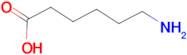
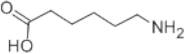
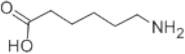
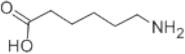
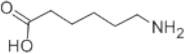
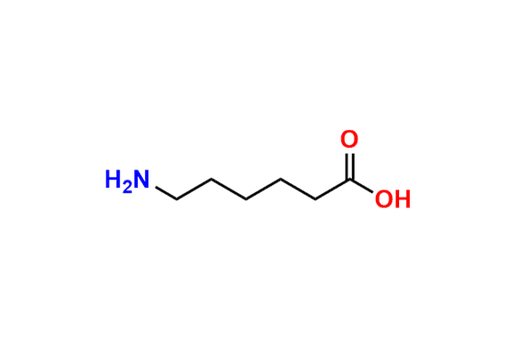
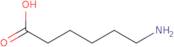
Acide 6-aminohexanoïque, également connu sous le nom d'acide ε-aminocaproïque, est un acide aminé à six carbones avec la formule moléculaire C6H13NO2. Il présente un groupe amino (-NH2) et un groupe acide carboxylique (-COOH) sur sa chaîne carbonée, ce qui en fait un composé polyvalent dans les applications biochimiques. Ce solide cristallin incolore est soluble dans l'eau et présente une nature légèrement acide en raison de son groupe acide carboxylique. Acide 6-aminohexanoïque est principalement utilisé dans la synthèse de polyamides, en particulier le nylon-6, et sert de bloc de construction dans diverses réactions chimiques. De plus, il a des applications en médecine, notamment en tant qu'agent antifibrinolytique pour réduire les saignements pendant la chirurgie. Le composé est généralement considéré comme sûr lorsqu'il est utilisé correctement, mais il peut provoquer des effets secondaires chez certaines personnes. Ses propriétés structurelles lui permettent de participer à diverses voies biochimiques, ce qui le rend significatif tant dans les contextes industriels que pharmaceutiques.
Formule :C6H13NO2
InChI :InChI=1S/C6H13NO2/c7-5-3-1-2-4-6(8)9/h1-5,7H2,(H,8,9)
Code InChI :InChIKey=SLXKOJJOQWFEFD-UHFFFAOYSA-N
SMILES :C(CC(O)=O)CCCN
Synonymes :- 177 J.D.
- 6-Amino-n-hexanoic acid
- 6-Aminohexanoate
- 6-Aminohexanoic acid
- A 14719
- ACS
- Acepramin
- Acepramine
- Acide aminocaproique
- Acido Aminocaproico
- Acikaprin
- Afibrin
- Amicar
- Amikar
- Aminocaproic acid
- Aminocapronsaure
- Aminokapron
- An 0064-1
- Caplamin
- Capramol
- Caprocid
- Caproic acid, ε-amino-
- Caprolisin
- Cl 10304
- Cy 116
- E-Aminocaproic Acid
- Eaca
- Eacs
- Epsamon
- Epsicapron
- Epsikapron
- Epsilcapramin
- Epsilon S
- Epsilon-Aminocapronsaeure
- H-6-Aca-OH
- H-6-Ahx-OH
- H-EAhx-OH
- Hemocaprol
- Hemopar
- Hepin
- Hexanoic acid, 6-amino-
- Ipsilon
- Nsc 212532
- Nsc 26154
- Nsc 400230
- Respramin
- epsilon-Aminocaproic acid
- ε-Amino-n-caproic acid
- ε-Amino-n-hexanoic acid
- ε-Aminohexanoic acid
- ε-Leucine
- ε-Norleucine
- ω-Aminocaproic acid
- Voir plus de synonymes
Filtrer par
Pourcentage de pureté
0
100
|
0
|
50
|
90
|
95
|
100
- Tri par prix ascendant
- Tri par prix descendant
- Puretés inférieures
- Puretés supérieures
- Livraison estimée la plus rapide
Aminocaproic Acid in Water
CAS :WaterFormule :C6H13NO2Couleur et forme :SolidMasse moléculaire :131.176-Aminocaproic acid
CAS :Formule :C6H13NO2Degré de pureté :97%Couleur et forme :SolidMasse moléculaire :131.1756-Aminocaproic Acid extrapure, 99%
CAS :Formule :C6H13NO2Degré de pureté :min. 99%Couleur et forme :White, Crystalline powder, Clear, ColourlessMasse moléculaire :131.17Aminocaproic Acid IP
CAS :Formule :C6H13NO2Degré de pureté :98.5 - 101.0%Couleur et forme :Colourless or white, Crystals, crystalline powder, 20% aq. solution clear and colourless for 24 hrs.Masse moléculaire :131.17Aminocaproic Acid BP, 98.5-101%
CAS :Formule :C6H13NO2Degré de pureté :98.5 - 101.0%Couleur et forme :Whiteor almost white , Colourless, Crystalline powder, Crystals, Clear on standing standing 24hrs., Colourless, Solution S is colourless and remains clear on standing 24 hrs.Masse moléculaire :131.17Aminocaproic Acid USP, 98.5-101%
CAS :Formule :C6H13NO2Degré de pureté :98.5 -101.5% (On anhydrous bassis)Couleur et forme :White or almost white , colourless, Crystalline powder or crystalsMasse moléculaire :131.17Aminocaproic acid
CAS :Aminocaproic acid is a non-specific lysing agent that is used in the treatment of acute blood clots. Aminocaproic acid has minimal toxicity and low-dose effects, and can be used for the treatment of thrombotic disorders. It also has biological properties that are different from those of aminocaproate, which can lead to a more rapid dissolution of the clot. Aminocaproic acid is an organic compound that belongs to the class of dicarboxylic acids. It is synthesized from two molecules of aminoacetic acid by the enzyme aminocaproic acid synthetase. The synthesis occurs in a two-step process: first, caprylic acid reacts with ATP to form aminopropyl-adenylate (APA), followed by hydrolysis by APA lyase to form aminocaproic acid.Formule :C6H13NO2Couleur et forme :PowderMasse moléculaire :131.17 g/mol