CAS 601-75-2
:Acide éthylmalonique
Description :
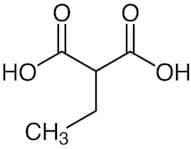
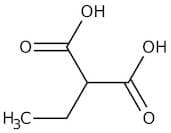
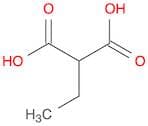
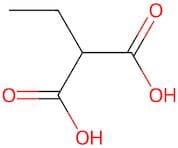
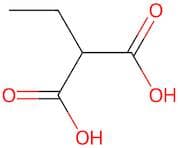
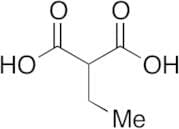
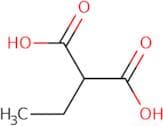
Acide éthylmalonique, avec le numéro CAS 601-75-2, est un acide dicarboxylique caractérisé par ses deux groupes fonctionnels carboxyles (-COOH) et un groupe éthyle attaché au carbone central. Il apparaît sous forme de solide cristallin blanc et est soluble dans l'eau, ce qui est typique de nombreux acides dicarboxyliques. Acide éthylmalonique est connu pour son rôle dans diverses voies biochimiques, en particulier dans le métabolisme des acides gras et des acides aminés. Il peut agir comme un intermédiaire dans la synthèse d'autres composés organiques. Le composé a un point de fusion relativement bas et peut subir des réactions typiques associées aux acides carboxyliques, telles que l'esterification et la décarboxylation. De plus, il a été étudié pour ses implications potentielles dans certains troubles métaboliques, en particulier ceux liés à la fonction mitochondriale. Sa formule structurelle permet la formation de divers dérivés, ce qui en fait un composé polyvalent dans la synthèse organique et la recherche biochimique.
Formule :C5H8O4
InChI :InChI=1S/C5H8O4/c1-2-3(4(6)7)5(8)9/h3H,2H2,1H3,(H,6,7)(H,8,9)
Code InChI :InChIKey=UKFXDFUAPNAMPJ-UHFFFAOYSA-N
SMILES :C(C(O)=O)(C(O)=O)CC
Synonymes :- 1,1-Propanedicarboxylic acid
- 2-Ethylmalonic acid
- 2-Ethylpropanedioic acid
- Ethylpropanedioate
- Ethylpropanedioic Acid
- Malonic acid, ethyl-
- Malonic acid, ethyl- (8CI)
- Nsc 96615
- Propanedioic acid, 2-ethyl-
- Propanedioic acid, ethyl-
- Propanedioic acid, ethyl- (9CI)
- alpha-Carboxybutyric acid
- α-Carboxybutyric acid
- 2-CARBOXY BUTYRIC ACID
- Ethylmalonicacid,98%
- Ethyl propoinic acid
- ETHYLMALONIC ACID
- Voir plus de synonymes
Trier par
Degré de pureté (%)
0
100
|
0
|
50
|
90
|
95
|
100
10 produits concernés.
Ethylmalonic Acid
CAS :Formule :C5H8O4Degré de pureté :>98.0%(T)Couleur et forme :White to Almost white powder to crystalMasse moléculaire :132.12Ethylmalonic acid, 97+%
CAS :Ethylmalonic acid is a important organic intermediate. It can be used in agrochemical, pharmaceutical and dyestuff field. This Thermo Scientific Chemicals brand product was originally part of the Alfa Aesar product portfolio. Some documentation and label information may refer to the legacy brand. ThFormule :C5H8O4Degré de pureté :97+%Couleur et forme :Crystals or powder or crystalline powder, WhiteMasse moléculaire :132.122-Ethylmalonic acid
CAS :Formule :C5H8O4Degré de pureté :97%Couleur et forme :SolidMasse moléculaire :132.1146Ethylmalonic acid
CAS :Ethylmalonic acid, found in blood, CSF, urine, and various tissues, is linked to metabolic disorders and anorexia, but is non-carcinogenic.Formule :C5H8O4Degré de pureté :99.88%Couleur et forme :LiquidMasse moléculaire :132.11Ethylmalonic Acid
CAS :Applications Ethylmalonic Acid is used as a diagnostic agent used in the diagnosis of Ethylmalonic encephalopathy which is a rare autosomal recessive inborn error of metabolism.
References Baertling, F. et al.: Eur. J. Pediat., 173, 1719 (2014); Sudo, Y. et al.: Hu,am Genome Var., 1, 15016 (2014);Formule :C5H8O4Couleur et forme :NeatMasse moléculaire :132.122-Ethylmalonic acid
CAS :Formule :C5H8O4Degré de pureté :97%Couleur et forme :SolidMasse moléculaire :132.115Ethylmalonic Acid
CAS :Ethylmalonic acid (EA) is a metabolic intermediate that is synthesized in the mitochondria. It is a product of the oxidation of malonyl-CoA and succinyl-CoA by the enzyme dehydrogenase. EA has been shown to be produced in vivo, and can be used as a marker for mitochondrial dysfunction. EA levels are increased in patients with metabolic disorders such as diabetes mellitus and obesity, as well as other diseases such as cancer, Alzheimer’s disease, Parkinson’s disease, Huntington’s disease, multiple sclerosis, amyotrophic lateral sclerosis (ALS), heart failure, chronic obstructive pulmonary disorder (COPD), kidney diseases, liver diseases and anemia. EA levels can also be used to diagnose mitochondrial disorders such as mitochondrial DNA depletion syndrome and Kearns-Sayre syndrome.Formule :C5H8O4Degré de pureté :Min. 95%Masse moléculaire :132.11 g/mol