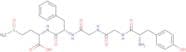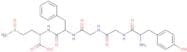
CAS 60283-51-4
:(Met(O)5)-Encéphaline
Description :
(Met(O)5)-Encéphaline, également connu comme une forme modifiée du peptide opioïde endogène enképhaline, se caractérise par la substitution du résidu de méthionine par un dérivé de sulfoxide, ce qui améliore sa stabilité et sa bioactivité. Ce composé fait partie de la famille des peptides opioïdes, qui joue un rôle crucial dans la modulation de la douleur et la neurotransmission. La modification à la position de la méthionine altère ses propriétés pharmacologiques, augmentant potentiellement son affinité pour les récepteurs opioïdes. (Met(O)5)-Encéphaline présente une structure spécifique qui lui permet d'interagir avec le récepteur mu-opioïde, contribuant à ses effets analgésiques. De plus, sa solubilité et sa stabilité dans les systèmes biologiques peuvent être améliorées grâce aux modifications, ce qui en fait un sujet d'intérêt en chimie médicinale et en développement de médicaments. Les caractéristiques uniques du composé, y compris sa nature peptidique et l'acide aminé modifié, le positionnent comme un outil précieux pour étudier les interactions des récepteurs opioïdes et développer de nouvelles thérapies analgésiques.
Formule :C27H35N5O8S
InChI :InChI=1/C27H35N5O8S/c1-41(40)12-11-21(27(38)39)32-26(37)22(14-17-5-3-2-4-6-17)31-24(35)16-29-23(34)15-30-25(36)20(28)13-18-7-9-19(33)10-8-18/h2-10,20-22,33H,11-16,28H2,1H3,(H,29,34)(H,30,36)(H,31,35)(H,32,37)(H,38,39)/t20-,21-,22-,41?/m0/s1
SMILES :CS(=O)CC[C@@H](C(=O)O)N=C([C@H](Cc1ccccc1)N=C(CN=C(CN=C([C@H](Cc1ccc(cc1)O)N)O)O)O)O
Synonymes :- H-Tyr-Gly-Gly-Phe-Met(O)-OH
- L-tyrosylglycylglycyl-N-[(1S)-1-carboxy-3-(methylsulfinyl)propyl]-L-phenylalaninamide
Trier par
Degré de pureté (%)
0
100
|
0
|
50
|
90
|
95
|
100
2 produits concernés.
(Met(O)5)-Enkephalin
CAS :Met-enkephalin is a molecule that is formed from two of the three parts of the endorphin molecule, which are Tyr-Gly-Gly-Phe and Met(O)OH. It is a neurotransmitter that has been shown to inhibit pain in humans and animals. In coelomocytes, met-enkephalin binds to receptors on the cell membrane and inhibits the release of dopamine by binding to dopamine receptors. The sulfoxide group of this molecule can be reduced to form enkephalinase, which is an enzyme that cleaves Met(O)OH from the peptide chain. This process is not known to occur in humans or other mammals. Met-enkephalin has been localized in ganglia cells in animals, but not humans. It has also been found in messenger RNA (mRNA) for translation into protein, but it does not appear to be translated into protein in humans or other mammals.Formule :C27H35N5O8SDegré de pureté :Min. 95%Masse moléculaire :589.66 g/mol(Met(O)5)-Enkephalin
CAS :Enkephalins are a group of endogenous peptides that are the most potent natural analgesic and have been shown to relieve pain by inhibiting neurotransmitters. The (Met(O)5)-enkephalin analog is a structural analog of the enkephalin peptide with a sulfoxide linkage at position 5. This analog has been shown to inhibit acetylcholine release from intestinal ganglia, which may be related to its effects on postsynaptic potentials and glutamate release. This compound also absorbs in the small intestine, where it is taken into the blood stream and transported to the brain. The (Met(O)5)-enkephalin analog has been shown to reduce pain in Sprague-Dawley rats, as well as inhibit intestinal transit time and stimulate intestinal motility.
Formule :C27H35N5O8SDegré de pureté :Min. 95%Masse moléculaire :589.67 g/mol