CymitQuimica logo

CAS 603-00-9

:

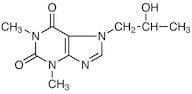
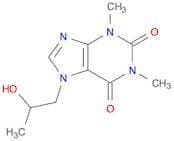
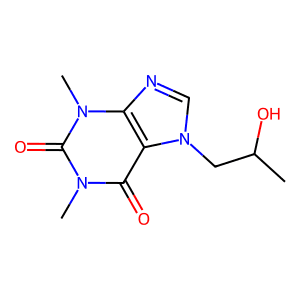
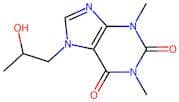
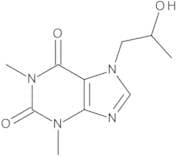
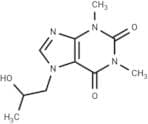
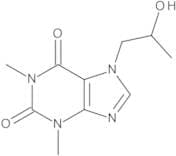
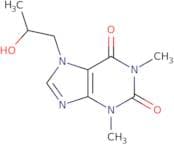
Proxiphylline

Description :
Proxiphylline est un composé chimique classé comme un dérivé de xanthine, principalement connu pour ses propriétés bronchodilatatrices. Il est souvent utilisé dans le traitement des affections respiratoires telles que l'asthme et la maladie pulmonaire obstructive chronique (MPOC) en raison de sa capacité à détendre les muscles lisses bronchiques et à améliorer le flux d'air. Le composé a une formule moléculaire qui inclut des éléments tels que le carbone, l'hydrogène, l'azote et l'oxygène, contribuant à son activité pharmacologique. Proxiphylline présente une solubilité modérée dans l'eau et est généralement administré par voie orale. Son mécanisme d'action implique l'inhibition de la phosphodiestérase, entraînant une augmentation des niveaux d'AMP cyclique, ce qui favorise la bronchodilatation. De plus, Proxiphylline peut avoir des effets diurétiques légers. Comme pour tout médicament, il est essentiel de prendre en compte les effets secondaires potentiels, qui peuvent inclure des troubles gastro-intestinaux et des effets cardiovasculaires. Dans l'ensemble, Proxiphylline est un agent thérapeutique précieux dans la gestion des maladies respiratoires, bien que son utilisation puisse être limitée par la disponibilité de nouveaux médicaments avec des profils d'efficacité et de sécurité améliorés.
Formule :C10H14N4O3
InChI :InChI=1S/C10H14N4O3/c1-6(15)4-14-5-11-8-7(14)9(16)13(3)10(17)12(8)2/h5-6,15H,4H2,1-3H3
Code InChI :InChIKey=KYHQZNGJUGFTGR-UHFFFAOYSA-N
SMILES :C(C(C)O)N1C2=C(N(C)C(=O)N(C)C2=O)N=C1
Synonymes :
  • (±)-Proxyphyllin
  • 1,3-Dimethyl-7-(2-hydroxypropyl)xanthine
  • 1H-Purine-2,6-dione, 3,7-dihydro-7-(2-hydroxypropyl)-1,3-dimethyl-
  • 2,6-Dioxo-3,7-dihydro-7-(2-hydroxypropyl)-1,3-dimethylpurine
  • 2-Hydroxypropyl-7-theophylline
  • 3,7-Dihydro-7-(2-hydroxypropyl)-1,3-dimethyl-1H-purine-2,6-dione
  • 7-(2-Hydroxypropyl)Theophylline
  • 7-(2-hydroxypropyl)-1,3-dimethyl-3,7-dihydro-1H-purine-2,6-dione
  • 7-(β-Hydroxypropyl)-1,3-dimethylxanthine
  • Brontyl
  • Voir plus de synonymes
Trier par

Degré de pureté (%)
0
100
|
0
|
50
|
90
|
95
|
100
13 produits concernés.
  • Proxyphylline

    CAS :
    Formule :C10H14N4O3
    Degré de pureté :>98.0%(HPLC)(N)
    Couleur et forme :White to Almost white powder to crystal
    Masse moléculaire :238.25

    Ref: 3B-H1430

    5g
    48,00€
    25g
    137,00€
  • PROXYPHYLLINE CRS

    CAS :
    PROXYPHYLLINE CRS
    Formule :C10H14N4O3
    Couleur et forme :Crystalline Powder. White. Powder.
    Masse moléculaire :238.2432

    Ref: 41-P3800000

    100mg
    132,00€
  • 7-(2-hydroxypropyl)-1,3-dimethyl-2,3,6,7-tetrahydro-1H-purine-2,6-dione

    CAS :
    Formule :C10H14N4O3
    Degré de pureté :98%
    Couleur et forme :Solid
    Masse moléculaire :238.2432

    Ref: IN-DA00IAOH

    1g
    37,00€
    5g
    68,00€
    25g
    189,00€
    250mg
    33,00€
  • 7-(2-Hydroxypropyl)theophylline

    CAS :
    7-(2-Hydroxypropyl)theophylline
    Degré de pureté :99%
    Masse moléculaire :238.24g/mol

    Ref: 54-OR1012044

    1g
    36,00€
    5g
    57,00€
    25g
    197,00€
    100g
    695,00€
    250mg
    32,00€
  • Proxyphylline

    CAS :
    Proxyphylline
    Degré de pureté :≥98%
    Masse moléculaire :238.24g/mol

    Ref: 54-BUP18231

    1g
    86,00€
    2g
    119,00€
    200mg
    51,00€
    500mg
    66,00€
  • Proxyphylline

    Produit contrôlé
    CAS :
    Formule :C10H14N4O3
    Couleur et forme :Neat
    Masse moléculaire :238.24

    Ref: 86-MM1284.00

    250mg
    À demander
  • Proxyphylline

    CAS :
    Proxyphylline (7-(2-Hydroxypropyl)theophylline) is a dual of adenosine A1/A2a receptor inhibitor and phosphodiesterase (PDE) inhibitor.
    Formule :C10H14N4O3
    Degré de pureté :99.48%
    Couleur et forme :Solid
    Masse moléculaire :238.24

    Ref: TM-T5940

    1g
    34,00€
    1mL*10mM (DMSO)
    49,00€
  • Proxyphylline

    CAS :
    Formule :C10H14N4O3
    Masse moléculaire :238.25

    Ref: 4Z-T-6044

    5mg
    À demander
    10mg
    À demander
    25mg
    À demander
    50mg
    À demander
    100mg
    À demander
  • 7-(2-Hydroxypropyl)-1,3-dimethyl-1H-purine-2,6(3H,7H)-dione

    CAS :
    Formule :C10H14N4O3
    Degré de pureté :95.0%
    Masse moléculaire :238.247

    Ref: 10-F324007

    1g
    29,00€
    5g
    74,00€
    25g
    224,00€
    250mg
    23,00€
  • 7-(beta-Hydroxypropyl)theophylline

    Produit contrôlé
    CAS :

    Applications A metabolite of Theophylline in human plasma.
    References Young, R., et al.: J. Med. Chem., 28, 201 (1993), Abraham, M., et al.: J. Pharm. Sci., 83, 1085 (1994), Caron, G., et al.: J. Med. Chem., 48, 3269 (2005),

    Formule :C10H14N4O3
    Couleur et forme :Neat
    Masse moléculaire :238.24

    Ref: TR-H952640

    10mg
    86,00€
    100mg
    127,00€
  • Diprophylline EP Impurity D

    CAS :
    Formule :C10H14N4O3
    Masse moléculaire :238.2

    Ref: ST-EA-CP-D166004

    10mg
    À demander
    25mg
    À demander
    50mg
    À demander
    100mg
    À demander
  • Proxyphylline

    CAS :
    Formule :C10H14N4O3
    Masse moléculaire :238.25

    Ref: ST-EA-CP-P405000

    10mg
    À demander
    25mg
    À demander
    50mg
    À demander
    100mg
    À demander
  • Proxylphylline

    Produit contrôlé
    CAS :

    Proxylphylline is a methylxanthine drug that is used to treat bronchial asthma. It is an anti-inflammatory agent that acts by inhibiting phosphodiesterases, which are enzymes that break down cyclic nucleotides such as cAMP and cGMP. Proxylphylline has been shown to have inotropic effects on the heart, increasing the force of contraction and decreasing the time between contractions. This drug also reverses the bronchoconstricting effects of allergens. Proxylphylline is absorbed into cells through a chloride channel and then converted to theophylline before it inhibits phosphodiesterases. Theophylline is metabolized in the liver to 3-methylxanthine, 1-methyluric acid, and 1-methylurate.

    Degré de pureté :Min. 95%