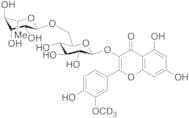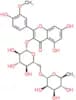
CAS 604-80-8
:Narcissine
Description :
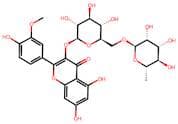
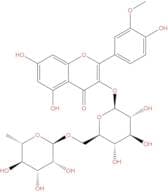
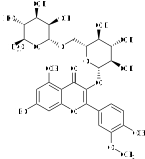
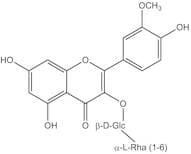
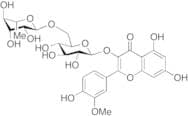
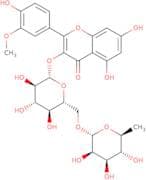
Narcissine, avec le numéro CAS 604-80-8, est un glycoside flavonoïde principalement trouvé dans diverses espèces végétales, en particulier dans la famille des Amaryllidaceae. Il se caractérise par sa structure chimique, qui consiste en un aglycone flavonoïde lié à un moiety de sucre, typiquement du glucose. Narcissine présente des propriétés antioxydantes, contribuant à ses potentiels bienfaits pour la santé, y compris des activités anti-inflammatoires et anticancéreuses. Ce composé est souvent étudié pour son rôle dans la médecine traditionnelle et ses effets sur la santé humaine. En termes de solubilité, Narcissine est généralement soluble dans des solvants polaires, ce qui est typique pour de nombreux glycosides flavonoïdes. Sa stabilité peut être influencée par des facteurs tels que le pH et la température, ce qui rend important de considérer ces conditions dans des environnements expérimentaux. De plus, la présence de Narcissine dans diverses plantes souligne son importance écologique, car elle peut jouer un rôle dans les mécanismes de défense des plantes contre les herbivores et les pathogènes. Dans l'ensemble, Narcissine est un composé d'intérêt tant dans la recherche pharmacologique que dans la chimie des produits naturels.
Formule :C28H32O16
InChI :InChI=1S/C28H32O16/c1-9-18(32)21(35)23(37)27(41-9)40-8-16-19(33)22(36)24(38)28(43-16)44-26-20(34)17-13(31)6-11(29)7-15(17)42-25(26)10-3-4-12(30)14(5-10)39-2/h3-7,9,16,18-19,21-24,27-33,35-38H,8H2,1-2H3/t9-,16+,18-,19+,21+,22-,23+,24+,27+,28-/m0/s1
Code InChI :InChIKey=UIDGLYUNOUKLBM-GEBJFKNCSA-N
SMILES :O(C1=C(OC=2C(C1=O)=C(O)C=C(O)C2)C3=CC(OC)=C(O)C=C3)[C@@H]4O[C@H](CO[C@H]5[C@H](O)[C@H](O)[C@@H](O)[C@H](C)O5)[C@@H](O)[C@H](O)[C@H]4O
Synonymes :- 3'-Methylquercetin 3-O-rutinoside
- 3-O-Rutinosylisorhamnetin
- 3-[[6-O-(6-Deoxy-α-<span class="text-smallcaps">L</smallcap>-mannopyranosyl)-β-<smallcap>D</span>-glucopyranosyl]oxy]-5,7-dihydroxy-2-(4-hydroxy-3-methoxyphenyl)-4H-1-benzopyran-4-one
- 3′-O-Methylquercetin 3-rutinoside
- 4H-1-Benzopyran-4-one, 3-[[6-O-(6-deoxy-α-<span class="text-smallcaps">L</smallcap>-mannopyranosyl)-β-<smallcap>D</span>-glucopyranosyl]oxy]-5,7-dihydroxy-2-(4-hydroxy-3-methoxyphenyl)-
- 4H-1-benzopyran-4-one, 3-[[6-O-(6-deoxy-alpha-L-mannopyranosyl)-beta-D-glucopyranosyl]oxy]-5,7-dihydroxy-2-(4-hydroxy-3-methoxyphenyl)-
- 5,7-dihydroxy-2-(4-hydroxy-3-methoxyphenyl)-4-oxo-4H-chromen-3-yl 6-O-(6-deoxy-a-L-mannopyranosyl)-b-D-glucopyranoside
- 5,7-dihydroxy-2-(4-hydroxy-3-methoxyphenyl)-4-oxo-4H-chromen-3-yl 6-O-(6-deoxy-α-D-mannopyranosyl)-β-D-glucopyranoside
- Isorhamentin 3-O-β-<span class="text-smallcaps">D</span>-rutinoside
- Isorhamnetin 3-O-(6′′-O-α-<span class="text-smallcaps">L</smallcap>-rhamnopyransoyl)-β-<smallcap>D</span>-glucopyranoside
- Isorhamnetin 3-O-rutinoside
- Isorhamnetin 3-O-α-<span class="text-smallcaps">L</smallcap>-rhamnosyl(1→6)-β-<smallcap>D</span>-glucopyranoside
- Isorhamnetin 3-O-α-rhamnopyranosyl-(1→6)-β-glucopyranoside
- Isorhamnetin 3-O-β-<span class="text-smallcaps">D</smallcap>-(6-O-α-<smallcap>L</span>-rhamnosyl)glucoside
- Isorhamnetin 3-O-β-<span class="text-smallcaps">D</smallcap>-(6′′-O-α-<smallcap>L</span>-rhamnopyranosyl)glucopyranoside
- Isorhamnetin 3-O-β-rutinoside
- Isorhamnetin 3-rhamnoglucoside
- Isorhamnetin 3-β-<span class="text-smallcaps">D</smallcap>-glucopyranosyl-(6→1)-<smallcap>L</span>-rhamnopyranoside
- Isorhamnetin 3-β-O-rutinoside
- Isorhamnetin 3β-rutinoside
- Isorhamnetin rutinoside
- Isorhamnetin-3-O-β-<span class="text-smallcaps">D</span>-rutinoside
- Isorhamnetin-3-Rutinoside
- Isorhamnetol 3-O-rutinoside
- Narcissoside
- Quercetin 3′-O-methyl-3-O-α-<span class="text-smallcaps">L</smallcap>-rhamnopyranosyl(1→6)-β-<smallcap>D</span>-glucopyranoside
- 3-[[6-O-(6-Deoxy-α-L-mannopyranosyl)-β-D-glucopyranosyl]oxy]-5,7-dihydroxy-2-(4-hydroxy-3-methoxyphenyl)-4H-1-benzopyran-4-one
- Narcissin
- Voir plus de synonymes
Trier par
Degré de pureté (%)
0
100
|
0
|
50
|
90
|
95
|
100
14 produits concernés.
Isorhamnetin-3-O-rutinoside
CAS :Isorhamnetin-3-O-rutinoside analytical standard provided with w/w absolute assay, to be used for quantitative titration.Formule :C28H32O16Degré de pureté :(HPLC) ≥99%Couleur et forme :PowderMasse moléculaire :624.56Isorhamnetin-3-O-Rutinoside
CAS :Other glycosides, natural or reproduced by synthesis, and their salts, ethers, esters and other derivativesFormule :C28H32O16Couleur et forme :Yellow PowderMasse moléculaire :624.169034H-1-Benzopyran-4-one,3-[[6-O-(6-deoxy-a-L-mannopyranosyl)-b-D-glucopyranosyl]oxy]-5,7-dihydroxy-2-(4-hydroxy-3-methoxyphenyl)-
CAS :Formule :C28H32O16Degré de pureté :98%Couleur et forme :SolidMasse moléculaire :624.5441Narcissoside
CAS :Formule :C28H32O16Degré de pureté :≥ 95.0%Couleur et forme :Pale yellow to yellow powderMasse moléculaire :624.55Narcissoside
CAS :Narcissoside is a good 15-LO and α-glucosidase inhibitor, it with synergism of B.flavum flavonoid and rutin, could be responsible for stronger protection against mitochondrial induced oxidative stress.Formule :C28H32O16Degré de pureté :95%~99%Masse moléculaire :624.548Narcissin
CAS :Narcissin (isorhamnetin 3-rutin) acts synergistically with flavonoids and rutin and may be more protective against mitochondria-induced oxidative stress.Formule :C28H32O16Degré de pureté :99.88% - 99.91%Couleur et forme :SolidMasse moléculaire :624.54Ref: TM-T6S1768
1mg46,00€5mg94,00€10mg119,00€1mL*10mM (DMSO)124,00€25mg193,00€50mg286,00€100mg423,00€Isorhamnetin 3-rutinoside
CAS :Natural glycosideFormule :C28H32O16Degré de pureté :≥ 95.0 % (HPLC)Couleur et forme :PowderMasse moléculaire :624.55Narcissoside
CAS :Applications Narcissoside is a flavonoid from Nitraria tangutorum. Narcissoside may have antiproliferative activity in human colon cancer cell line (HT29).
References Wu, Z., et. al.: Chem. Nat. Compnd., 49, 1125 (2014); Serra, A.T., et. al.: Food Res. Int., 54, 892 (2013)Formule :C28H32O16Couleur et forme :NeatMasse moléculaire :624.54Narcissin
CAS :Narcissin is a flavonoid glycoside, which is a bioactive compound isolated from the Narcissus species, particularly found in various plant parts of the genus Narcissus. The source of narcissin is primarily within the botanical family Amaryllidaceae, known for its diverse metabolic profile and prominent ornamental species.Formule :C28H32O16Degré de pureté :Min. 95%Couleur et forme :PowderMasse moléculaire :624.54 g/molNarcissoside-d3
CAS :Produit contrôléFormule :C28D3H29O16Couleur et forme :NeatMasse moléculaire :627.563
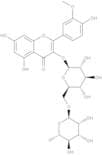


![4H-1-Benzopyran-4-one,3-[[6-O-(6-deoxy-a-L-mannopyranosyl)-b-D-glucopyranosyl]oxy]-5,7-dihydroxy-2…](/_next/image/?url=https%3A%2Fstatic.cymitquimica.com%2Fproducts%2FIN%2Fthumb%2FDA00IKM7.jpg&w=3840&q=75)