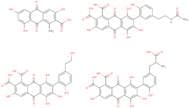
CAS 60687-93-6
:Acide laccaïque
Description :
Acide laccaïque, avec le numéro CAS 60687-93-6, est un composé organique naturel dérivé principalement de l'insecte lac, qui le sécrète comme partie de sa résine. Ce composé est classé comme un acide polyphénolique et est connu pour sa couleur brun rougeâtre distinctive, qui est attribuée à sa structure contenant plusieurs groupes hydroxyles. Acide laccaïque présente des propriétés antioxydantes, ce qui le rend intéressant dans diverses applications, y compris la conservation des aliments et les cosmétiques. Il est soluble dans des solvants organiques mais a une solubilité limitée dans l'eau. Le composé est également reconnu pour son utilisation potentielle dans la teinture et comme colorant naturel en raison de sa teinte vibrante. De plus, Acide laccaïque a été étudié pour ses propriétés antimicrobiennes, qui peuvent contribuer à son utilité dans diverses applications industrielles. Dans l'ensemble, Acide laccaïque représente un exemple fascinant d'un composé naturel avec des applications diverses dans des contextes à la fois traditionnels et modernes.
Formule :Unspecified
Synonymes :- C.I. Natural Red 25
- Lac
- Laccaic acid
- C.I. 75450
- Lac dye
Trier par
Degré de pureté (%)
0
100
|
0
|
50
|
90
|
95
|
100
5 produits concernés.
Laccaic acid
CAS :Formule :C91H62N2O44Degré de pureté :99%Couleur et forme :SolidMasse moléculaire :1887.4530Laccaic Acid (Technical Grade)
CAS :Produit contrôléApplications Laccaic acid (cas# 60687-93-6) is an organic dye with antimicrobial properties towards various pathogenic bacteria and fungi. Laccaic acid is also used as a component of solar cells due to its photoelectric properties.
References Srivastava, S.; et al.: Indian J. Med. Microbiol., 57, 470 (2017); Ren, P.; et al.: J. Mol. Liq., 247, 193 (2017).Formule :C91H62N2O44Couleur et forme :NeatMasse moléculaire :1887.45Laccaic acid
CAS :Laccaic acid is a chemical compound that is composed of carbon, hydrogen, oxygen, and sulfur. It has been used as a precursor to sodium carbonate (soda ash) in the production of glass, soap, and textiles. Laccaic acid can be obtained by reacting sodium carbonate with fatty acids or with inorganic acids such as hydrochloric acid. Laccaic acid inhibits the activity of enzymes such as catalase and peroxidase that are involved in cell death. The toxicity of laccaic acid has been studied extensively in hamster V79 cells; it was found to induce necrotic cell death at high concentrations (>1 mM). Laccaic acid also has potent antitumor activity when combined with other anticancer drugs.Formule :C91H62N2O44Degré de pureté :Min. 95%Couleur et forme :PowderMasse moléculaire :1,887.4 g/mol