CAS 607-97-6
:Éthyl 2-éthylacétoacétate
Description :
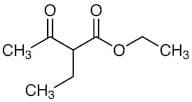
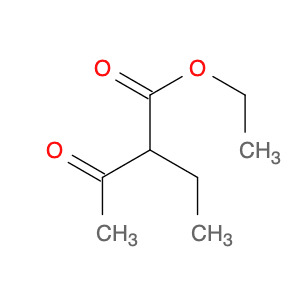
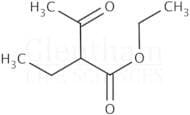
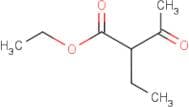
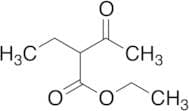
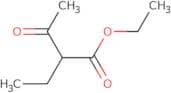
Éthyl 2-éthylacétoacétate, avec le numéro CAS 607-97-6, est un composé organique qui appartient à la classe des β-céto esters. Il se caractérise par son groupe fonctionnel d'ester éthylique et un substituant 2-éthyle sur la partie acétoacétate. Ce composé apparaît généralement sous la forme d'un liquide incolore à jaune pâle avec une odeur fruitée. Il est soluble dans des solvants organiques tels que l'éthanol et l'éther, mais a une solubilité limitée dans l'eau en raison de sa nature hydrophobe. Éthyl 2-éthylacétoacétate est connu pour sa réactivité, en particulier dans les réactions de condensation, ce qui le rend utile dans la synthèse organique, y compris la préparation de divers produits pharmaceutiques et agrochimiques. De plus, il peut subir une énolisation, ce qui est significatif dans son comportement chimique et sa réactivité. Les données de sécurité indiquent qu'il doit être manipulé avec précaution, car il peut provoquer des irritations de la peau et des yeux. Dans l'ensemble, sa structure unique et sa réactivité en font un composé précieux en chimie organique de synthèse.
Formule :C8H14O3
InChI :InChI=1S/C8H14O3/c1-4-7(6(3)9)8(10)11-5-2/h7H,4-5H2,1-3H3
Code InChI :InChIKey=OKANYBNORCUPKZ-UHFFFAOYSA-N
SMILES :C(C(OCC)=O)(C(C)=O)CC
Synonymes :- 2-Ethyl-3-oxo-butyric acid ethyl ester
- 2-Ethyl-3-oxobutanoic acid ethyl ester
- 2-Ethylacetoacetic acid ethyl ester
- Acetoacetic acid, 2-ethyl-, ethyl ester
- Butanoic acid, 2-ethyl-3-oxo-, ethyl ester
- Ethyl 2-acetylbutanoate
- Ethyl 2-acetylbutyrate
- Ethyl 2-ethyl-3-ketobutyrate
- Ethyl 2-ethyl-3-oxobutanoate
- Ethyl 2-ethyl-3-oxobutanoate:Diethyl acetoacetate
- Ethyl 2-ethyl-3-oxobutyrate
- Ethyl 2-ethylacetylacetate
- Ethyl α-acetylbutyrate
- Ethyl α-ethylacetoacetate
- NSC 53775
- ethyl (2R)-2-ethyl-3-oxobutanoate
- Voir plus de synonymes
Trier par
Degré de pureté (%)
0
100
|
0
|
50
|
90
|
95
|
100
10 produits concernés.
Ethyl 2-Ethylacetoacetate
CAS :Formule :C8H14O3Degré de pureté :>97.0%(GC)Couleur et forme :Colorless to Almost colorless clear liquidMasse moléculaire :158.20Ethyl 2-ethylacetoacetate, 95%
CAS :This Thermo Scientific Chemicals brand product was originally part of the Alfa Aesar product portfolio. Some documentation and label information may refer to the legacy brand. The original Alfa Aesar product / item code or SKU reference has not changed as a part of the brand transition to Thermo SciFormule :C8H14O3Degré de pureté :95%Couleur et forme :Liquid, Clear colorlessMasse moléculaire :158.20Ethyl 2-ethyl-3-oxobutanoate
CAS :Formule :C8H14O3Degré de pureté :98%Couleur et forme :LiquidMasse moléculaire :158.1950Ethyl 2-Ethylacetoacetate
CAS :Ethyl 2-EthylacetoacetateDegré de pureté :99%Masse moléculaire :158.19g/molEthyl 2-ethylacetoacetate
CAS :Ethyl 2-ethylacetoacetate
Degré de pureté :97%Couleur et forme :LiquidMasse moléculaire :158.19g/molRef: 54-OR905609
2.5lÀ demander5mlÀ demander10lÀ demander25mlÀ demander100gÀ demander100mlÀ demander500gÀ demander500mlÀ demanderEthyl 2-ethylacetoacetate
CAS :Formule :C8H14O3Degré de pureté :95%Couleur et forme :LiquidMasse moléculaire :158.197Ethyl 2-Ethylacetoacetate
CAS :Produit contrôléApplications Ethyl 2-Ethylacetoacetate was a useful reagent in systematic investigation of saccharomyces cerevisiae enzymes catalyzing carbonyl reductions.
References Kaluzna, I., et al.: J. Am. Chem. Soc., 126, 12827 (2004);Formule :C8H14O3Couleur et forme :NeatMasse moléculaire :158.19Ethyl 2-ethylacetoacetate
CAS :Ethyl 2-ethylacetoacetate is a carbonyl compound that belongs to the supramolecular class of chromenones. The molecule has an x-ray diffraction pattern that is characteristic of a ring structure. It can be synthesized by an efficient method involving the reaction of ethyl benzoylacetate with a halide in the presence of acid catalyst. The reactants are isolated in high yield and structural analysis shows the presence of a methylene group and an ethyl group on opposite sides of the ring, which are bonded to each other through an acetoacetate group. This chromenone also displays photochemical properties and can be used as a substrate for functional theory studies.Formule :C8H14O3Degré de pureté :Min. 95%Masse moléculaire :158.19 g/mol