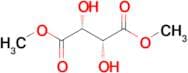
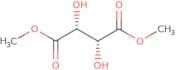
CAS 608-68-4
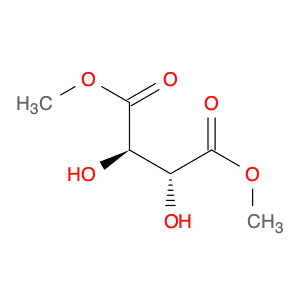
:1,4-Diméthyl 2,3-dihydroxy- (2R,3R)butanedioate
Description :
1,4-Diméthyl 2,3-dihydroxy-(2R,3R)butanedioate, avec le numéro CAS 608-68-4, est un composé chimique caractérisé par sa stéréochimie spécifique et ses groupes fonctionnels. Il présente deux groupes hydroxyles (-OH) et un groupe fonctionnel diester, qui contribue à sa réactivité et à sa solubilité dans des solvants polaires. La présence des groupes méthyles améliore son caractère hydrophobe tandis que les groupes hydroxyles augmentent son potentiel de liaison hydrogène. Ce composé est typiquement un solide cristallin blanc à blanc cassé à température ambiante et est soluble dans l'eau et divers solvants organiques. Sa stéréochimie, indiquée par la configuration (2R,3R), joue un rôle crucial dans son activité biologique et ses interactions avec d'autres molécules. Le 1,4-Diméthyl 2,3-dihydroxy-(2R,3R)butanedioate est souvent étudié pour ses applications potentielles en pharmacie et en biochimie, en particulier dans la synthèse de molécules organiques plus complexes. Comme pour de nombreux composés organiques, une manipulation et un stockage appropriés sont essentiels pour maintenir sa stabilité et prévenir sa dégradation.
Formule :C6H10O6
InChI :InChI=1S/C6H10O6/c1-11-5(9)3(7)4(8)6(10)12-2/h3-4,7-8H,1-2H3/t3-,4-/m1/s1
Code InChI :InChIKey=PVRATXCXJDHJJN-QWWZWVQMSA-N
SMILES :[C@@H]([C@H](C(OC)=O)O)(C(OC)=O)O
Synonymes :- (+)-Tartaric acid dimethyl ester
- (2R,3R)-(+)-Dimethyl tartrate
- 1,4-Dimethyl 2,3-dihydroxy- (2R,3R)butanedioate
- <span class="text-smallcaps">L</span>-(+)-Dimethyl tartrate
- <span class="text-smallcaps">L</span>-Tartaric acid dimethyl ester
- Butanedioic acid, 2,3-dihydroxy- (2R,3R)-, 1,4-dimethyl ester
- Butanedioic acid, 2,3-dihydroxy- (2R,3R)-, dimethyl ester
- Butanedioic acid, 2,3-dihydroxy- [R-(R*,R*)]-, dimethyl ester
- Dimethyl (+)-<span class="text-smallcaps">L</span>-tartrate
- Dimethyl (+)-tartrate
- Dimethyl (R,R)-tartrate
- Dimethyl <span class="text-smallcaps">L</span>-tartarate
- Dimethyl L-(+)-tartarate
- Dimethyl d-tartrate
- Dimethyl-L-(+)-Tartratic
- L-plus-tartaric acid dimethyl ester
- NSC 517
- Voir plus de synonymes
Trier par
Degré de pureté (%)
0
100
|
0
|
50
|
90
|
95
|
100
6 produits concernés.
(+)-Dimethyl L-tartrate
CAS :Formule :C6H10O6Degré de pureté :98%Couleur et forme :SolidMasse moléculaire :178.1400Dimethyl L-tartrate
CAS :Formule :C6H10O6Degré de pureté :≥ 98.0%Couleur et forme :White to off-white or light yellow crystalline powderMasse moléculaire :178.14L-(+)-Tartaric acid dimethyl ester
CAS :L-(+)-Tartaric acid dimethyl esterFormule :C6H10O6Degré de pureté :99%Couleur et forme : white solidMasse moléculaire :178.14g/molDimethyl L-(+)-Tartrate
CAS :Formule :C6H10O6Degré de pureté :>98.0%(GC)Couleur et forme :White to Almost white powder to crystalMasse moléculaire :178.14(2R,3R)-Dimethyl 2,3-dihydroxysuccinate
CAS :Degré de pureté :95.0%Couleur et forme :SolidMasse moléculaire :178.13999938964844Dimethyl L-(+)-tartrate
CAS :Dimethyl L-(+)-tartrate is a natural compound that can be found in wines and honey. It has been shown to have antiviral activity against herpes simplex virus type 1 (HSV-1). Dimethyl L-(+)-tartrate has also been shown to be a potent inhibitor of the human immunodeficiency virus type 1 (HIV-1) by preventing it from entering cells. Dimethyl L-(+)-tartrate inhibits HIV-1 by interfering with the ability of the virus to bind to CD4 receptors, thereby blocking entry into cells. Dimethyl L-(+)-tartrate is a tetronic acid, which is an organic acid that contains two carboxyl groups, one on each end of the molecule. It exhibits structural features such as vibrational and hydrogen bonding properties that are similar to those observed for other nucleophilic compounds, such as trifluoroacetic acid and dimethyl sulfate. The molecule consists of twoFormule :C6H10O6Degré de pureté :Min. 98%Couleur et forme :White PowderMasse moléculaire :178.14 g/mol