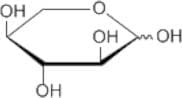
CAS 609-06-3
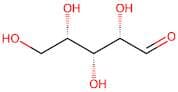
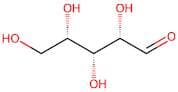
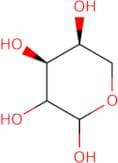
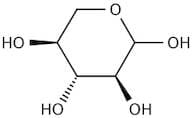
:L-Xylose
- <span class="text-smallcaps">L</span>-Xylose
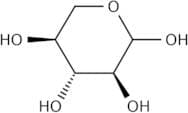
- L-xylopyranose
- NSC 26213
- Xylose, <span class="text-smallcaps">L</span>-
- alpha-L-xylopyranose
- beta-L-xylopyranose
- Xylose, L-
- L-Xylose
- L-XYLOSE
L-(-)-Xylose
CAS :Formule :C5H10O5Degré de pureté :>97.0%(T)Couleur et forme :White to Almost white powder to crystalMasse moléculaire :150.13L-(-)-Xylose, 99%
CAS :This Thermo Scientific Chemicals brand product was originally part of the Alfa Aesar product portfolio. Some documentation and label information may refer to the legacy brand. The original Alfa Aesar product / item code or SKU reference has not changed as a part of the brand transition to Thermo SciFormule :C5H10O5Degré de pureté :99%Couleur et forme :White to pale cream, Crystals or powder or crystalline powderMasse moléculaire :150.13L-(-)-Xylose
CAS :Formule :C5H10O5Degré de pureté :97%Couleur et forme :SolidMasse moléculaire :150.1299L-Xylose
CAS :Formule :C5H10O5Degré de pureté :≥ 98.0%Couleur et forme :White or almost white crystalline powderMasse moléculaire :150.13L-Xylose
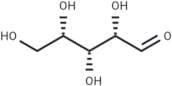
CAS :L-Xylose (L-(-)-Xylose), a Xylose levo-isomer, is classified as the aldopentose type monosaccharide.
Formule :C5H10O5Degré de pureté :99.926%Couleur et forme :Fine Crystalline PowderMasse moléculaire :150.13L-Xylose
CAS :Applications L-Xylose is used in the synthesis of L-Xylose derivatives as selective sodium-dependent glucose cotransporter 2 (SGLT2) inhibitors for the treatment of type 2 diabetes.
References Goodwin, N.C., et. al.: J. Med. Chem., 52, 6201 (2009)Formule :C5H10O5Couleur et forme :White Crystalline PowderMasse moléculaire :150.13L-Xylose
CAS :Chiral-pool resource for organic synthesisFormule :C5H10O5Degré de pureté :Min. 99 Area-%Couleur et forme :White PowderMasse moléculaire :150.13 g/molL-(-)-Xylose extrapure, 99%
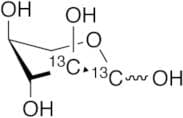
CAS :Formule :C5H10O5Degré de pureté :min. 99%Couleur et forme :White to off - white, Crystalline powder, ClearMasse moléculaire :150.13L-[13C5]Xylose
CAS :Produit contrôléApplications L-Xylose is part of the chemical profile of a polysaccharide extracted in aquatic life that shows anti-viral activites against herpes simplex virus 1 & 2 as well as influenza A virus. This is the L-[13C5]Xylose labeled analog.
References Lee, J.B. et al.: Biol. Pharm. Bullet., 29, 2135 (2006);Formule :C5H10O5Couleur et forme :Off White SolidMasse moléculaire :155.1L-Xylose
CAS :L-Xylose is a monosaccharide that is found in many plants. It is used as a sweetener, and also has been shown to be beneficial in the treatment of diabetic neuropathy. L-Xylose can be metabolized by the enzyme xylitol dehydrogenase to produce energy for the cell. The enzyme catalyzes the conversion of xylitol to D-xylulose and then D-xylulose 1-phosphate, which can be converted into ATP for use by cells. L-Xylose is not metabolized by bacterial enzymes and does not affect blood sugar levels. L-Xylose has been shown to have an effect on taste perception, with a sweet taste at concentrations of 10 milligrams per liter (mg/L). This sweet taste is due to its hydroxymethyl group on the C2 position, which reacts with sodium ions in the mouth. The optimum pH for L-xylose
Formule :C5H10O5Degré de pureté :Min. 99.0 Area-%Masse moléculaire :150.13 g/mol
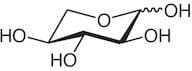

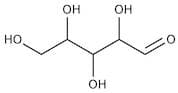

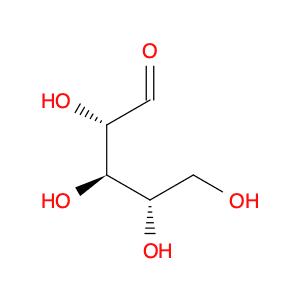









![L-[13C5]Xylose](/_next/image/?url=https%3A%2Fstatic.cymitquimica.com%2Fproducts%2FTR%2Fthumb%2FX750706.jpg&w=3840&q=75)