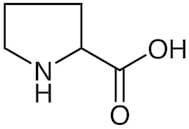
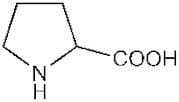
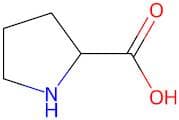
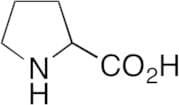
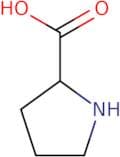
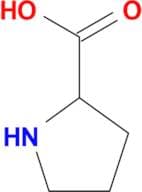
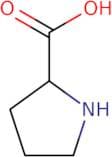
CAS 609-36-9
:DL-Proline
- (+/-)-Pyrrolidine-2-carboxylic acid
- (.+-.)-Proline
- (RS)-Proline
- 2-Pyrrolidinylcarboxylic acid
- <span class="text-smallcaps">D</smallcap><smallcap>L</span>-Pro
- <span class="text-smallcaps">D</smallcap><smallcap>L</span>-Proline
- DL-Pro
- DL-Prolin
- DL-prolina
- H-DL-Pro-OH
- Nsc 97923
- Proline, <span class="text-smallcaps">D</smallcap><smallcap>L</span>-
- Proline, DL-
- ProlinePyrrolidinecarboxylicacid
- Voir plus de synonymes
DL-Proline
CAS :Formule :C5H9NO2Degré de pureté :>99.0%(T)(HPLC)Couleur et forme :White to Almost white powder to crystalMasse moléculaire :115.13DL-Proline, 99%
CAS :DL-Proline is used as an agonist of glycine receptors. It acts as a catalyst for aldol condensation. It is an essential component of collagen. It plays a significant role in the immune system and strengthening of heart muscles. It is an osmoprotectant and therefore is used in many pharmaceutical, biFormule :C5H9NO2Degré de pureté :99%Couleur et forme :White, Crystals or powder or crystalline powderMasse moléculaire :115.13DL-proline
CAS :Formule :C5H9NO2Degré de pureté :98%Couleur et forme :SolidMasse moléculaire :115.1305Ref: IN-DA003PUI
25kgÀ demander50kgÀ demander100kgÀ demander10g20,00€5g23,00€25g24,00€100g33,00€500g92,00€DL-Proline
CAS :DL-Proline is a DL mixture of proline with multiple biological activities, and is commonly used in solid-phase or liquid-phase peptide synthesis.Formule :C5H9NO2Degré de pureté :99.93%Couleur et forme :Flat Needles From Alcohol + Ether; Prisms From Water White Crystalline PowderMasse moléculaire :115.13DL-Proline
CAS :Formule :C5H9NO2Degré de pureté :≥ 98.0%Couleur et forme :White to off-white powderMasse moléculaire :115.13DL-Proline
CAS :DL-ProlineFormule :C5H9NO2Degré de pureté :98%Couleur et forme : white to off-white solidMasse moléculaire :115.13g/molDL-Proline
CAS :Applications DL-Proline is the racemic mixture of both L-Proline (P755995) and D-Proline (P755990).
References Bondarenko, L.B., et al.: Int. J. Peptides., 2, 1687 (2012); Rimer, T., et al.: Biomacromolecules, 13, 2110 (2012);Formule :C5H9NO2Couleur et forme :NeatMasse moléculaire :115.13DL-Proline
CAS :A useful as an intermediate in the synthesis of peptides, proteins, and other organic molecules. It can be used as a reagent or as an additive to other chemicals.Formule :C5H9NO2Degré de pureté :Min. 99 Area-%Masse moléculaire :115.13 g/molH-DL-Pro-OH
CAS :M02942 - H-DL-Pro-OH
Formule :C5H9NO2Degré de pureté :98%Couleur et forme :SolidMasse moléculaire :115.132DL-Proline
CAS :DL-Proline is a biological molecule that has been shown to bind to the DNA binding domains of proteins. This binding can be seen with the crystal structures of DL-proline and protein. The reaction mechanism for DL-proline is as follows:
DL-Proline + Protein → Proline + Protein
The equilibrium constant for this reaction is 1.0 at 298 K. The pKa value for the amide group in DL-proline is 4.8, which means that it will react with water and form an amine group at physiological pH levels. DL-Proline has been shown to have metabolic disorders.Formule :C5H9NO2Degré de pureté :Min. 95%Couleur et forme :PowderMasse moléculaire :115.13 g/mol