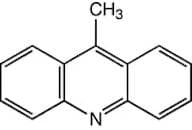
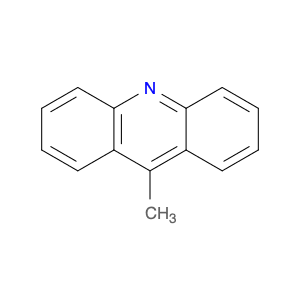
CAS 611-64-3
:9-Méthylacridine
Description :
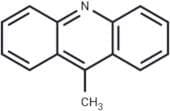
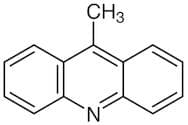
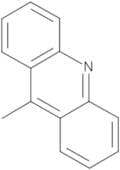
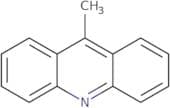
9-Méthylacridine est un composé organique appartenant à la famille des acridines, caractérisé par une structure à trois cycles fusionnés comprenant un atome d'azote. C'est un solide de couleur jaune pâle à brun à température ambiante et il est connu pour ses propriétés aromatiques. La présence du groupe méthyle en position 9 du système d'anneaux d'acridine influence son comportement chimique, en faisant un candidat potentiel pour diverses applications en synthèse organique et comme sonde fluorescente. 9-Méthylacridine est modérément soluble dans des solvants organiques, tels que l'éthanol et l'acétone, mais a une solubilité limitée dans l'eau. Sa réactivité chimique est principalement attribuée à l'atome d'azote, qui peut participer à diverses réactions, y compris la substitution électrophile et l'oxydation. De plus, 9-Méthylacridine présente des propriétés photophysiques, ce qui le rend utile dans les études liées à la fluorescence et à la photochimie. Les données de sécurité indiquent qu'il doit être manipulé avec précaution, car il peut présenter des risques pour la santé en cas d'exposition. Dans l'ensemble, 9-Méthylacridine est un composé d'intérêt tant dans la recherche académique que dans les applications industrielles.
Formule :C14H11N
InChI :InChI=1/C14H11N/c1-10-11-6-2-4-8-13(11)15-14-9-5-3-7-12(10)14/h2-9H,1H3
Code InChI :InChIKey=FLDRLXJNISEWNZ-UHFFFAOYSA-N
SMILES :CC=1C2=C(N=C3C1C=CC=C3)C=CC=C2
Synonymes :- 5-Methylacridine
- 5-Methylacridine (European)
- 9-Methylakridin
- 9-Methylakridin [Czech]
- Acridine, 9-methyl-
- Brn 0133084
- Nsc 1234
- 9-Methylacridine
- 5-20-08-00253 (Beilstein Handbook Reference)
- 9-Methylacridine
- 9-Methylacridine, 99+%
- 9-Methylacridin
- 9-Methylacridine, 99+% 1GR
- 9-methyl-acridin
- Voir plus de synonymes
Trier par
Degré de pureté (%)
0
100
|
0
|
50
|
90
|
95
|
100
12 produits concernés.
9-Methylacridine, 96%
CAS :This Thermo Scientific Chemicals brand product was originally part of the Alfa Aesar product portfolio. Some documentation and label information may refer to the legacy brand. The original Alfa Aesar product / item code or SKU reference has not changed as a part of the brand transition to Thermo SciFormule :C14H11NDegré de pureté :96%Couleur et forme :Yellow to brown, Powder or crystalline powderMasse moléculaire :193.259-Methylacridine
CAS :Heterocyclic compounds with nitrogen hetero-atom(s) only, aromatic or modified aromatic, nesoiFormule :C14H11NCouleur et forme :Yellow PowderMasse moléculaire :193.089159-Methylacridine
CAS :Formule :C14H11NDegré de pureté :98%Couleur et forme :SolidMasse moléculaire :193.24389-Methyl Acridine
CAS :Formule :C14H11NCouleur et forme :Yellowish-Brown SolidMasse moléculaire :193.259-Methylacridine
CAS :Produit contrôléFormule :C14H11NCouleur et forme :NeatMasse moléculaire :193.249-Methylacridine
CAS :9-Methylacridine is an environmentally sensitive fluorescent probe that can couple with carboxylic acid molecules.Formule :C14H11NCouleur et forme :SolidMasse moléculaire :193.249-Methylacridine
CAS :Formule :C14H11NDegré de pureté :>97.0%(GC)Couleur et forme :Light yellow to Brown to Dark green powder to crystalMasse moléculaire :193.259-Methylacridine
CAS :Degré de pureté :95.0%Couleur et forme :SolidMasse moléculaire :193.248992919921889-Methylacridine
CAS :Produit contrôléApplications 9-Methylacridine is an derivative of Acridine (A190900), a quinoline derivative used as manufacturing dyes and as an intermediate for the synthesis of antileishmanial agents.
References Pathak, D. et al.: Pharma Chemica, 3, 239 (2011); Mathieu, O. et al.: Xenobiotica, 41, 91 (2011); Rubbo, S.D. et al.: Br. J. Exp. Pathol., 28, 1 (1947);Formule :C14H11NCouleur et forme :NeatMasse moléculaire :193.249-methylacridine
CAS :9-Methylacridine is a chemical compound that is a member of the acridine family. It has shown anticancer activity in animal studies and also has been used as an immunosuppressant. 9-Methylacridine can be synthesized by reacting sodium carbonate with intramolecular hydrogen, which is then purified by Langmuir adsorption isotherm. The antiviral effect of 9-methylacridine was tested on herpes simplex virus and it was found that this compound inhibited the transfer reactions of viral DNA to host cells, leading to inhibition of viral replication. Studies have also shown that 9-methylacridine has anti-inflammatory effects against caproic acid and malonic acid in rats. One study found that 9-methylacridine inhibits the cationic polymerization and biological samples are usually anhydrous sodium chloride or human serum.Formule :C14H11NDegré de pureté :Min. 95%Masse moléculaire :193.24 g/mol