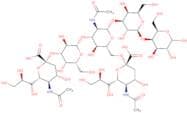
CAS 61278-38-4
:Disialyllacto-N-tétraose
Description :
Disialyllacto-N-tétraose est un glucide complexe, spécifiquement un type d'oligosaccharide, qui consiste en une chaîne d'unités de sucre. Il se caractérise par la présence de deux résidus d'acide sialique, qui sont chargés négativement et contribuent aux propriétés globales de la molécule, y compris sa solubilité et son interaction avec les systèmes biologiques. Cet oligosaccharide est dérivé du lactose et fait partie de la grande famille des glycanes, qui jouent des rôles cruciaux dans la reconnaissance cellulaire, la signalisation et la réponse immunitaire. Disialyllacto-N-tétraose se trouve souvent dans le lait humain et on pense qu'il a des effets prébiotiques, favorisant la croissance de bactéries intestinales bénéfiques. Sa structure comprend une combinaison d'unités de galactose, de glucose et de N-acétylglucosamine, liées ensemble dans un agencement spécifique qui influence son activité biologique. La présence d'acide sialique améliore également sa stabilité et sa résistance à la dégradation enzymatique, en faisant un composant important dans divers processus biologiques. Dans l'ensemble, Disialyllacto-N-tétraose illustre la complexité et la fonctionnalité des structures de glycanes dans les systèmes biologiques.
Formule :C48H79N3O37
InChI :InChI=1S/C48H79N3O37/c1-13(58)49-25-16(61)4-47(45(75)76,86-38(25)29(68)19(64)7-53)79-12-24-33(72)37(27(51-15(3)60)42(82-24)85-40-31(70)22(10-56)80-43(34(40)73)83-36(21(66)9-55)28(67)18(63)6-52)84-44-35(74)41(32(71)23(11-57)81-44)88-48(46(77)78)5-17(62)26(50-14(2)59)39(87-48)30(69)20(65)8-54/h6,16-44,53-57,61-74H,4-5,7-12H2,1-3H3,(H,49,58)(H,50,59)(H,51,60)(H,75,76)(H,77,78)/t16-,17-,18-,19+,20+,21+,22+,23+,24+,25+,26+,27+,28+,29+,30+,31-,32-,33+,34+,35+,36+,37+,38+,39+,40-,41-,42-,43-,44-,47+,48-/m0/s1
Code InChI :InChIKey=BTDPEAPRLHRFIA-VYZFFVDYSA-N
SMILES :O([C@@]1(C(O)=O)O[C@@]([C@@H]([C@@H](CO)O)O)([C@H](NC(C)=O)[C@@H](O)C1)[H])[C@@H]2[C@@H](O)[C@H](O[C@@H]3[C@@H](NC(C)=O)[C@H](O[C@@H]4[C@@H](O)[C@H](O[C@@H]([C@@H]([C@H](C=O)O)O)[C@@H](CO)O)O[C@H](CO)[C@@H]4O)O[C@H](CO[C@@]5(C(O)=O)O[C@@]([C@@H]([C@@H](CO)O)O)([C@H](NC(C)=O)[C@@H](O)C5)[H])[C@H]3O)O[C@H](CO)[C@@H]2O
Synonymes :- <span class="text-smallcaps">D</smallcap>-Glucose, O-(N-acetyl-α-neuraminosyl)-(2→6)-O-[O-(N-acetyl-α-neuraminosyl)-(2→3)-β-<smallcap>D</smallcap>-galactopyranosyl-(1→3)]-O-2-(acetylamino)-2-deoxy-β-<smallcap>D</smallcap>-glucopyranosyl-(1→3)-O-β-<smallcap>D</span>-galactopyranosyl-(1→4)-
- Di-N-Acetylneuraminosyllacto-N-tetraose
- Disialyllacto-N-tetraose
- Disialyllacto-N-tetraose, Disodium Salt, Human Milk
- O-(N-Acetyl-α-neuraminosyl)-(2→6)-O-[O-(N-acetyl-α-neuraminosyl)-(2→3)-β-<span class="text-smallcaps">D</smallcap>-galactopyranosyl-(1→3)]-O-2-(acetylamino)-2-deoxy-β-<smallcap>D</smallcap>-glucopyranosyl-(1→3)-O-β-<smallcap>D</smallcap>-galactopyranosyl-(1→4)-<smallcap>D</span>-glucose
- D-Glucose, O-(N-acetyl-α-neuraminosyl)-(2→6)-O-[O-(N-acetyl-α-neuraminosyl)-(2→3)-β-D-galactopyranosyl-(1→3)]-O-2-(acetylamino)-2-deoxy-β-D-glucopyranosyl-(1→3)-O-β-D-galactopyranosyl-(1→4)-
- O-(N-Acetyl-α-neuraminosyl)-(2→6)-O-[O-(N-acetyl-α-neuraminosyl)-(2→3)-β-D-galactopyranosyl-(1→3)]-O-2-(acetylamino)-2-deoxy-β-D-glucopyranosyl-(1→3)-O-β-D-galactopyranosyl-(1→4)-D-glucose
Trier par
Degré de pureté (%)
0
100
|
0
|
50
|
90
|
95
|
100
2 produits concernés.
Disialyllacto-N-tetraose
CAS :Formule :C48H79N3O37Degré de pureté :≥ 90%Couleur et forme :White to off-white solidMasse moléculaire :1290.16Disialyllacto-N-tetraose
CAS :Disialyllacto-N-tetraose is a medicinal compound that has shown promising anticancer properties. It is an analog of a human urinary glycoprotein and has been found to induce apoptosis in cancer cells. Disialyllacto-N-tetraose acts as a tumor inhibitor by blocking the activity of certain protein kinases, which are enzymes that play a role in cell growth and division. This compound has been studied extensively in Chinese medicine and has shown potential as an effective anticancer agent. Its unique structure and mechanism of action make it a promising candidate for further research into cancer treatment.Formule :C48H79N3O37Degré de pureté :Min. 85%Masse moléculaire :1,290.16 g/mol