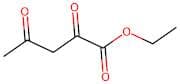
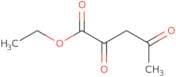
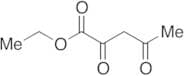
CAS 615-79-2
:Éthyl ester de l'acide 2,4-dioxopentanoïque
Description :
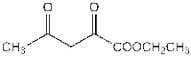
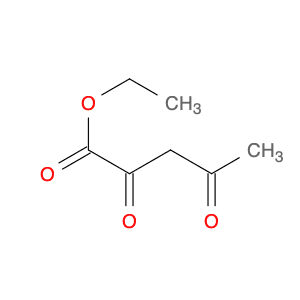
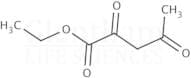
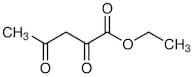
Éthyl ester de l'acide 2,4-dioxopentanoïque, également connu sous le nom d'éthyle 2,4-pentanedionate, est un composé organique caractérisé par son groupe fonctionnel ester et sa structure de diketone. Il apparaît généralement sous la forme d'un liquide incolore à jaune pâle avec une odeur fruitée. Ce composé est soluble dans des solvants organiques tels que l'éthanol et l'éther, mais a une solubilité limitée dans l'eau en raison de sa chaîne alkylique hydrophobe. La présence des deux groupes carbonyles contribue à sa réactivité, le rendant utile dans diverses synthèses chimiques, y compris comme précurseur d'autres composés organiques. Éthyl ester de l'acide 2,4-dioxopentanoïque peut participer à des réactions de condensation et est souvent utilisé dans la production d'agents chélatants et comme agent aromatisant dans l'industrie alimentaire. Sa structure moléculaire permet la formation de liaisons hydrogène, influençant son point d'ébullition et sa volatilité. Les données de sécurité indiquent qu'il doit être manipulé avec précaution, car il peut provoquer des irritations au contact de la peau ou des yeux. Un stockage approprié dans un endroit frais et sec est recommandé pour maintenir sa stabilité.
Formule :C7H10O4
InChI :InChI=1S/C7H10O4/c1-3-11-7(10)6(9)4-5(2)8/h3-4H2,1-2H3
Code InChI :InChIKey=OYQVQWIASIXXRT-UHFFFAOYSA-N
SMILES :C(C(OCC)=O)(CC(C)=O)=O
Synonymes :- 2,4-Dioxopentanoic acid ethyl ester
- Ethoxalylacetone
- Ethyl (acetylmethyl)glyoxylate
- Ethyl 2,4-Dioxopentanoate
- Ethyl acetopyruvate
- Ethyl acetylpyruvate
- NSC 1243
- NSC 97434
- Pentanoic acid, 2,4-dioxo-, ethyl ester
- Valeric acid, 2,4-dioxo-, ethyl ester
- ethyl (2Z)-2-hydroxy-4-oxopent-2-enoate
- Voir plus de synonymes
Trier par
Degré de pureté (%)
0
100
|
0
|
50
|
90
|
95
|
100
8 produits concernés.
Ethyl acetopyruvate, 98%
CAS :Ethyl acetopyruvate is used in the preparation of 5-methyl-isoxazole-3-carboxylic acid ethyl ester. It is involved in the preparation of ethyl 5-amino-2-methylpyndine-4-carboxyIate by reacting with nitroacetamide. This Thermo Scientific Chemicals brand product was originally part of the Alfa AesarFormule :C7H10O4Degré de pureté :98%Couleur et forme :Clear, colourless to yellow, liquidMasse moléculaire :158.15Ethyl 2,4-dioxopentanoate
CAS :Formule :C7H10O4Degré de pureté :96%Couleur et forme :SolidMasse moléculaire :158.1519Ethyl acetopyruvate
CAS :Formule :C7H10O4Degré de pureté :≥ 98.0%Couleur et forme :Colourless to yellow liquidMasse moléculaire :158.15Ethyl 2,4-Dioxovalerate
CAS :Formule :C7H10O4Degré de pureté :>98.0%(GC)(T)Couleur et forme :Colorless to Light orange to Yellow clear liquidMasse moléculaire :158.15Ethyl 2,4-dioxopentanoate
CAS :Ethyl 2,4-dioxopentanoateFormule :C7H10O4Degré de pureté :97%Couleur et forme : clear. faint yellow to light yellow liquid/ light yellow low-melting solid solidMasse moléculaire :158.15g/molEthyl acetopyruvate
CAS :Ethyl acetopyruvate is a chemical compound that is an amide and an ester. It has inhibitory properties against HIV, which may be due to its ability to inhibit the methylation of DNA. Ethyl acetopyruvate also inhibits tumor cell growth in culture. This compound has been shown to have anti-inflammatory effects as well as inhibitory effects on the replication of other viruses, such as herpes simplex virus type 1 (HSV-1) and human cytomegalovirus (HCMV). The immunosuppressive effects of ethyl acetopyruvate are thought to be related to its ability to suppress the production of cytokines.Formule :C7H10O4Degré de pureté :Min. 95%Couleur et forme :Clear LiquidMasse moléculaire :158.15 g/molEthyl 2,4-Dioxopentanoate
CAS :Formule :C7H10O4Degré de pureté :96%Couleur et forme :LiquidMasse moléculaire :158.153Ethyl 2,4-Dioxovalerate
CAS :Produit contrôléApplications Ethyl 2,4-Dioxovalerate is an analog of Ethyl Pyruvate (P998915) and exhibits anti-inflammatory properties in vivo and/or in vitro. It is a potential antifungal agent that inhibits the growth of Candida albicans and Microsporum canis.
References Sappington, P.L., et al.: Biochem. Pharmacol., 70, 1579 (2005); Burch, H.A., et al.: J. Med. Chem., 15, 429 (1972)Formule :C7H10O4Couleur et forme :NeatMasse moléculaire :158.15