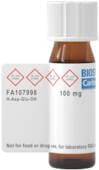
CAS 6157-06-8
:Acide L-aspartyl-L-glutamique
Description :
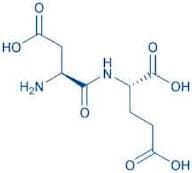
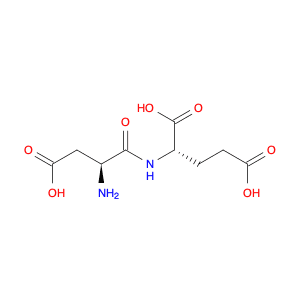
Acide L-aspartyl-L-glutamique, avec le numéro CAS 6157-06-8, est un dipeptide composé des acides aminés acide aspartique et acide glutamique liés par une liaison peptidique. Ce composé se caractérise par son rôle dans divers processus biologiques, en particulier dans le système nerveux central, où il peut fonctionner comme un neurotransmetteur ou un neuromodulateur. Il est connu pour son implication potentielle dans les fonctions cognitives et la plasticité synaptique. Acide L-aspartyl-L-glutamique est généralement soluble dans l'eau, reflétant la nature polaire de ses acides aminés constitutifs. Sa structure moléculaire comprend des groupes fonctionnels carboxyles et aminés, contribuant à ses propriétés acides. Le composé est souvent étudié pour ses applications potentielles en nutrition et en pharmacie, en particulier dans les formulations visant à améliorer les performances cognitives ou la neuroprotection. De plus, il peut présenter des propriétés antioxydantes, ce qui le rend intéressant dans la recherche liée au stress oxydatif et aux maladies neurodégénératives. Dans l'ensemble, Acide L-aspartyl-L-glutamique est un composé significatif en biochimie avec des implications pour la santé et la maladie.
Formule :C9H14N2O7
InChI :InChI=1S/C9H14N2O7/c10-4(3-7(14)15)8(16)11-5(9(17)18)1-2-6(12)13/h4-5H,1-3,10H2,(H,11,16)(H,12,13)(H,14,15)(H,17,18)/t4-,5-/m0/s1
Code InChI :InChIKey=CKAJHWFHHFSCDT-WHFBIAKZSA-N
SMILES :[C@H](NC([C@H](CC(O)=O)N)=O)(CCC(O)=O)C(O)=O
Synonymes :- 16: PN: EP2161028 PAGE: 10 claimed protein
- 3: PN: WO2008083678 PAGE: 33 claimed protein
- <span class="text-smallcaps">L</smallcap>-Aspartyl-<smallcap>L</span>-glutamic acid
- <span class="text-smallcaps">L</smallcap>-Glutamic acid, <smallcap>L</span>-α-aspartyl-
- <span class="text-smallcaps">L</smallcap>-Glutamic acid, N-<smallcap>L</span>-α-aspartyl-
- <span class="text-smallcaps">L</smallcap>-α-Aspartyl-<smallcap>L</span>-glutamic acid
- Glutamic acid, N-<span class="text-smallcaps">L</smallcap>-α-aspartyl-, <smallcap>L</span>-
- L-glutamic acid, L-alpha-aspartyl-
- N-Aspartyl-<span class="text-smallcaps">L</span>-glutamic acid
- N-Aspartylglutamic acid
- L-Glutamic acid, N-L-α-aspartyl-
- Glutamic acid, N-L-α-aspartyl-, L-
- L-Glutamic acid, L-α-aspartyl-
- L-Aspartyl-L-glutamic acid
- Voir plus de synonymes
Trier par
Degré de pureté (%)
0
100
|
0
|
50
|
90
|
95
|
100
5 produits concernés.
H-Asp-Glu-OH
CAS :Bachem ID: 4008675.
Formule :C9H14N2O7Degré de pureté :> 99%Couleur et forme :White PowderMasse moléculaire :262.22H-Asp-glu-oh
CAS :Formule :C9H14N2O7Degré de pureté :95%Couleur et forme :SolidMasse moléculaire :262.2167L-Aspartyl-L-glutamic acid
CAS :L-Aspartyl-L-glutamic acidDegré de pureté :97%Masse moléculaire :262.22g/molAspartylglutamate
CAS :Aspartylglutamate, acetylated to NAAG, acts as an mGlu receptor agonist.Formule :C9H14N2O7Couleur et forme :SolidMasse moléculaire :262.22H-Asp-Glu-OH
CAS :H-Asp-Glu-OH is a molecule that may be a potential biomarker for prostate cancer cells. It was found to affect the brain functions, including the growth of brain cells and neurotransmitter release. H-Asp-Glu-OH has been shown to inhibit the growth of tumor cells in mice, but it is not as potent as other molecules in this class. This compound has also been shown to enhance hematopoietic cell proliferation and suppress the production of Th2 cytokines. Magnetic resonance spectroscopy studies have indicated that H-Asp-Glu-OH binds with low potency to GABA receptors in brain tissue, which may be associated with its ability to regulate neuronal excitability and inhibit epileptic seizures.Formule :C9H14N2O7Degré de pureté :Min. 95 Area-%Couleur et forme :White Off-White PowderMasse moléculaire :262.22 g/mol