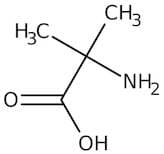
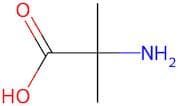
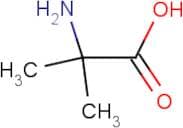
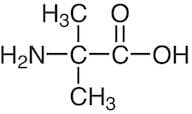
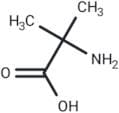
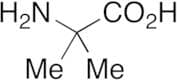
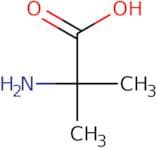
CAS 62-57-7
:Acide amino-isobutyrique
- 2,2-Dimethylglycine
- 2-Amino-2-methylpropanoic acid
- 2-Amino-2-methylpropionic acid
- 2-Amino-2-methylpropionsaure
- 2-Methylalanine
- AIB
- Acide 2-amino-2-methylpropionique
- Acido 2-Amino-2-Metilpropionico
- Alanine, 2-methyl-
- Aminoisobutyric acid
- H-Aib-OH
- Nsc 16590
- alpha-Aminoisobutyric acid
- Α-Aminoisobutyric Acid
- α,α-Dimethylglycine
- α-Aminoisobutanoic acid
- Voir plus de synonymes
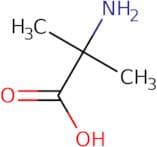
2-Aminoisobutyric acid, 99%
CAS :2-Aminoisobutyric acid is a non- protein amino acid present in some antibiotics. It acts as a strong helix inducer in peptides. It is non-metabolisable used in bioassays. This Thermo Scientific Chemicals brand product was originally part of the Alfa Aesar product portfolio. Some documentation and laFormule :C4H9NO2Degré de pureté :99%Couleur et forme :White, Crystals or powder or crystalline powder or lumpsMasse moléculaire :103.122-Aminoisobutyric acid
CAS :Formule :C4H9NO2Degré de pureté :97%Couleur et forme :SolidMasse moléculaire :103.1198Ref: IN-DA003GCM
5gÀ demander25kgÀ demander50kgÀ demander100kgÀ demander25g20,00€100g25,00€500g71,00€2-Aminoisobutyric acid
CAS :2-Aminoisobutyric acidFormule :C4H9NO2Degré de pureté :98% (nmr) (Typical Value in Batch COA)Couleur et forme : white solidMasse moléculaire :103.11975g/mol2-Aminoisobutyric acid
CAS :Formule :C4H9NO2Degré de pureté :≥ 98.0%Couleur et forme :White crystalline powderMasse moléculaire :103.122-Aminoisobutyric Acid
CAS :Formule :C4H9NO2Degré de pureté :>98.0%(T)Couleur et forme :White powder to crystalMasse moléculaire :103.12α,α-Dimethylglycine
CAS :NSC-16590 (2-Aminoisobutyric acid) is a nonprotein amino acid (is an end product of pyrimidine Metabolism) excreted in the urine of about 5% of healthyFormule :C4H9NO2Degré de pureté :99.65%Couleur et forme :SolidMasse moléculaire :103.122-Aminoisobutyric Acid (2-Methylalanine)
CAS :Produit contrôléApplications 2-Methylalanine is an Alanine (A481400) derivative. Alanine is an amino acid that occurs naturally in nature. It is a functional component in the alanine cycle which regulates the level of alanine aminotransferases which can be used as a diagnostic tool to predict type II diabetes.
References Naveed S. et al.: Diab., 53, 11 (2004); Barlind, J. et al.: Bioorg. Med. Chem. Lett., 23, 2721 (2013);Formule :C4H9NO2Couleur et forme :NeatMasse moléculaire :103.122-Aminoisobutyric acid
CAS :2-Aminoisobutyric acid (2-AIBA) is a natural compound that has been shown to have significant cytotoxicity against cancer cells. It is also thermodynamically stable and has a low toxicity in normal cells. 2-AIBA is able to cross the blood-brain barrier and can be taken up by the trigeminal nerve. It has been found to have lactogenic effects on the mammary gland, which may be due to its ability to increase prolactin levels. 2-AIBA has been shown to significantly inhibit radiation induced apoptosis in a model system of human papillary muscle cells. The uptake of 2-AIBA was found to be dependent on its ester hydrochloride form, with titration calorimetry being used for this study.Formule :C4H9NO2Degré de pureté :Min. 95%Couleur et forme :PowderMasse moléculaire :103.12 g/mol2-Aminoisobutyric acid
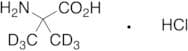
CAS :Formule :C4H9NO2Degré de pureté :97%Couleur et forme :Solid, White solidMasse moléculaire :103.1212-Methylalanine-d6 Hydrochloride
CAS :Produit contrôléApplications A labelled alanine derivative.
Formule :C4H3D6NO2·HClCouleur et forme :NeatMasse moléculaire :145.622-Aminoisobutyric acid
CAS :2-Aminoisobutyric acid is a chemical compound with the molecular formula C4H9NO2. It has a melting point of -147 °C and is soluble in water, methanol and acetone. 2-Aminoisobutyric acid can be used as a building block for other chemical compounds or as an intermediate in organic synthesis. It is also used as a reagent in many reactions because it reacts with alkenes to form amides, with nitriles to form amides, and with carboxylic acids to form esters. 2-Aminoisobutyric acid has been shown to inhibit the growth of bacteria such as Escherichia coli, Bacillus subtilis, Streptococcus pyogenes, Helicobacter pylori, Salmonella enterica serovar Typhi and Klebsiella pneumoniae.
Formule :C4H9NO2Masse moléculaire :103.12 g/molRef: 3D-A-6036
-Unit-kgkgÀ demander1kgÀ demander5kgÀ demander10kgÀ demander250gÀ demander2500gÀ demander