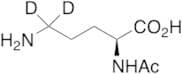
CAS 6205-08-9
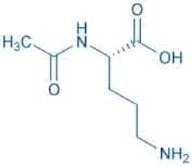
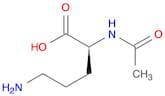
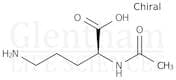
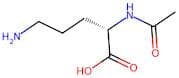
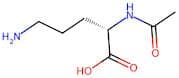
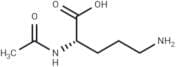
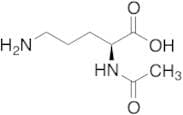
:N-Acétyl-L-ornithine
Description :
N-Acétyl-L-ornithine est un dérivé de l'acide aminé ornithine, caractérisé par l'ajout d'un groupe acétyle à l'atome d'azote du groupe amino. C'est une poudre cristalline blanche à blanc cassé qui est soluble dans l'eau et présente un pH légèrement acide à neutre. Ce composé joue un rôle significatif dans le cycle de l'urée, où il participe à la synthèse de l'arginine et est impliqué dans divers processus métaboliques. N-Acétyl-L-ornithine est souvent utilisé dans la recherche biochimique et a des applications potentielles dans les domaines de la nutrition et de la médecine, en particulier dans les études liées aux troubles métaboliques et au métabolisme des acides aminés. Sa formule moléculaire reflète sa structure, contenant des atomes de carbone, d'hydrogène, d'azote et d'oxygène. De plus, il est important de manipuler ce composé avec précaution, en suivant les directives de sécurité appropriées, comme pour toute substance biochimique. Dans l'ensemble, N-Acétyl-L-ornithine sert de composé important tant dans les fonctions physiologiques que dans les applications de recherche.
Formule :C7H14N2O3
InChI :InChI=1/C7H14N2O3/c1-5(10)9-6(7(11)12)3-2-4-8/h6H,2-4,8H2,1H3,(H,9,10)(H,11,12)/t6-/m0/s1
Code InChI :InChIKey=JRLGPAXAGHMNOL-LURJTMIESA-N
SMILES :[C@@H](NC(C)=O)(C(O)=O)CCCN
Synonymes :- (2S)-2-Acetamido-5-aminopentanoic acid
- (2S)-5-Amino-2-acetamidopentanoic acid
- <span class="text-smallcaps">L</span>-Ornithine, N<sup>2</sup>-acetyl-
- Ac-Orn-OH
- N-Acetyl-<span class="text-smallcaps">L</span>-ornithine
- N-Acetylornithine
- N<sup>2</sup>-Acetyl-<span class="text-smallcaps">L</span>-ornithine
- N<sup>α</sup>-Acetyl-<span class="text-smallcaps">L</span>-ornithine
- N<sup>α</sup>-Acetylornithine
- N~2~-acetyl-L-ornithine
- Ornithine, N<sup>2</sup>-acetyl-
- Ornithine, N<sup>2</sup>-acetyl-, <span class="text-smallcaps">L</span>-
- N2-Acetyl-L-ornithine
- Ornithine, N2-acetyl-
- L-Ornithine, N2-acetyl-
- Ornithine, N2-acetyl-, L-
- Nα-Acetyl-L-ornithine
- N-ACETYL-L-ORN
- N-ALPHA-ACETYL-L-ORNITHINE
- AC-ORNITHINE
- ACETYL-L-ORNITHINE
- N-A-acetyl-L-ornithine crystalline
- Nα-Acetyl-L-ornithine≥ 98% (HPLC)
- Voir plus de synonymes
Trier par
Degré de pureté (%)
0
100
|
0
|
50
|
90
|
95
|
100
11 produits concernés.
Ac-Orn-OH
CAS :Bachem ID: 4002042.
Formule :C7H14N2O3Degré de pureté :> 99%Couleur et forme :White PowderMasse moléculaire :174.2N-α-ACETYL-L-ORNITHINE
CAS :Formule :C7H14N2O3Degré de pureté :95%Couleur et forme :SolidMasse moléculaire :174.1977N-Acetyl-L-ornithine
CAS :Formule :C7H14N2O3Degré de pureté :≥ 95%Couleur et forme :White to off-white powderMasse moléculaire :174.20Nα-Acetyl-L-ornithine-5,5-d2
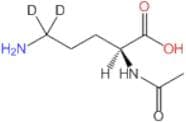
CAS :Formule :H2NCD2(CH2)2CH(NHCOCH3)COOHDegré de pureté :98 atom % DCouleur et forme :White SolidMasse moléculaire :176.113N-Acetylornithine
CAS :N-Acetylornithine is found in human blood plasma (avg. 1.1±0.4 μmol/L) and urine (~1 μmol/day).Formule :C7H14N2O3Degré de pureté :99.86% - ≥95%Couleur et forme :SolidMasse moléculaire :174.2Nalpha-Acetyl-L-ornithine
CAS :Produit contrôléFormule :C7H14N2O3Couleur et forme :Off-WhiteMasse moléculaire :174.2Nα-Acetyl-L-ornithine-d2
CAS :Produit contrôléApplications Nα-Acetyl-L-ornithine (AORN) is a substrate for the identification, differentiation and characterization of N(α)-acetyl-L-ornithine deacetylase(s) and of N-Acetyl-l-ornithine transcarbamylase(s) (AOTCase).
References McGregor, W., et al.: J. Am. Chem. Soc., 127, 14100 (2005); Morizono, H., et al.: J. Bacetriol., 188, 2974 (2006);Formule :C7D2H12N2O3Couleur et forme :NeatMasse moléculaire :176.21Na-Acetyl-L-ornithine
CAS :Formule :C7H14N2O3Degré de pureté :97%Couleur et forme :SolidMasse moléculaire :174.2N-alpha-Acetyl-L-ornithine
CAS :N-alpha-Acetyl-L-ornithine is an intermediate in the urea cycle that has been shown to be a potential biomarker for metabolic disorders. It has also been shown to inhibit glutamate synthesis and nitrogen oxidation by inhibiting arginase and nitric oxide synthase. N-alpha-Acetyl-L-ornithine is synthesized from L-arginine and acetyl coenzyme A, catalyzed by synthetases. The reaction requires ATP, magnesium ion, and a molecule of NADPH. This synthetic pathway can be monitored using high performance liquid chromatography (HPLC). N-alpha-Acetyl-L ornithine can be used as a precursor in the production of caproic acid, which is an important organic acid used in chemical biology.Formule :C7H14N2O3Degré de pureté :Min. 95%Masse moléculaire :174.2 g/mol