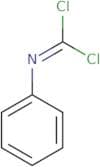
CAS 622-44-6
:Dichlorure de N-phénylcarbonimide
Description :
Dichlorure de N-phénylcarbonimide, avec le numéro CAS 622-44-6, est un composé organique caractérisé par sa structure de dérivé d'acide imidique, présentant un groupe phényle attaché à un atome de carbone qui est également lié à deux atomes de chlore. Ce composé est typiquement un liquide ou un solide incolore à jaune pâle, selon son état physique à température ambiante. Il est connu pour sa réactivité, en particulier en tant qu'agent chlorant, et est souvent utilisé dans la synthèse organique pour introduire le moiety phénylcarbonimidique dans divers substrats. La présence du groupe fonctionnel dichlorure en fait un électrophile puissant, lui permettant de participer à des réactions de substitution nucléophile. Les précautions de sécurité sont essentielles lors de la manipulation de ce composé, car il peut être corrosif et peut présenter des risques pour la santé en cas d'exposition. Un stockage approprié dans un endroit frais et sec, à l'abri de l'humidité et des substances incompatibles, est crucial pour maintenir sa stabilité et prévenir la dégradation.
Formule :C7H5Cl2N
InChI :InChI=1S/C7H5Cl2N/c8-7(9)10-6-4-2-1-3-5-6/h1-5H
Code InChI :InChIKey=TTWWZVGVBRPHLE-UHFFFAOYSA-N
SMILES :N(=C(Cl)Cl)C1=CC=CC=C1
Synonymes :- (Phenylimino)carbonyl dichloride
- 1,1-Dichloro-N-phenylmethanimine
- Benzenamine, N-(dichloromethylene)-
- Carbonic dichloride, (phenylimino)-
- Carbonimidic dichloride, N-phenyl-
- Carbonimidic dichloride, phenyl-
- Dichloro(phenylimino)methane
- Imidocarbonyl chloride, phenyl-
- N-(Phenylimino)phosgene
- N-(dichloromethylene)aniline
- N-Phenylcarbimide dichloride
- N-Phenylcarbonimidic dichloride
- N-Phenylimidophosgene
- N-Phenylimidoyl dichloride
- N-Phenyliminocarbonyl dichloride
- NSC 2051
- Phenyl carbylamine chloride
- Phenylcarbonimidic Dichloride
- Phenylimidocarbonyl chloride
- Phenylisonitrile dichloride
- Voir plus de synonymes
Trier par
Degré de pureté (%)
0
100
|
0
|
50
|
90
|
95
|
100
1 produits concernés.
Phenyl isocyanide dichloride
CAS :Produit contrôléPhenyl isocyanide dichloride (PIC) is a chemical compound that has been shown to have antihypertensive activity. PIC binds to the receptor site of the angiotensin II receptor, which inhibits the binding of angiotensin II to this receptor. PIC also has been shown to produce x-ray crystal structures and inhibit chemical reactions in which alkoxy radicals are formed. The ability of PIC to inhibit these chemical reactions may be due to its ability to bind with high affinity at the receptor site for the angiotensin II receptor, thereby preventing it from binding with an angiotensin II molecule. This prevents activation of the enzyme that catalyzes the reaction and leads to inhibition of the chemical reaction. PIC also has been shown as a potential treatment for autoimmune diseases such as multiple sclerosis, rheumatoid arthritis and psoriasis. It has been shown that PIC can reduce inflammation by inhibiting an enzyme known as p-Formule :C7H5Cl2NDegré de pureté :Min. 95%Masse moléculaire :174.03 g/mol