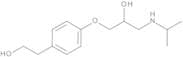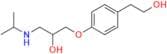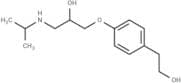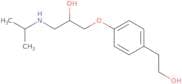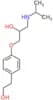
CAS 62572-94-5
:O-déméthylmétoprolol
- (±)-4-[2-Hydroxy-3-(isopropylamino)propoxy]phenylethyl alcohol
- (±)-O-Demethylmetoprolol
- 4-[2-Hydroxy-3-[(1-methylethyl)amino]propoxy]benzeneethanol
- Benzeneethanol, 4-[2-hydroxy-3-[(1-methylethyl)amino]propoxy]-
- H 105/22
- O-Desmethyl Metoprolol
- O-Desmethylmetoprolol
- Sl 80-0088
O-Desmethylmetoprolol (1-(4-(2-hydroxyethyl)phenoxy)-3-(isopropylamino)propan-2-ol)
CAS :Amino-alcohols, other than those containing more than one kind of oxygen function, their ethers and esters, salts thereof, nesoiFormule :C14H23NO3Couleur et forme :White Off-White SolidMasse moléculaire :253.16779Metoprolol EP Impurity H (Betaxolol EP Impurity B)
CAS :Formule :C14H23NO3Couleur et forme :White To Off-White SolidMasse moléculaire :253.34(2RS)-1-[4-(2-Hydroxyethyl)phenoxy]-3-[(1-methylethyl)amino]propan-2-ol
CAS :Produit contrôléFormule :C14H23NO3Couleur et forme :NeatMasse moléculaire :253.34O-Desmethyl Metoprolol
CAS :Produit contrôléImpurity Metoprolol EP Impurity H / Betaxolol EP Impurity B
Applications O-Desmethyl Metoprolol (Metoprolol EP Impurity H) is a metabolite of Metoprolol.
References Lennard, M.S., et al.: Br. J. Clin. Pharmacol., 14, 713 (1982), Gengo, F.M., et al.: Clin. Pharmacol. Ther., 36, 320 (1984),Formule :C14H23NO3Couleur et forme :White To Off-WhiteMasse moléculaire :253.34O-Desmethyl Metoprolol
CAS :O-Desmethyl metoprolol, a metabolite of metoprolol, acts as a β1-adrenergic receptor (β1-AR) antagonist. This compound is produced through the metabolism of metoprolol by the cytochrome P450 (CYP) isoform CYP2D6.Formule :C14H23NO3Couleur et forme :SolidMasse moléculaire :253.342O-Desmethyl metoprolol
CAS :O-Desmethyl metoprolol is an active metabolite of metoprolol. It has an inhibitory effect on beta-adrenergic receptors and acts as a vasodilator. O-Desmethyl metoprolol is formed by the action of cytochrome P450 on the parent drug, which has a strong acidic nature and is easily soluble in water. This metabolite can be detected in urine samples using a chromatographic method with detection sensitivity of 1 ng/mL. The stereoselectivity of the parent drug and its active metabolite is different, with the former being more selective for beta1 receptors while the latter is more selective for beta2 receptors. O-Desmethyl metoprolol may have clinical relevance because it was found to decrease blood pressure in hypertensive patients when given at doses that are much lower than those needed for its parent drug. The concentration of this metabolite in plasma was found to be proportional to dosage level and kinetic data suggest
Formule :C14H23NO3Degré de pureté :Min. 95%Masse moléculaire :253.34 g/mol



![(2RS)-1-[4-(2-Hydroxyethyl)phenoxy]-3-[(1-methylethyl)amino]propan-2-ol](/_next/image/?url=https%3A%2Fstatic.cymitquimica.com%2Fproducts%2F86%2Fthumb%2FMM0027.10.jpg&w=3840&q=75)