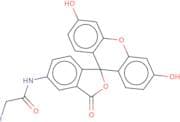
CAS 63368-54-7
:5-(iodoacétamido)fluorescéine
- 5-Iodoacetamidofluorescein (5-IAF)
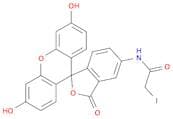
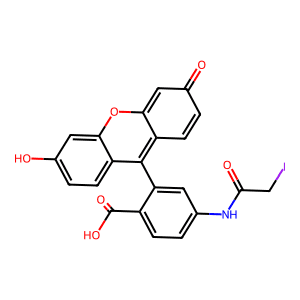
- N-(3',6'-dihydroxy-3-oxo-3H-spiro[2-benzofuran-1,9'-xanthen]-5-yl)-2-iodoacetamide
- 2-(6-hydroxy-3-oxo-3H-xanthen-9-yl)-4-[(iodoacetyl)amino]benzoic acid
5-Iodoacetamido fluorescein
CAS :5-Iodoacetamido fluorescein
Couleur et forme :PowderMasse moléculaire :515.25g/mol5-IAF
CAS :5-IAF is a fluorescein derivative of indoleacetamide, a fluorescent probe that can be used to label proteins and others containing free thiols (cysteine sideFormule :C22H14INO6Degré de pureté :98%Couleur et forme :SolidMasse moléculaire :515.255-(Iodoacetamido)fluorescein
CAS :Produit contrôléApplications 5-(Iodoacetamido)fluorescein is a thiol reactive fluorescein derivative.
Formule :C22H14INO6Couleur et forme :NeatMasse moléculaire :515.255-(Iodoacetamido)fluorescein
CAS :5-(Iodoacetamido)fluorescein is a fluorescent probe that can be used as a substrate for the detection of proteolytic enzymes. It binds to the disulfide bond of serine protease and reacts with iodoacetic acid. This reaction leads to a biphasic response, with an initial fluorescence increase followed by a decrease in fluorescence intensity. The initial fluorescence increase is due to the formation of a stable 5-iodoacetylamino-2-aminopyridine intermediate, which is converted into 5-iodoacetamido-2-aminopyridine upon cleavage of the disulfide bond. Fluorescence emission from 5-(Iodoacetamido)fluorescein increases when it binds to tryptophan residues on actin filaments, which are found in large numbers in human liver cells. 5-(Iodoacetamido)fluorescein also binds to herpes simplex virus and
Formule :C22H14INO6Degré de pureté :Min. 95%Couleur et forme :Red PowderMasse moléculaire :515.25 g/mol