CAS 637-44-5
:Acide phénylpropiolique
Description :
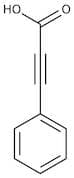
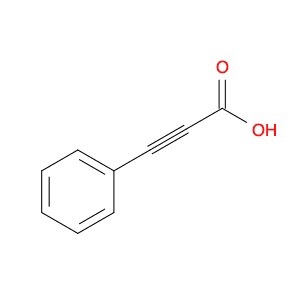
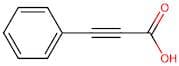
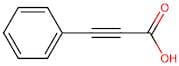
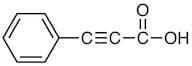
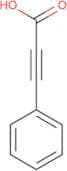
Acide phénylpropiolique, avec le numéro CAS 637-44-5, est un composé organique caractérisé par son groupe fonctionnel alcyne et un moiety d'acide carboxylique. Il présente un groupe phényle attaché à une chaîne de trois carbones qui se termine par un acide carboxylique, ce qui en fait un membre de la famille des acides propenoïques. Ce composé est généralement un liquide ou un solide incolore à jaune pâle, selon sa pureté et sa température. Acide phénylpropiolique est connu pour sa réactivité, en particulier en raison de la présence de la liaison triple, qui peut participer à diverses réactions chimiques, y compris des cycloadditions et des polymérisations. Il est également reconnu pour ses applications potentielles en synthèse organique et comme élément de base dans le développement de produits pharmaceutiques et d'agrochimiques. De plus, il présente un certain degré d'activité biologique, qui a été exploré dans des contextes de recherche. Cependant, des précautions de sécurité doivent être prises lors de la manipulation de ce composé, car il peut présenter des risques pour la santé en cas d'exposition.
Formule :C9H6O2
InChI :InChI=1S/C9H6O2/c10-9(11)7-6-8-4-2-1-3-5-8/h1-5H,(H,10,11)
Code InChI :InChIKey=XNERWVPQCYSMLC-UHFFFAOYSA-N
SMILES :C(#CC(O)=O)C1=CC=CC=C1
Synonymes :- 2-Propynoic acid, 3-phenyl-
- 3-Phenyl-2-propynoic acid
- 3-Phenylprop-2-Ynoate
- 3-Phenylprop-2-Ynoic Acid
- 3-Phenylpropargylic acid
- 3-Phenylpropiolic acid
- 3-Phenylpropynoic acid
- 4-Phenylpropynoic acid
- Benzenepropynoic acid
- NSC 13669
- Phenyl Propiolic Acid
- Phenyl-2-propynoic acid
- Phenylacetylenecarboxylic acid
- Phenylacetylenecarboxylic acid~3-Phenylpropynoic acid
- Phenylacetylenemonocarboxylic acid
- Phenylpropargylic acid
- Phenylpropiolic acid, (3-Phenylpropynoic acid)
- Phenylpropioplic Acid
- Phenylpropynoic acid
- Propiolic acid, phenyl-
- β-Phenylpropargylic acid
- Voir plus de synonymes
Trier par
Degré de pureté (%)
0
100
|
0
|
50
|
90
|
95
|
100
11 produits concernés.
Phenylpropiolic acid, 98+%
CAS :Phenylpropiolic acid is used as a Pharmaceutical Intermediates, laboratory chemicals. This Thermo Scientific Chemicals brand product was originally part of the Alfa Aesar product portfolio. Some documentation and label information may refer to the legacy brand. The original Alfa Aesar product / itemFormule :C9H6O2Degré de pureté :98+%Couleur et forme :White to cream, Crystals or powder or crystalline powderMasse moléculaire :146.153-Phenylpropiolic acid
CAS :Formule :C9H6O2Degré de pureté :97%Couleur et forme :SolidMasse moléculaire :146.1427Phenylpropiolic acid, 10mM (in DMSO)
CAS :Phenylpropiolic acid, 10mM (in DMSO)Degré de pureté :≥98%Masse moléculaire :146.14g/molPhenylpropiolic acid
CAS :Phenylpropiolic acid is an endogenous metabolite.Formule :C9H6O2Degré de pureté :99.94%Couleur et forme :SolidMasse moléculaire :146.14Phenylpropiolic Acid
CAS :Formule :C9H6O2Degré de pureté :>98.0%(T)Couleur et forme :White to Light yellow to Light red powder to crystalMasse moléculaire :146.15Phenylpropiolic acid
CAS :Phenylpropiolic acid is a chemical that is used as a reagent in organic synthesis and as a building block for the synthesis of other chemicals. This compound can be used as a building block to produce more complex compounds, such as phenylpropanolamine, which is used in some over-the-counter drugs. Phenylpropiolic acid has been shown to be useful in the synthesis of research chemicals and has also been shown to have high reactivity with many different types of compounds. It can serve as a versatile intermediate or scaffold for reactions that require an aromatic ring or an electron-rich center.
Formule :C9H6O2Masse moléculaire :146.15 g/molPhenylpropiolic acid
CAS :Phenylpropiolic acid is an organic compound that is used as a building block for the synthesis of other organic compounds. It has been shown to have inhibitory effects on squamous cell carcinoma cells and may be useful in the treatment of this type of cancer. This compound is also a strong inhibitor of mitochondrial membrane potential, which leads to the inhibition of cellular respiration and death. Phenylpropiolic acid has been shown to act as a copper chelator in biological systems, which may be due to its ability to form complexes with copper ions at low pH.Formule :C9H6O2Degré de pureté :Min. 95%Couleur et forme :White PowderMasse moléculaire :146.14 g/molPhenylpropiolic acid
CAS :Formule :C9H6O2Degré de pureté :97%Couleur et forme :SolidMasse moléculaire :146.145