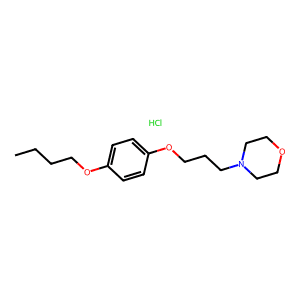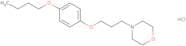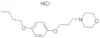
CAS 637-58-1
:Chlorhydrate de pramoxine
Description :
Chlorhydrate de pramoxine est un anesthésique local couramment utilisé pour ses propriétés analgésiques dans les formulations topiques. Il se caractérise par sa capacité à bloquer les signaux nerveux dans la zone où il est appliqué, offrant un soulagement temporaire de la douleur et des démangeaisons. La substance apparaît sous forme de poudre cristalline blanche à blanc cassé et est soluble dans l'eau, ce qui facilite son utilisation dans diverses préparations pharmaceutiques. Chlorhydrate de pramoxine a un profil de toxicité relativement faible, ce qui le rend adapté aux produits en vente libre, en particulier dans les formulations pour les irritations cutanées, les hémorroïdes et les piqûres d'insectes. Son mécanisme d'action implique l'inhibition des canaux sodiques, ce qui empêche la propagation des impulsions nerveuses. De plus, il est souvent combiné avec d'autres ingrédients actifs pour améliorer son efficacité et fournir un spectre plus large de soulagement. Comme pour tout médicament, il est essentiel de suivre les dosages recommandés et de consulter des professionnels de la santé pour une utilisation appropriée, en particulier chez les populations sensibles telles que les enfants ou les personnes ayant des problèmes de santé spécifiques.
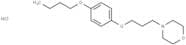
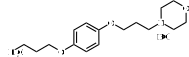
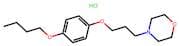
Formule :C17H28ClNO3
InChI :InChI=1/C17H27NO3.ClH/c1-2-3-12-20-16-5-7-17(8-6-16)21-13-4-9-18-10-14-19-15-11-18;/h5-8H,2-4,9-15H2,1H3;1H
Code InChI :InChIKey=SYCBXBCPLUFJID-UHFFFAOYSA-N
SMILES :O(CCCN1CCOCC1)C2=CC=C(OCCCC)C=C2.Cl
Synonymes :- 4-[3-(p-Butoxyphenoxy)propyl]morpholine hydrochloride
- Morpholine, 4-[3-(4-butoxyphenoxy)propyl]-, hydrochloride (1:1)
- Morpholine, 4-[3-(p-butoxyphenoxy)propyl]-, hydrochloride
- Pramacort
- Pramocaina, Clorhidrato
- Pramocaine Hydrochloride
- Pramocaine, Chlorhydrate
- Pramocainhydrochlorid
- Pramoxine hydrochloride
- Proctofoam
- Tronolaine
- Tronothan
- Tronothane
- Tronothane hydrochloride
- Pramoxine HCL
- Praxomine Hydrochloride
- 4-(3-(p-butoxyphenoxy)propyl)-morpholinhydrochloride
- 4-[3-(4-butoxyphenoxy)propyl]morpholine Hydrochloride (1:1)
- 4-N-BUTOXYPHENYL G-MORPHOLINOPROPYL ETHER Hydrochloride
- gamma-morpholinopropyl4-n-butoxyphenyletherhydrochloride
- p-butoxyphenylgamma-morpholinopropyletherhydrochloride
- Morpholine, 4-[3-(4-butoxyphenoxy)propyl]-, hydrochloride
- 4-n-butoxyphenyl gamma-morpholinopropyl ether hydrochloride
- PRAMOXINEHYDROCHLORIDE,USP
- 4-[3-(P-BUTOXYPHENOXY)PROPYL]MORPHOLINE HYDROCHLORIDE USP
- Proxazocaine hydrochloride
- MORPHOLINE,4-(3-(PARA-BUTOXYPHENOXY)PROPYL)-,HYDROCHLORIDE
- PRAMOXINE HCL USP
- TRONOTHANE HYDROCHLORIDE USP
- Voir plus de synonymes
Trier par
Degré de pureté (%)
0
100
|
0
|
50
|
90
|
95
|
100
14 produits concernés.
Pramoxine Hydrochloride
CAS :Nucleic acids and their salts, whether or not chemically defined; other heterocyclic compounds, nesoiFormule :C17H27NO3·HClCouleur et forme :White PowderMasse moléculaire :329.17577Morpholine, 4-[3-(4-butoxyphenoxy)propyl]-, hydrochloride
CAS :Formule :C17H28ClNO3Degré de pureté :98%Couleur et forme :SolidMasse moléculaire :329.8621Pramocaine hydrochloride
CAS :Pramocaine hydrochloride (Pramoxine HCl), a topical anesthetic, is served as an antipruritic.Formule :C17H27NO3·HClDegré de pureté :99.15% - 99.61%Couleur et forme :Crystals White Or Off White Crystalline PowderMasse moléculaire :329.86Pramoxine HCl
CAS :Formule :C17H27NO3·HClCouleur et forme :White To Off-White SolidMasse moléculaire :293.41 36.464-(3-(4-Butoxyphenoxy)Propyl)Morpholine Hydrochloride
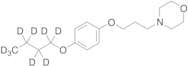
CAS :4-(3-(4-Butoxyphenoxy)Propyl)Morpholine HydrochlorideDegré de pureté :98%Masse moléculaire :329.86g/molPramoxine-d9 HCl
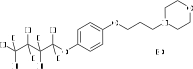
CAS :Formule :C17H18D9NO3·HClCouleur et forme :White To Off-White SolidMasse moléculaire :302.46 36.46Pramocaine hydrochloride
CAS :Pramocaine hydrochlorideDegré de pureté :≥98%Masse moléculaire :329.86g/molPramoxine hydrochloride
CAS :Produit contrôléFormule :C17H27NO3·ClHCouleur et forme :NeatMasse moléculaire :329.86Pramoxine Hydrochloride
CAS :Produit contrôléApplications Pramoxine Hydrochloride is used as a local anaesthetic and often in anti-itch formulations.
References Young, T. et al.: J. Derm. Treat., 20, 76 (2009); Schmidt, A. et al.: Pharm. Res.. 22. 2121 (2005);Formule :C17H27NO3·ClHCouleur et forme :Off-WhiteMasse moléculaire :329.86Pramoxine-d9
CAS :Produit contrôléApplications Pramoxine-d9 is the isotope labelled analog of Pramoxine (P700850); used as a local anaesthetic and often found in anti-itch formulations.
References Young, T. et al.: J. Derm. Treat., 20, 76 (2009); Schmidt, A. et al.: Pharm. Res.. 22. 2121 (2005)Formule :C17D9H18NO3Couleur et forme :NeatMasse moléculaire :302.457Pramoxine HCl
CAS :Pramoxine HCl is a leukotriene receptor antagonist that inhibits the action of the enzyme phospholipase A2, which is responsible for the conversion of arachidonic acid to prostaglandin H2. Pramoxine HCl has been shown to inhibit skin cell proliferation and induce apoptosis in human skin cells. It also has anti-inflammatory properties, and may have therapeutic potential for treating autoimmune diseases such as Crohn's disease. Pramoxine HCl is a colorless liquid that has a particle size of less than 10 microns, and has an odor of benzalkonium chloride. The melting point of pramoxine is 203°C, and its boiling point is 390°C.Formule :C17H27NO3·HClDegré de pureté :Min. 95%Masse moléculaire :329.86 g/mol
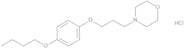


![Morpholine, 4-[3-(4-butoxyphenoxy)propyl]-, hydrochloride](/_next/image/?url=https%3A%2Fstatic.cymitquimica.com%2Fproducts%2FIN%2Fthumb%2FDA00IB9C.jpg&w=3840&q=75)