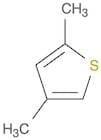
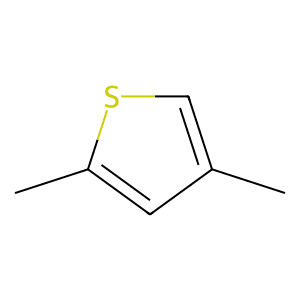
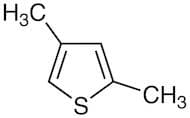
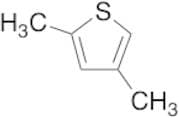
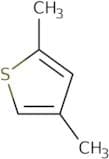
CAS 638-00-6
:2,4-Diméthylthiophène
- 2,4-Dibromo-3,5-Dimethylthiophene
- 2-(5-amino-1H-indazol-1-yl)ethanol
- Thiophene, 2,4-dimethyl-
- 2,4-Dimethylthiophene
2,4-Dimethylthiophene
CAS :Formule :C6H8SDegré de pureté :95%Couleur et forme :LiquidMasse moléculaire :112.19272,4-Dimethylthiophene
CAS :Formule :C6H8SDegré de pureté :>95.0%(GC)Couleur et forme :Colorless to Light yellow clear liquidMasse moléculaire :112.192,4-Dimethylthiophene
CAS :Formule :C6H8SDegré de pureté :97%Couleur et forme :LiquidMasse moléculaire :112.192,4-Dimethylthiophene
CAS :Produit contrôléApplications 2,4-Dimethylthiophene is a biochemical used for proteomics and food research.
References Xu, Q. et al.: Food Res. Int., 54, 683 (2013);Formule :C6H8SCouleur et forme :NeatMasse moléculaire :112.1932,4-Dimethylthiophene
CAS :2,4-Dimethylthiophene is a potential use for the treatment of respiratory infection. It has been shown to have bactericidal effects on Escherichia coli, Staphylococcus aureus, and Klebsiella pneumoniae at concentrations of 0.5-8μM. The minimal inhibitory concentration (MIC) for 2,4-dimethylthiophene against these bacteria was found to be significantly lower than that of erythromycin. 2,4-Dimethylthiophene has also been shown to have antibacterial activity against methicillin resistant Staphylococcus aureus (MRSA). This property may be due to its ability to react with fatty acids in the bacterial cell membrane and form an antibacterial molecule called diallyl trisulfide. 2,4-Dimethylthiophene reacts with hydrochloric acid in water at room temperature to form propionate ions and hydrogen chloride gas. Reaction products
Formule :C6H8SDegré de pureté :Min. 95%Couleur et forme :Clear LiquidMasse moléculaire :112.19 g/mol