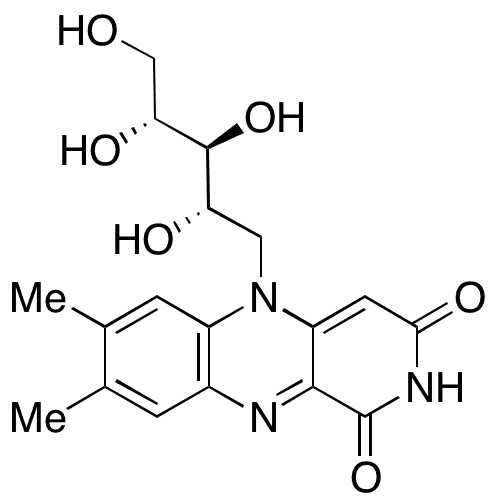
![1-deoxy-1-(7,8-dimethyl-1,3-dioxo-2,3-dihydropyrido[3,4-b]quinoxalin-5(1H)-yl)pentitol](/_next/image/?url=https%3A%2Fstatic.cymitquimica.com%2Fcas-image%2Fthumb-webp%2F77481-1-deoxy-1-78-dimethyl-13-dioxo-23-dihydropyrido-34-b-quinoxalin-5-1h-yl-pentitol.webp&w=3840&q=75)
CAS 64183-66-0
:1-désoxy-1-(7,8-diméthyl-1,3-dioxo-2,3-dihydropyrido[3,4-b]quinoxalin-5(1H)-yl)pentitol
Description :
1-désoxy-1-(7,8-diméthyl-1,3-dioxo-2,3-dihydropyrido[3,4-b]quinoxalin-5(1H)-yl)pentitol est un composé organique complexe caractérisé par ses caractéristiques structurelles uniques, y compris un groupe de sucre pentitol et un dérivé de pyridoquinoxaline. La présence de groupes fonctionnels dioxo indique une réactivité potentielle, en particulier dans la formation de liaisons hydrogène ou la participation à des réactions redox. Ce composé peut présenter une activité biologique en raison de sa structure complexe, qui pourrait interagir avec divers cibles biologiques. Les substitutions diméthyles sur l'anneau de pyridoquinoxaline suggèrent qu'il pourrait posséder des propriétés lipophiles, influençant potentiellement sa solubilité et sa perméabilité dans les systèmes biologiques. De plus, la stéréochimie du composant pentitol peut affecter son interaction avec des enzymes ou des récepteurs. Dans l'ensemble, les caractéristiques de ce composé suggèrent qu'il pourrait être d'un intérêt particulier en chimie médicinale, notamment dans le développement de produits pharmaceutiques ou comme outil de recherche dans les études biochimiques. Des investigations supplémentaires seraient nécessaires pour élucider ses propriétés spécifiques et ses applications potentielles.
Formule :C18H21N3O6
InChI :InChI=1/C18H21N3O6/c1-8-3-10-11(4-9(8)2)21(6-13(23)17(26)14(24)7-22)12-5-15(25)20-18(27)16(12)19-10/h3-5,13-14,17,22-24,26H,6-7H2,1-2H3,(H,20,25,27)
SMILES :Cc1cc2c(cc1C)n(CC(C(C(CO)O)O)O)c1cc(nc(=O)c1n2)O
Trier par
Degré de pureté (%)
0
100
|
0
|
50
|
90
|
95
|
100
2 produits concernés.
1-Deazariboflavin
CAS :Produit contrôléFormule :C18H21N3O6Couleur et forme :NeatMasse moléculaire :375.3761-Deazariboflavin
CAS :<p>1-Deazariboflavin is an analog of riboflavin that has been shown to have potent anticancer activity. It functions as a kinase inhibitor, preventing the phosphorylation of proteins involved in cancer cell growth and survival. 1-Deazariboflavin has been found in urine samples from cancer patients, suggesting that it may play a role in the body's natural defense against cancer. Studies have shown that this compound induces apoptosis (programmed cell death) in human cancer cells, including those derived from breast, lung, and colon tumors. Additionally, 1-Deazariboflavin has been found to inhibit glycerol kinase activity in Chinese hamster ovary cells. These findings suggest that 1-Deazariboflavin may be a promising candidate for the development of novel anticancer therapies.</p>Formule :C18H21N3O6Degré de pureté :Min. 95%Masse moléculaire :375.4 g/mol