CAS 642-31-9
:9-Anthracènecarboxaldéhyde
Description :
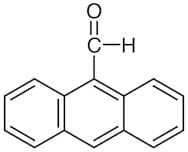
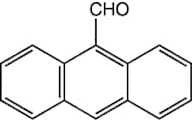
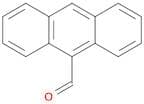
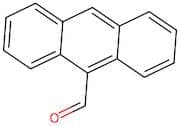
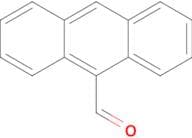
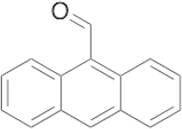
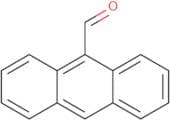
9-Anthracènecarboxaldéhyde, avec le numéro CAS 642-31-9, est un composé organique appartenant à la classe des aldéhydes. Il présente une structure d'anthracène, qui est un hydrocarbure aromatique polycyclique, avec un groupe formyle (-CHO) attaché à la position 9. Ce composé se caractérise par son état solide à température ambiante, apparaissant typiquement comme une substance cristalline de couleur jaune à brun clair. Il a un point de fusion relativement élevé et est peu soluble dans l'eau mais plus soluble dans des solvants organiques tels que l'éthanol et le dichlorométhane. 9-Anthracènecarboxaldéhyde est connu pour ses applications en synthèse organique, en particulier dans la préparation de divers dérivés et comme élément de base dans le développement de matériaux et de colorants fluorescents. De plus, il présente des propriétés photophysiques intéressantes, ce qui le rend utile dans la recherche liée aux dispositifs optoélectroniques. Comme de nombreux aldéhydes aromatiques, il peut présenter des risques pour la santé s'il est inhalé ou ingéré, nécessitant des précautions de sécurité appropriées lors de sa manipulation.
Formule :C15H10O
InChI :InChI=1S/C15H10O/c16-10-15-13-7-3-1-5-11(13)9-12-6-2-4-8-14(12)15/h1-10H
Code InChI :InChIKey=YMNKUHIVVMFOFO-UHFFFAOYSA-N
SMILES :C(=O)C=1C2=C(C=C3C1C=CC=C3)C=CC=C2
Synonymes :- 9-Anthracenaldehyde
- 9-Anthracenealdehyde
- 9-Anthracenecarbaldehyde
- 9-Anthracenecarboxaldehyde
- 9-Anthracenemethanal
- 9-Anthrylaldehyde
- 9-Anthrylcarboxaldehyde
- 9-Formylanthracene
- A-9-A
- Akos B029849
- Akos Bbs-00003154
- Antharacene-1-carboxaldehyde
- Anthracen-9-carbaldehyd
- Anthracene-9-Carbaldehyde
- Anthracene-9-Carboxaldehyde
- Anthraldehyde(9)
- Antraceno-9-Carbaldehido
- Nsc 15
- Voir plus de synonymes
Trier par
Degré de pureté (%)
0
100
|
0
|
50
|
90
|
95
|
100
8 produits concernés.
9-Anthracenecarboxaldehyde
CAS :Formule :C15H10ODegré de pureté :>99.0%(GC)Couleur et forme :White to Amber powder to crystalMasse moléculaire :206.249-Anthraldehyde, 98%
CAS :9-Anthraldehyde is used to prepare asymmetrical tridentate Schiff base ligands, 2-(9-anthrylmethyl-ideneamino)-4-methyl-phenol and functionalized ligand like 2-(anthracen-9-ylidene)-4,5-bis(diphenylphosphino)-4-cyclopentene-1,3-dione through Knoevenangel condensation with the diphosphine ligand 4,5-Formule :C15H10ODegré de pureté :98%Couleur et forme :Yellow to green, PowderMasse moléculaire :206.249-Anthraldehyde
CAS :Formule :C15H10ODegré de pureté :97%Couleur et forme :SolidMasse moléculaire :206.23939-Anthraldehyde
CAS :9-AnthraldehydeFormule :C15H10ODegré de pureté :98%Couleur et forme : yellow solidMasse moléculaire :206.24g/mol9-Formylanthracene
CAS :9-Formylanthracene is a hydroxylated derivative of anthracene. This molecule has significant cytotoxicity and shows high resistance to cancer cells. It is also capable of inducing apoptosis in carcinoma cell lines. 9-Formylanthracene binds to DNA polymerase, inhibiting the enzyme activity and blocking synthesis of DNA. It also inhibits other enzymes that are necessary for cellular metabolism, such as the ribonucleotide reductase enzyme. 9-Formylanthracene is a potential anticancer drug candidate due to its ability to inhibit DNA polymerase and induce apoptosis in cancer cells, but it does not show any effect on normal liver cells.
Degré de pureté :Min. 95%