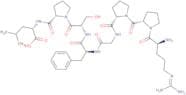
CAS 64695-06-3
:(Des-Arg9,Leu8)-Bradykinine
- H-Arg-Pro-Pro-Gly-Phe-Ser-Pro-Leu-OH
- N~5~-(diaminomethylidene)-L-ornithyl-L-prolyl-L-prolylglycyl-L-phenylalanyl-L-seryl-L-prolyl-L-leucine
Des-Arg9-[Leu8]-Bradykinin
CAS :Des-Arg9-[Leu8]-bradykinin is a bradykinin receptor activator. This peptide can be used as a research tool to study the relationship between peptides and ion channels in cell biology, and to assess the effects of inhibitors on protein interactions. Des-Arg9-[Leu8]-bradykinin has shown inhibitory activity against a number of ligand binding receptors, including the beta-adrenergic receptor, angiotensin II receptor, and acetylcholine muscarinic receptor. The affinity of this peptide for different receptors is dependent on its position within the molecule.
Formule :C41H63N11O10Degré de pureté :Min. 95%Masse moléculaire :870.01 g/mol(Des-Arg9,Leu8)-Bradykinin
CAS :Bradykinin is a peptide hormone that is produced in the body and has been found to be involved in many physiological processes. Bradykinin is formed from the cleavage of a larger protein, kininogen, by the enzyme kallikrein. Bradykinin binds to two types of receptors, B1 and B2. This antibody reacts with both types of receptor. The B2 receptor is found mainly on muscle cells and causes contraction, while the B1 receptor is found mainly on endothelial cells and causes vasodilation. The maximal response of bradykinin occurs when it binds to extracellular receptors. When knockout mice lack either type of bradykinin receptor they have an increased inflammatory response following injection with carrageenan or formaldehyde.
Formule :C41H63N11O10Degré de pureté :Min. 95%Masse moléculaire :870.01 g/mol
![Des-Arg9-[Leu8]-Bradykinin](/_next/image/?url=https%3A%2Fstatic.cymitquimica.com%2Fproducts%2F3D%2Fthumb%2FPBK-4065-V.jpg&w=3840&q=75)