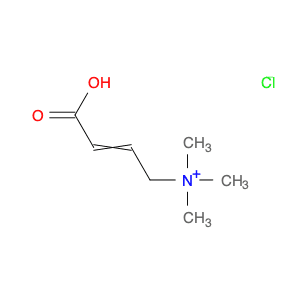
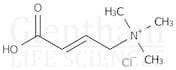
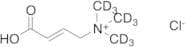
CAS 6538-82-5
:2-Propen-1-aminium, 3-carboxy-N,N,N-triméthyl-, chlorure (1:1)
- 2-Propen-1-aminium, 3-carboxy-N,N,N-trimethyl-, chloride
- 2-Propen-1-aminium, 3-carboxy-N,N,N-trimethyl-, chloride (1:1)
- Crotonobetaine hydrochloride
- Ammonium, (3-carboxyallyl)trimethyl-, chloride
- (3-Carboxyallyl)trimethylammonium chloride
- Levocarnitine Impurity A as Chloride
- (3-carboxyallyl)trimethyl-ammoniuchloride
- 2-Propen-1-aminium, 3-carboxy-N,N,Ntrimethyl-, chloride (1:1)
- Crotonoylbetaine hydrochloride
- crotonobetainehydrochloride
- Levocarnitine Related CoMpound A
- Levocarnitine Related Impurity A
- Levocarnitine EP Impurity A Chloride
- Levocarnitine Impurity 1(Levocarnitine EP Impurity A)
- Levocarnitine Related Compound A (100 mg) (2-propen-1-aminium, 3-carboxy-N,N,N-trimethyl-, chloride)
- (3-carboxyallyl)trimethylammoniumchloride
- LEVOCARNITINE RELATED COMPOUND A (100 MG) (3-CARBOXY-N,N,N-TRIMETHYL-2-PROPEN-1-AMINIUM CHLORIDE)
- Levocarnitine EP Impurity A as Chloride
- (E)-3-carboxyprop-2-enyl]-trimethylazanium,chloride
- 3-carboxy-n,n,n-trimethyl-2-propen-1-aminiuchloride
- Levocarnitine Related Compound A (2-propen-1-aminium, 3-carboxy-N,N,N-trimethyl-, chloride) (1359925)
- Levocarnitine EP Impurity A
- Levocarnitine Related Compound A as Chloride
- Levocarnitine USP Related Compound A as Chloride
- 3-carboxy-N,N,N-trimethylprop-2-en-1-aminium chloride
- Levocarnitine Impurity 1
- Voir plus de synonymes
Levocarnitine Related Compound A (2-Propen-1-aminium, 3-carboxy-N,N,N-trimethyl-, chloride)
CAS :Quaternary ammonium salts and hydroxides, whether or not chemically defined, nesoiFormule :C7H14NO2ClCouleur et forme :White Crystalline PowderMasse moléculaire :179.07131LEVOCARNITINE RELATED COMPOUND A (100 MG) (3-CARBOXY-N,N,N-TRIMETHYL-2-PROPEN-1-AMINIUM CHLORIDE)
CAS :Formule :C7H14ClNO2Degré de pureté :98%Couleur et forme :SolidMasse moléculaire :179.6446Crotonobetaine hydrochloride
CAS :Formule :C7H14ClNO2Degré de pureté :≥ 98.0%Couleur et forme :White to off-white solidMasse moléculaire :179.64(2EZ)-4-(Trimethylazaniumyl)but-2-enoic Acid Chloride (Crotonobetaine Hydrochloride)
CAS :Produit contrôléFormule :C7H14NO2·ClCouleur et forme :NeatMasse moléculaire :179.64Crotonobetaine Hydrochloride
CAS :Impurity Levocarnitine USP Related Compound A
Stability Hygroscopic
Applications Crotonobetaine Hydrochloride is HCl salt of Crotonobetaine (C818800) which is a trimethylammonium compound that can be converted into L-Carnitine by Escherichia coli via stereoselective hydration. Levocarnitine USP Related Compound A.
References Seim, H. et al.: Eur. Congr. Biotechnol., 1, 481 (1984); Seim, H. et al.: Appl. Microbiol. Biotechnol., 27, 538 (1988);Formule :C7H14NO2·ClCouleur et forme :Off-WhiteMasse moléculaire :179.64Crotonobetaine Hydrochloride-d9
CAS :Produit contrôléApplications Labelled analogue of Crotonobetaine Hydrochloride, a trimethylammonium compound that can be converted into L-Carnitine by Escherichia coli via stereoselective hydration.
References Seim, H. et al.: Eur. Congr. Biotechnol., 1, 481 (1984); Seim, H. et al.: Appl. Microbiol. Biotechnol., 27, 538 (1988);Formule :C7H5D9ClNO2Couleur et forme :NeatMasse moléculaire :188.7Levocarnitine Related Compound A
CAS :Levocarnitine Related Compound A is an organic compound with the chemical formula of CHClNO. It is a chloride salt that can be used as a pharmaceutical formulation. Levocarnitine Related Compound A has been shown to have anti-inflammatory properties by inhibiting the production of prostaglandin E2, which may be due to its ability to inhibit intestinal betaine and carnitine metabolism. This compound also has the ability to prevent infarction in rats by preventing acid-induced release of choline from phosphatidylcholine. Levocarnitine Related Compound A has been found to bind to monoclonal antibodies and has been used for the detection of microbial metabolites in various food products.
Formule :C7H14ClNO2Degré de pureté :Min. 95%Couleur et forme :PowderMasse moléculaire :179.64 g/mol