CAS 65884-46-0
:Ciadóx
Description :
Ciadóx est un composé antibiotique principalement utilisé en médecine vétérinaire, en particulier pour le bétail. Il appartient à la classe des dérivés de quinoxaline et est connu pour son efficacité contre certaines infections bactériennes, en particulier celles causées par des bactéries Gram-positives. Ciadóx agit en inhibant la synthèse des protéines bactériennes, empêchant ainsi la croissance et la reproduction des pathogènes. Il est souvent utilisé dans l'alimentation animale pour favoriser la croissance et améliorer l'efficacité alimentaire. La substance se caractérise par sa solubilité relativement faible dans l'eau, ce qui influence sa biodisponibilité et son absorption chez les animaux. De plus, Ciadóx a été étudié pour ses effets potentiels sur la santé animale et ses implications pour la sécurité alimentaire, car des résidus peuvent persister dans les produits d'origine animale. Les agences réglementaires surveillent son utilisation pour s'assurer qu'elle ne présente pas de risques pour la santé humaine ou l'environnement. Comme pour tout antibiotique, le développement de résistance est une préoccupation, nécessitant une gestion prudente de son application dans les pratiques agricoles.
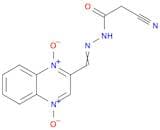
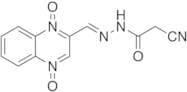
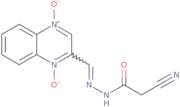
Formule :C12H9N5O3
InChI :InChI=1S/C12H9N5O3/c13-6-5-12(18)15-14-7-9-8-16(19)10-3-1-2-4-11(10)17(9)20/h1-4,7-8H,5H2,(H,15,18)
Code InChI :InChIKey=MBCZYLSVSCJJJQ-UHFFFAOYSA-N
SMILES :O=N=1C2=C(N(=O)=CC1C=NNC(CC#N)=O)C=CC=C2
Synonymes :- 3-{(E)-[(E)-(1-hydroxy-4-oxidoquinoxalin-2(1H)-ylidene)methyl]diazenyl}-3-oxopropanenitrile
- Acetic acid, 2-cyano-, 2-[(1,4-dioxido-2-quinoxalinyl)methylene]hydrazide
- Acetic acid, cyano-, (2-quinoxalinylmethylene)hydrazide, N,N-dioxide
- Acetic acid, cyano-, [(1,4-dioxido-2-quinoxalinyl)methylene]hydrazide
- Brn 0826894
- Ciadox [INN]
- Ciadoxum
- Ciadoxum [INN-Latin]
- Cyadox
- Cyanoacetic acid (2-quinoxalinylmethylene)hydrazide, N(sup 1),N(sup 4)-dioxide
- Cyanoacetylhydrazone 2-formylquinoxaline-1,4-dioxide
- N'-(2-Chinoxalinylmethylen)cyanacetohydrazid 1,4-dioxid
- Unii-Hx312O5Ugn
- Vufb 11502
- Voir plus de synonymes
Trier par
Degré de pureté (%)
0
100
|
0
|
50
|
90
|
95
|
100
5 produits concernés.
Acetic acid, cyano-, (2-quinoxalinylmethylene)hydrazide, N,N′-dioxide
CAS :Formule :C12H9N5O3Degré de pureté :98%Couleur et forme :SolidMasse moléculaire :271.2316Cyadox
CAS :Applications Cyadox is an antibiotic drug and has the potential to be used as a feedstuff additive in promoting the growth of animals.
References Huang, C., et al.: J. Proteome, Res. 4, 537 (2013); Wu, H.X., et al.: J. Pharma. Biomed. Anal., 67, 175 (2012);Formule :C12H9N5O3Couleur et forme :Yellow-Red SolidMasse moléculaire :271.23Cyadox-13C,15N2
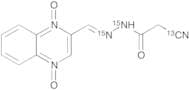
CAS :Produit contrôléFormule :CC11H915N2N3O3Couleur et forme :NeatMasse moléculaire :274.211Cyadox
CAS :Cyadox is a metal chelate compound that has been shown to have antibacterial efficacy against Gram-positive bacteria. Cyadox binds to fatty acids on the bacterial cell membrane and forms an ionic complex, which results in the disruption of the lipid bilayer and inhibition of protein synthesis. Cyadox has been shown to inhibit epidermal growth factor (EGF) activity in human serum and may be used for the treatment of skin infections. Cyadox also shows genotoxic activity at high concentrations, but not at low concentrations. Cyadox is effective against Gram-positive bacteria and has been used in combination with other antibiotics to treat infections caused by methicillin-resistant Staphylococcus aureus (MRSA). The LC-MS/MS method was used to determine the concentration of cyadox in human liver cells.Formule :C12H9N5O3Degré de pureté :Min. 95%Masse moléculaire :271.23 g/mol