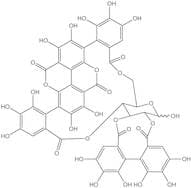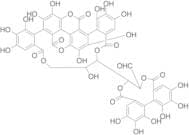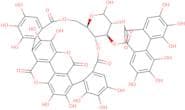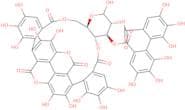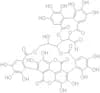
CAS 65995-63-3
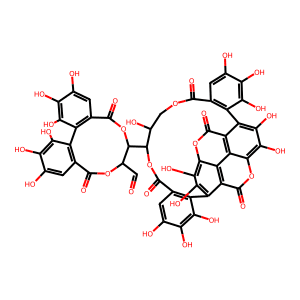
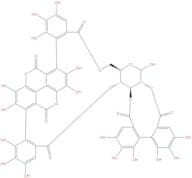
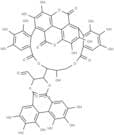
:Punicalagine
Description :
Punicalagine est un composé polyphénolique que l'on trouve principalement dans les grenades, en particulier dans l'écorce et le jus du fruit. Il appartient à une classe de composés connus sous le nom d'ellagitanins, qui sont reconnus pour leurs propriétés antioxydantes. Punicalagine se caractérise par sa capacité à piéger les radicaux libres, contribuant ainsi aux bienfaits pour la santé associés à la consommation de grenade, tels que des effets anti-inflammatoires et des effets anticancéreux potentiels. Le composé est soluble dans l'eau et présente une structure complexe qui comprend plusieurs groupes hydroxyles, ce qui améliore sa réactivité et son activité biologique. Punicalagine a suscité un intérêt dans la recherche nutritionnelle et pharmaceutique en raison de ses applications thérapeutiques potentielles, y compris la santé cardiovasculaire et la gestion du syndrome métabolique. De plus, il peut influencer la composition du microbiote intestinal, contribuant ainsi à ses effets bénéfiques pour la santé. Dans l'ensemble, Punicalagine est un composé bioactif significatif qui illustre les bienfaits pour la santé de la grenade et de ses dérivés.
Formule :C48H28O30
InChI :InChI=1S/C48H28O30/c49-5-16-40(76-46(70)9-3-13(52)28(56)32(60)18(9)17-8(44(68)74-16)2-12(51)27(55)31(17)59)39-15(54)6-73-43(67)7-1-11(50)29(57)33(61)19(7)21-25-23-24-26(48(72)78-41(23)37(65)35(21)63)22(36(64)38(66)42(24)77-47(25)71)20-10(45(69)75-39)4-14(53)30(58)34(20)62/h1-5,15-16,39-40,50-66H,6H2
Code InChI :InChIKey=SKNLUADAGHCXKF-UHFFFAOYSA-N
SMILES :O=C1C=2C=3C=4C5=C(C=6C(=CC(O)=C(O)C6O)C(=O)OCC(O)C(OC(=O)C=7C(C2C(O)=C(O)C3OC5=O)=C(O)C(O)=C(O)C7)C8C(C=O)OC(=O)C=9C(C=%10C(C(=O)O8)=CC(O)=C(O)C%10O)=C(O)C(O)=C(O)C9)C(O)=C(O)C4O1
Synonymes :- 1,2,3,11,12,13-Hexahydroxy-5,10-Dioxo-8-[3,4,5,11,17,18,19,22,23,34,35-Undecahydroxy-8,14,26,31-Tetraoxo-9,13,25,32-Tetraoxaheptacyclo[25.8.0.02,7.015,20.021,30.024,29.028,33]Pentatriaconta-1(35),2,4,6,15,17,19,21,23,27,29,33-Dodecaen-10-Yl]-5,7,8,10-Tetrahydrodibenzo[F,H][1,4]Dioxecine-7-Carbaldehyde (Non-Preferred Name)
- 2,20,1,23-(Epoxy[2]propene[1,2]diyl[3]ylidene)-11H,15H-tribenzo[g,i,q][1,5,12]trioxacyclononadecin, <span class="text-smallcaps">D</span>-glucose deriv.
- <span class="text-smallcaps">D</span>-Glucose, cyclic 4,6-[(2S,2′S)-2,2′-(5,10-dihydro-2,3,7,8-tetrahydroxy-5,10-dioxo[1]benzopyrano[5,4,3-cde][1]benzopyran-1,6-diyl)bis[3,4,5-trihydroxybenzoate]] cyclic 2,3-[(1S)-4,4′,5,5′,6,6′-hexahydroxy[1,1′-biphenyl]-2,2′-dicarboxylate]
- <span class="text-smallcaps">D</span>-Glucose, cyclic 4,6-[(S,S)-2,2′-(5,10-dihydro-2,3,7,8-tetrahydroxy-5,10-dioxo[1]benzopyrano[5,4,3-cde][1]benzopyran-1,6-diyl)bis[3,4,5-trihydroxybenzoate]] cyclic 2,3-[(S)-4,4′,5,5′,6,6′-hexahydroxy[1,1′-biphenyl]-2,2′-dicarboxylate]
- <span class="text-smallcaps">D</span>-Glucose, cyclic 4,6-[2,2′-(5,10-dihydro-2,3,7,8-tetrahydroxy-5,10-dioxo[1]benzopyrano[5,4,3-cde][1]benzopyran-1,6-diyl)bis[3,4,5-trihydroxybenzoate]] cyclic 2,3-(4,4′,5,5′,6,6′-hexahydroxy[1,1′-biphenyl]-2,2′-dicarboxylate), [2(S),4(S,S)]-
- D-Glucose, cyclic 4,6-(2,2'-(5,10-dihydro-2,3,7,8-tetrahydroxy-5,10-dioxo(1)benzopyrano(5,4,3-cde)(1)benzopyran-1,6-diyl)bis(3,4,5-trihydroxybenzoate)) cyclic 2,3-(4,4',5,5',6,6'-hexahydroxy(1,1'-biphenyl)-2,2'-dicarboxylate)-, (2(S),4(S,S))-
- Dibenzo[f,h][1,4]dioxecin, <span class="text-smallcaps">D</span>-glucose deriv.
- Pomegranate extract
- Punicalagins
- D-Glucose, cyclic 4,6-[(2S,2′S)-2,2′-(5,10-dihydro-2,3,7,8-tetrahydroxy-5,10-dioxo[1]benzopyrano[5,4,3-cde][1]benzopyran-1,6-diyl)bis[3,4,5-trihydroxybenzoate]] cyclic 2,3-[(1S)-4,4′,5,5′,6,6′-hexahydroxy[1,1′-biphenyl]-2,2′-dicarboxylate]
- Dibenzo[f,h][1,4]dioxecin, D-glucose deriv.
- D-Glucose, cyclic 4,6-[2,2′-(5,10-dihydro-2,3,7,8-tetrahydroxy-5,10-dioxo[1]benzopyrano[5,4,3-cde][1]benzopyran-1,6-diyl)bis[3,4,5-trihydroxybenzoate]] cyclic 2,3-(4,4′,5,5′,6,6′-hexahydroxy[1,1′-biphenyl]-2,2′-dicarboxylate), [2(S),4(S,S)]-
- Punicalagin
- Voir plus de synonymes
Trier par
Degré de pureté (%)
0
100
|
0
|
50
|
90
|
95
|
100
11 produits concernés.
Punicalagin
CAS :Aromatic heterocyclic compounds with oxygen hetero-atom(s) only, nesoiFormule :C48H28O30Couleur et forme :Green Yellow Light Yellow PowderMasse moléculaire :1084.06654D-Glucose, cyclic4,6-[(2S,2'S)-2,2'-(5,10-dihydro-2,3,7,8-tetrahydroxy-5,10-dioxo[1]benzopyrano[5,4,3-cde][1]benzopyran-1,6-diyl)bis[3,4,5-trihydroxybenzoate]]cyclic2,3-[(S)-4,4',5,5',6,6'-hexahydroxy[1,1'-biphenyl]-2,2'-dicarboxylate]
CAS :Formule :C6H6FNDegré de pureté :98%Couleur et forme :SolidMasse moléculaire :111.1169Punicalagin
CAS :Formule :C48H28O30Degré de pureté :≥ 98.0%Couleur et forme :Pale yellow to dark yellow powderMasse moléculaire :1084.72Punicalagin
CAS :Punicalagin has antifungal , antiviral, anti-atherosclerotic, hepatoprotective , anti-obesity., antiproliferative, anti-apoptotic, anti-inflammatory, and antioxidant effects. It can suppress the phosphorylation of MAPK including p38, c-JNK, and ERK, it also has potently inhibiting the activity of fatty acid synthase with half-inhibitory concentration values (IC 50 ) of 4.50μM.Formule :C48H28O30Degré de pureté :95%~99%Masse moléculaire :1084.72Punicalagin
CAS :Punicalagin, an ellagitannin in pomegranates, has antioxidant, anti-inflammatory, anticancer properties, and combats heart issues from high-fat diets.Formule :C48H28O30Degré de pureté :98% - 99.7%Couleur et forme :White Crystalline PowderMasse moléculaire :1084.72Punicalagin (a + b mixture)
CAS :Natural glycosideFormule :C48H28O30Degré de pureté :≥ 90.0 % (HPLC)Couleur et forme :PowderMasse moléculaire :1084.73Punicalagin
CAS :Applications Punicalagin is a natural polyphenolic compound extracted from the fruit of Pomegranate and acts as an effective anti-inflammatory and anti-oxidant.
References Xu, X. et al.: Inflamm., 37, 956 (2014); Ordoudi, S. et al.: J. Func. Food., 8, 161 (2014);Formule :C48H28O30Couleur et forme :NeatMasse moléculaire :1084.72Punicalagin - technical
CAS :Produit contrôléPunicalagin is a hydrolyzable tannin, which is derived from the peel and seeds of pomegranates (Punica granatum). This compound is one of the primary polyphenols contributing to the fruit’s potent antioxidant capabilities. Structurally, punicalagin is distinguished by its galloyl and ellagic acid moieties, facilitating its remarkable stability and bioavailability.Formule :C48H28O30Degré de pureté :(%) Min. 40%Couleur et forme :PowderMasse moléculaire :1,084.72 g/molPunicalagin, (mixture of α+β) - 98% min
CAS :Produit contrôléPunicalagin (mixture of α+β) - 98% min is a highly pure tannin-derived compound, specifically classified as an ellagitannin, known for its potent antioxidant properties. It is primarily sourced from pomegranate (Punica granatum) and several other plant species. The compound consists of isomeric forms, α and β, collectively contributing to its efficacy.Formule :C48H28O30Degré de pureté :Min. 98 Area-%Couleur et forme :Off-White PowderMasse moléculaire :1,084.72 g/mol


![D-Glucose, cyclic4,6-[(2S,2'S)-2,2'-(5,10-dihydro-2,3,7,8-tetrahydroxy-5,10-dioxo[1]benzopyrano[5,…](/_next/image/?url=https%3A%2Fstatic.cymitquimica.com%2Fproducts%2FIN%2Fthumb%2FDA00IKLU.jpg&w=3840&q=75)