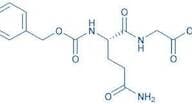
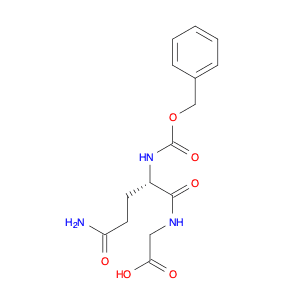
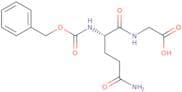
CAS 6610-42-0
:Benzyloxycarbonyl-L-glutaminylglycine
- 2-[[(2S)-5-Amino-5-oxo-2-(phenylmethoxycarbonylamino)pentanoyl]amino]acetic acid
- Benzyloxycarbonyl-<span class="text-smallcaps">L</span>-glutaminylglycine
- Carbobenzoxy-<span class="text-smallcaps">L</span>-glutaminylglycine
- Glycine, N-(N<sup>2</sup>-carboxy-<span class="text-smallcaps">L</span>-glutaminyl)-, N-benzyl ester
- Glycine, N-(N<sup>2</sup>-carboxy-<span class="text-smallcaps">L</span>-glutaminyl)-, N<sup>2</sup>-benzyl ester
- Glycine, N-[N<sup>2</sup>-[(phenylmethoxy)carbonyl]-<span class="text-smallcaps">L</span>-glutaminyl]-
- Glycine, N<sup>2</sup>-[(phenylmethoxy)carbonyl]-<span class="text-smallcaps">L</span>-glutaminyl-
- N-(Benzyloxycarbonyl)-<span class="text-smallcaps">L</span>-glutaminylglycine
- N<sup>2</sup>-[(Phenylmethoxy)carbonyl]-<span class="text-smallcaps">L</span>-glutaminylglycine
- N<sup>α</sup>-(Benzyloxycarbonyl)-<span class="text-smallcaps">L</span>-glutaminylglycine
- NSC 186901
- N~2~-[(benzyloxy)carbonyl]glutaminylglycine
- Z-Gln-Gly-OH
- Glycine, N-(N2-carboxy-L-glutaminyl)-, N2-benzyl ester
- Glycine, N-[N2-[(phenylmethoxy)carbonyl]-L-glutaminyl]-
- Glycine, N2-[(phenylmethoxy)carbonyl]-L-glutaminyl-
- Glycine, N-(N2-carboxy-L-glutaminyl)-, N-benzyl ester
- Voir plus de synonymes
N-Benzyloxycarbonyl-L-glutaminylglycine, 98%
CAS :This Thermo Scientific Chemicals brand product was originally part of the Alfa Aesar product portfolio. Some documentation and label information may refer to the legacy brand. The original Alfa Aesar product / item code or SKU reference has not changed as a part of the brand transition to Thermo SciFormule :C15H19N3O6Degré de pureté :98%Couleur et forme :White to pale cream, PowderMasse moléculaire :337.33Z-Gln-Gly-OH
CAS :Substrate for tissue transaminase. De Macédo et al. described a direct continuous spectrophotometric assay for transglutaminase (TGase) activity.Formule :C15H19N3O6Degré de pureté :> 99%Couleur et forme :White PowderMasse moléculaire :337.33Z-GLN-GLY-OH
CAS :Formule :C15H19N3O6Degré de pureté :98%Couleur et forme :SolidMasse moléculaire :337.3279Z-Gln-Gly
CAS :Z-Gln-Gly is a protected dipeptide, which is commonly used as an intermediate in peptide synthesis. It is derived from the amino acids glutamine and glycine, with the N-terminal glutamine being protected by a benzyloxycarbonyl (Z or Cbz) group. This protective group is essential for preventing undesirable reactions at the amine site during peptide chain elongation.The primary mode of action for Z-Gln-Gly involves its use in solid-phase peptide synthesis, where the Z-group safeguards the amine functionality. This protection allows for selective reactions at other sites of the molecule until the final deprotection step, facilitating the sequential addition of amino acids.Z-Gln-Gly is used predominantly in research and development within biochemical and pharmaceutical laboratories. Its applications are critical in the synthesis of longer peptide chains and peptide-based drugs, where precision and control over the peptide structure are paramount for investigating biological processes and therapeutic functions.Formule :C15H19N3O6Degré de pureté :Min. 95%Masse moléculaire :337.33 g/molZ-Gln-Gly-OH
CAS :Z-Gln-Gly-OH is a synthetic dipeptide, which is a modified amino acid sequence commonly used in biochemical applications. It consists of a carbobenzoxy-protected glutamine and a glycine residue. This compound originates from custom organic synthesis, derived through specific chemical protocols to introduce protective groups that block reactive sites on the amino acids. This controlled modification alters the peptide's stability and solubility.The mode of action involves the protection of active sites during complex syntheses, enabling the sequential construction of peptide chains without unintended reactions. This protection is critical in solid-phase peptide synthesis methodologies where precision and specificity of reactions are paramount. The Z-group (benzyloxycarbonyl) ensures the stability of glutamine under various chemical conditions, preventing side reactions that may compromise the integrity of peptide constructs.In research, Z-Gln-Gly-OH finds applications in the design of peptide-based inhibitors, structural studies, and the synthesis of longer chain peptides that mimic biologically relevant structures. The protection strategy allows scientists to develop and manipulate peptides with high fidelity, facilitating advancements in understanding protein functions and interactions in physiological contexts.
Formule :C15H19N3O6Degré de pureté :Min. 95%Couleur et forme :PowderMasse moléculaire :337.33 g/mol(S)-2-(5-Amino-2-(((benzyloxy)carbonyl)amino)-5-oxopentanamido)acetic acid
CAS :Formule :C15H19N3O6Degré de pureté :98%Masse moléculaire :337.332