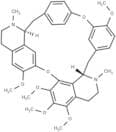
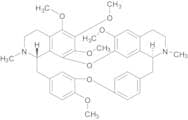
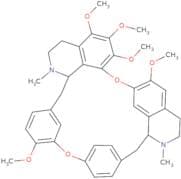
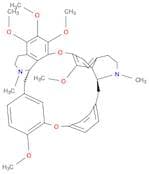
CAS 6681-13-6
:(4aS,16aS)-3,4,4a,5,16a,17,18,19-Octahydro-12,20,21,22,26-pentaméthoxy-4,17-diméthyl-16H-1,24:6,9-diéthéno-11,15-méthéno-2H-pyrido[2′,3′:17,18][1,11]dioxacycloéicosino[2,3,4-ij]isoquinoléine
Description :
La substance chimique portant le nom "(4aS,16aS)-3,4,4a,5,16a,17,18,19-Octahydro-12,20,21,22,26-pentaméthoxy-4,17-diméthyl-16H-1,24:6,9-diéthéno-11,15-méthéno-2H-pyrido[2′,3′:17,18][1,11]dioxacycloéicosino[2,3,4-ij]isoquinoléine" et le numéro CAS "6681-13-6" est un composé organique complexe caractérisé par une structure à plusieurs cycles qui incorpore divers groupes fonctionnels, y compris des moieties méthoxy et éthylène. Sa stéréochimie est définie par des configurations spécifiques à plusieurs centres chiraux, qui contribuent à son activité biologique potentielle. La présence de plusieurs groupes méthoxy suggère qu'il pourrait présenter des propriétés uniques de solubilité et de réactivité. De plus, le cadre complexe du composé indique des applications potentielles en chimie médicinale, en particulier dans le développement de produits pharmaceutiques. La complexité structurelle peut également influencer ses interactions avec des cibles biologiques, en faisant un sujet d'intérêt pour des recherches supplémentaires dans la conception et la synthèse de médicaments. Dans l'ensemble, ce composé illustre la diversité et la complexité que l'on trouve dans la chimie organique, en particulier dans le domaine des dérivés de produits naturels.
Formule :C39H44N2O7
InChI :InChI=1S/C39H44N2O7/c1-40-16-14-25-21-32(43-4)34-22-28(25)29(40)18-23-8-11-26(12-9-23)47-33-20-24(10-13-31(33)42-3)19-30-35-27(15-17-41(30)2)36(44-5)38(45-6)39(46-7)37(35)48-34/h8-13,20-22,29-30H,14-19H2,1-7H3/t29-,30-/m0/s1
Code InChI :InChIKey=FUZMQNZACIFDBL-KYJUHHDHSA-N
SMILES :O(C)C1=C2C3=C(C(OC)=C1OC)CCN(C)[C@]3(CC=4C=C(C(OC)=CC4)OC=5C=CC(C[C@]6(C7=CC(O2)=C(OC)C=C7CCN6C)[H])=CC5)[H]
Synonymes :- (+)-Hernandezine
- (4aS,16aS)-3,4,4a,5,16a,17,18,19-Octahydro-12,20,21,22,26-pentamethoxy-4,17-dimethyl-16H-1,24:6,9-dietheno-11,15-metheno-2H-pyrido[2′,3′:17,18][1,11]dioxacycloeicosino[2,3,4-ij]isoquinoline
- 16H-1,24:6,9-Dietheno-11,15-metheno-2H-pyrido[2′,3′:17,18][1,11]dioxacycloeicosino[2,3,4-ij]isoquinoline, 3,4,4a,5,16a,17,18,19-octahydro-12,20,21,22,26-pentamethoxy-4,17-dimethyl-, (4aS,16aS)-
- 16H-1,24:6,9-Dietheno-11,15-metheno-2H-pyrido[2′,3′:17,18][1,11]dioxacycloeicosino[2,3,4-ij]isoquinoline, berbaman deriv.
- Berbaman, 5,6,6',7,12-pentamethoxy-2,2'-dimethyl-, (1beta)-
- Berbaman, 5,6,6′,7,12-pentamethoxy-2,2′-dimethyl-, (1β)-
- Hernandesine
- Thalicsimine
- (1beta)-5,6,6',7,12-Pentamethoxy-2,2'-dimethylberbaman
Trier par
Degré de pureté (%)
0
100
|
0
|
50
|
90
|
95
|
100
7 produits concernés.
Hernandezine
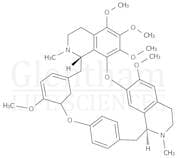
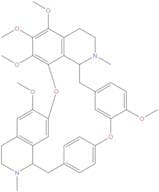
CAS :Hernandezine is an activator of AMPK activator and a selective reversing agent for ABCB1-mediated MDR in cancer cells.Formule :C39H44N2O7Degré de pureté :99.53%Couleur et forme :SolidMasse moléculaire :652.78Hernandezine
CAS :Produit contrôléApplications Hernandezine is a novel anticancer AMPK activator identified as a major major active constituent of Thalictrum Ranunculaceae.
References Song, Y. et al.: J. Pharm. Biomed. Anal., 141, 132 (2017);Formule :C39H44N2O7Couleur et forme :NeatMasse moléculaire :652.776Hernandezine
CAS :Hernandezine is a natural compound that belongs to the class of bisbenzylisoquinoline alkaloids. It is extracted from the bark of Quillaja saponaria, a chinese herb. Hernandezine has been shown to induce autophagy and inhibit lipid accumulation in hl-60 cells. This drug also has antitumor and antimetastatic effects on brain tumor cells, as well as anti-inflammatory properties. Hernandezine inhibits Ca2+ uptake in mitochondria, which can lead to cell death. Hernandezine has been shown to be a potential drug transporter for fat cells and may have immunosuppressive effects on autoimmune diseases such as diabetes or arthritis.Formule :C39H44N2O7Degré de pureté :Min. 95%Masse moléculaire :652.8 g/mol