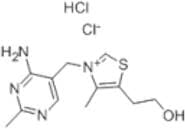
CAS 67-03-8
:Chlorhydrate de thiamine
- 3-(4-Amino-2-methylpyrimidyl-5-methyl)-4-methyl-5,β-hydroxyethylthiazolium chloride hydrochloride
- 3-[(4-Amino-2-Methylpyrimidin-5-Yl)Methyl]-5-(2-Hydroxyethyl)-4-Methyl-1,3-Thiazol-3-Ium Chloride Hydrochloride (1:1:1)
- 3-[(4-Amino-2-methyl-5-pyrimidinyl)methyl]-5-(2-hydroxyethyl)-4-methylthiazolium chloride monohydrochloride
- 3-[(4-Amino-2-methylpyrimidin-5-yl)methyl]-5-(2-hydroxyethyl)-4-methyl-1,3-thiazol-3-ium hydrochloride chloride
- Aneurine Hydrochloride
- Apate drops
- Beatine
- Bedome
- Begiolan
- Benerva
- Bequin
- Berin
- Betabion
- Betalin S
- Betaxin
- Bethiazine
- Beuion
- Bevitine
- Bewon
- Biamine
- Biuno
- Bivatin
- Bivita
- Clotiamina
- Eskapen
- Eskaphen
- Hydroxyethyl)-4-Methyl- Chloride, Monohydrochloride
- Lixa-Beta
- Metabolin
- Slowten
- THD
- Thiadoxine
- Thiamin chloride
- Thiamin dichloride
- Thiamin hydrochloride
- Thiaminal
- Thiamine HCL
- Thiamine Hcl Plant Cell Culture Tested
- Thiamine Hydrochloride (B1)
- Thiamine chlorhydrate
- Thiamine chloride
- Thiamine chloride hydrochloride
- Thiamine dichloride
- Thiamine, monohydrochloride
- ThiamineHydrochlorideB.P.U.S.P.
- Thiaminehydrochloride,FCC
- Thiaminhydrochlorid
- Thiaminhydrochloride
- Thiaminium Dichloride
- Thiaminium chloride
- Thiaminium chloride hydrochloride
- Thiamol
- Thiavit
- Thiazolium, 3-(4-amino-2-methyl-5-pyrimidinyl)methyl-5-(2-
- Thiazolium, 3-[(4-Amino-2-Methyl-5-Pyrimidinyl)Methyl]-5-(2-Hydroxyethyl)-4-Methyl Chloride, Mo..
- Thiazolium, 3-[(4-Amino-2-Methyl-5-Pyrimidinyl)Methyl]-5-(2-Hydroxyethyl)-4-Methyl-, Dichloride
- Thiazolium, 3-[(4-amino-2-methyl-5-pyrimidinyl)methyl]-5-(2-hydroxyethyl)-4-methyl- chloride (1:1), hydrochloride (1:1)
- Thiazolium, 3-[(4-amino-2-methyl-5-pyrimidinyl)methyl]-5-(2-hydroxyethyl)-4-methyl- chloride, monohydrochloride
- Thiazolium, 3-[(4-amino-2-methyl-5-pyrimidinyl)methyl]-5-(2-hydroxyethyl)-4-methyl-, chloride, hydrochloride (1:1:1)
- Tiamidon
- Tiamina, Clorhidrato
- Tiaminal
- Trophite
- Vetalin S
- Vinothiam
- Vit B1
- Vitamin B1 Hcl
- Vitamin B1 hydrochloride
- Vitamin B<sub>1</sub> hydrochloride
- Vitamin B_1 hydrochloride
- Vitamine B1 Hydrochloride
- Vitaneuron
- Thiamine, hydrochloride
- VB1 HCL
- 3-(4-AMINO-2-METHYLPYRIMIDYL-5-METHYL)-4-METHYL-5-(B-HYDROXYETHYL)THIAZOLIUM CHLORIDE HYDROCHLORIDE
- thiamine diphosphate chloride
- B1-THIAMINE HYDROCHLORIDE
- LABOTEST-BB LT00455558
- THIAMINE
- FEMA 3322
- ANEURIN HCL
- Voir plus de synonymes
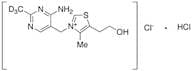
Thiamine-d3 Hydrochloride
CAS :Produit contrôléApplications Labelled Thiamine (T344185). Essential nutrient required for carbohydrate metabolism; also involved in nerve function. Biosynthesized by microorganisms and plants. Dietary sources include whole grains, meat products, vegetables, milk, legumes and fruit. Also present in rice husks and yeast. Converted in vivo to Thiamine diphosphate, a coenzyme in the decarboxylation of α-keto acids. Chronic deficiency may lead to neurological impairment, bariberi, Wernicke-Korsakoff syndrome.
References Kawaski, T., et al.: Methods Enzymol., 122, 15 (1986), Mascher, H., et al.: J. Pharm. Sci., 82, 56 (1993),Formule :C12H15D3Cl2N4OSCouleur et forme :NeatMasse moléculaire :340.29Thiamine Hydrochloride
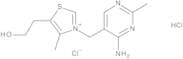
CAS :Applications Thiamine is a essential nutrient required for carbohydrate metabolism; also involved in nerve function. Biosynthesized by microorganisms and plants. Dietary sources include whole grains, meat products, vegetables, milk, legumes and fruit. Also present in rice husks and yeast. Converted in vivo to Thiamine diphosphate, a coenzyme in the decarboxylation of α-keto acids. Chronic deficiency may lead to neurological impairment, bariberi, Wernicke-Korsakoff syndrome.
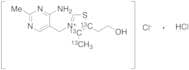
References Kawaski, T., et al.: Methods Enzymol., 122, 15 (1986), Mascher, H., et al.: J. Pharm. Sci., 82, 56 (1993),Formule :C12H17N4OS·Cl·HClCouleur et forme :NeatMasse moléculaire :337.27Thiamine-13C3 Hydrochloride
CAS :Formule :C913C3H18Cl2N4OSCouleur et forme :NeatMasse moléculaire :340.25Thiamine hydrochloride
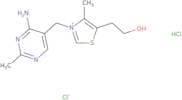
CAS :Thiamine hydrochloride is a water-soluble vitamin that belongs to the group of B vitamins. It has been used as a model system for investigating the phase transition temperature of fatty acids in biological membranes. In addition, it has been shown to enhance thermal expansion and improve chronic exposure in fetal bovine brain cells. Thiamine hydrochloride has also shown insecticidal activity against various species of insects, including the tobacco budworm and the Indianmeal moth. This drug has been found to be active against phytophagous insects that cause crop damage, such as Anthranilate and Pyridoxine Hydrochloride. Thiamine hydrochloride is involved in cellular metabolism by enhancing the conversion of l-lysine into succinic acid via an intermediate product called anthranilate. It also plays an important role in pyridoxal phosphate synthesis, which is essential for protein synthesis and tissue growth.
Formule :C12H18Cl2N4OSDegré de pureté :Min. 95%Couleur et forme :White Off-White PowderMasse moléculaire :337.27 g/molVitamin B1 hydrochloride
CAS :Vitamin B1 hydrochloride is a fine chemical that is used as a versatile building block in complex compounds. It has CAS number 67-03-8 and is also known as thiamine hydrochloride. Vitamin B1 hydrochloride can be used for research purposes, as a reagent, or as a speciality chemical. It can be used to synthesize other chemicals and compounds, or to act as an intermediate in the synthesis of useful scaffolds. This product is high quality and useful for many reactions.Formule :C12H18Cl2N4OSDegré de pureté :Min. 98.0 Area-%Masse moléculaire :337.27 g/molRef: 3D-Q-201928
-Unit-kgkgÀ demander1kgÀ demander5kgÀ demander10kgÀ demander25kgÀ demander2500gÀ demanderThiamine Hydrochloride ExiPlus, Multi-Compendial, 98.5%
CAS :Formule :C12H17N4OSCl·HClDegré de pureté :min. 98.5%Couleur et forme :White to off white, Crystalline powder, ClearMasse moléculaire :337.27Thiamine Hydrochloride pure, 98.5%
CAS :Formule :C12H17N4OSCl·HClDegré de pureté :min. 98.5%Couleur et forme :White to off-white, Crystalline powder, ClearMasse moléculaire :337.27Thiamine Hydrochloride for tissue culture, 98.5%
CAS :Formule :C12H17N4OSCl·HClDegré de pureté :min. 98.5%Couleur et forme :White to off-white, Crystalline powder, ClearMasse moléculaire :337.27Aneurine hydrochloride
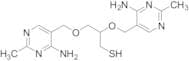
CAS :Formule :C12H18Cl2N4OSDegré de pureté :95.0%Couleur et forme :SolidMasse moléculaire :337.262,3-Bis((4-amino-2-methylpyrimidin-5-yl)methoxy)propane-1-thiol
CAS :Produit contrôléFormule :C15H22N6O2SCouleur et forme :NeatMasse moléculaire :350.439