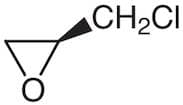
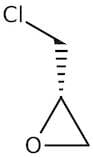
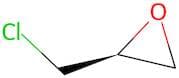
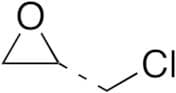
CAS 67843-74-7
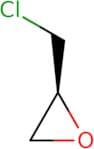
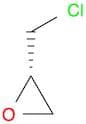
:(S)-(+)-épichlorhydrine
Description :
(S)-(+)-épichlorhydrine est un composé organique chiral caractérisé par son anneau d'époxyde à trois membres, qui contribue à sa réactivité et à son utilité dans diverses applications chimiques. C'est un liquide incolore à jaune pâle avec une odeur distinctive et il est soluble dans l'eau et les solvants organiques. Le composé est principalement utilisé comme intermédiaire dans la synthèse des résines époxy, qui sont appréciées pour leurs fortes propriétés adhésives et leur résistance chimique. De plus, (S)-(+)-épichlorhydrine sert de bloc de construction dans la production de produits pharmaceutiques et d'agrochimiques. Sa chiralité est significative dans les applications où la stéréochimie joue un rôle crucial dans l'activité biologique. Le composé est également connu pour être un irritant potentiel et doit être manipulé avec précaution, en suivant les protocoles de sécurité appropriés. Dans l'ensemble, (S)-(+)-épichlorhydrine est un produit chimique important tant dans les environnements industriels que de recherche, avec des applications diverses découlant de ses propriétés structurelles uniques.
Formule :C3H5ClO
InChI :InChI=1/C3H5ClO/c4-1-3-2-5-3/h3H,1-2H2/t3-/m1/s1
Code InChI :InChIKey=BRLQWZUYTZBJKN-GSVOUGTGSA-N
SMILES :C(Cl)[C@@H]1CO1
Synonymes :- (+)-2-(Chloromethyl)oxirane
- (+)-Epichlorohydrin
- (2S)-2-(chloromethyl)oxirane
- (S)-(Chloromethyl)oxirane
- (S)-1-Chloro-2,3-epoxypropane
- (S)-2-Chloromethyloxirane
- (S)-Epichlorhydrin
- 2(S)-Epichlorohydrin
- Oxirane, (chloromethyl)-, (2S)-
- Oxirane, (chloromethyl)-, (S)-
- Oxirane, 2-(chloromethyl)-, (2S)-
- (S)-Epichlorohydrin
- (S)-Epichlorohydrin
- (S)-(+)Epichlorohydrin
- S(+)-2-(CHLOROMETHYL)OXIRANE
- G-CHLOROPROPYLENE OXIDE
- AKOS BBS-00004288
- 1-CHLORO-2,3-EPOXYPROPANE
- 3-CHLOROPROPYLENE OXIDE
- EPICHLOROHYDRINE
- (S)-(+)-CHLOROMETHYLOXIRANE
- CHLOROMETHYLOXIRANE
- 2,3-EPOXYPROPYL CHLORIDE
- ALPHA-EPICHLOROHYDRIN
- EPICHLORHYDRIN
- (S)-3-CHLOROPROPYLENE OXIDE
- Voir plus de synonymes
Trier par
Degré de pureté (%)
0
100
|
0
|
50
|
90
|
95
|
100
10 produits concernés.
(S)-Epichlorohydrin
CAS :Formule :C3H5ClODegré de pureté :>98.0%(GC)Couleur et forme :Colorless to Light yellow clear liquidMasse moléculaire :92.52(S)-(+)-Epichlorohydrin, 98+%
CAS :(S)-(+)-Epichlorohydrin is utilized for the synthesis of macquarimicins and hydroxyisoxazolidines and (+)-cis-sylvaticin, which is a potential antitumor agent. It is used to synthesize inhibitors of fatty acid oxidation as potential metabolic modulators. It acts as a solvent for natural and synthetiFormule :C3H5ClODegré de pureté :98+%Couleur et forme :Clear colorless, LiquidMasse moléculaire :92.52(2S)-(+)-3-Chloro-1,2-propenoxide
CAS :(2S)-(+)-3-Chloro-1,2-propenoxideFormule :C3H5ClODegré de pureté :≥95%Couleur et forme : clear. almost colourless liquidMasse moléculaire :92.5242g/mol(S)-(+)-Epichlorohydrin
CAS :Formule :C3H5ClODegré de pureté :99.0%Couleur et forme :LiquidMasse moléculaire :92.52(S)-Epichlorohydrin
CAS :Produit contrôléApplications S-enantiomer of Epichlorohydrin, an important industrial chemical, is a bifunctional alkylating agent with the potential to form DNA cross-links. It is used as a solvent for natural and synthetic resins, gums, cellulose esters and ethers, paints, varnishes, nail enamels and lacquers, cement for Celluloid. Also, it is used as stabilizer.
Not a dangerous good if item is equal to or less than 1g/ml and there is less than 100g/ml in the package
References Romano, K.P. et al.: Chem. Res. Toxicol., 20, 832 (2007); Smyth, H.F., et al.: J. Ind. Hyg. Toxicol., 30, 63 (1948);Formule :C3H5ClOCouleur et forme :NeatMasse moléculaire :92.52(S)-(+)-Epichlorohydrin
CAS :(S)-(+)-Epichlorohydrin is a chlorohydrin that is used as an industrial chemical. It can be synthesized by reacting benzyl chloride with sodium hydroxide in the presence of water. The reaction mechanism for this process involves nucleophilic addition of the chlorine atom to the carbonyl group, followed by protonation and elimination of hydrogen chloride. The stereoselective synthesis of (S)-(+)-epichlorohydrin is based on asymmetric induction by enantiomers of the reactant. This product has been shown to have a constant pressure kinetic study at 0.1 M in acetonitrile and 0.2 M in dichloromethane with a turnover number of 1.4 × 10 mol/L/s, which is comparable to other synthetic methods for epichlorohydrin. Pharmacokinetic data for this product has been shown to show good bioavailability in rats, with a half-life of 0.Formule :C3H5ClODegré de pureté :Min. 95%Couleur et forme :Colorless PowderMasse moléculaire :92.52 g/mol(2S)-2-(chloromethyl)oxirane
CAS :Formule :C3H5ClODegré de pureté :98%Couleur et forme :LiquidMasse moléculaire :92.5242