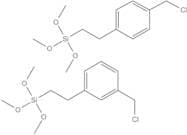
![1-(Chloromethyl)-3(or 4)-[2-(trimethoxysilyl)ethyl]benzene](/_next/image/?url=https%3A%2Fstatic.cymitquimica.com%2Fcas-image%2Fthumb-webp%2F1213-1-chloromethyl-3-or-4-2-trimethoxysilyl-ethyl-benzene.webp&w=3840&q=75)
CAS 68128-25-6
:1-(Chlorométhyl)-3(ou 4)-[2-(triméthoxysilyl)éthyl]benzène
- (2-(3(Or4)-(chloromethyl)phenyl)ethyl)trimethoxysilane
- 1-(Chloromethyl)-3(or 4)-[2-(trimethoxysilyl)ethyl]benzene
- 1-Trimethoxysilyl-2-(m,p-chloromethyl)phenylethane
- 1-Trimethoxysilyl-2-(p,m-chloromethyl)phenylethane
- 2-(m/p-Chloromethylphenyl)ethyltrimethoxysilane
- Benzene, 1-(chloromethyl)-3(or 4)-(2-(trimethoxysilyl)ethyl)-
- Silane, (2-(3(or 4)-(chloromethyl)phenyl)ethyl)trimethoxy-
- {2-[4-(Chloromethyl)Phenyl]Ethyl}(Trimethoxy)Silane
((CHLOROMETHYL)PHENYLETHYL)TRIMETHOXYSILANE
CAS :Halogen Functional Trialkoxy Silane
Silane coupling agents have the ability to form a durable bond between organic and inorganic materials to generate desired heterogeneous environments or to incorporate the bulk properties of different phases into a uniform composite structure. The general formula has two classes of functionality. The hydrolyzable group forms stable condensation products with siliceous surfaces and other oxides such as those of aluminum, zirconium, tin, titanium, and nickel. The organofunctional group alters the wetting or adhesion characteristics of the substrate, utilizes the substrate to catalyze chemical transformations at the heterogeneous interface, orders the interfacial region, or modifies its partition characteristics, and significantly effects the covalent bond between organic and inorganic materials.
((Chloromethyl)phenylethyl)trimethoxysilane; [2-[3(or 4)-(Chloromethyl)phenyl]ethyl]trimethoxysilane; (Trimethoxysilylethyl)benzyl chloride
Mixed m-, p- isomersUsed in microparticle surface modificationAdhesion promoter for polyphenylenesulfide and polyimide coatingsEmployed as a high temperature coupling agentDetermined by TGA a 25% weight loss of dried hydrolysates at 495 °CReagent for surface initiated atom-transfer radical-polymerization (ATRP) of N-isopropylacrylamide-butylmethacrylate copolymersFormule :C12H19ClO3SiDegré de pureté :97%Couleur et forme :Straw LiquidMasse moléculaire :274.82((Chloromethyl)phenylethyl)trimethoxysilane
CAS :S25108 - ((Chloromethyl)phenylethyl)trimethoxysilane
Formule :C12H19ClO3SiDegré de pureté :95%Couleur et forme :Liquid, ClearMasse moléculaire :274.82